
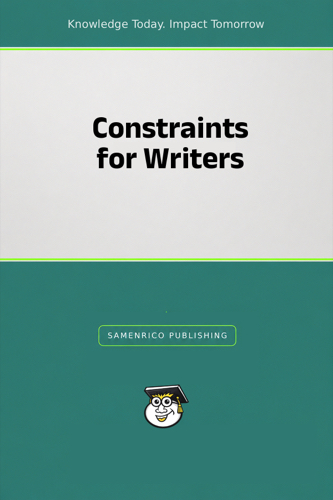
Constraints for Writers
Uses word limits and prompts for creativity.
by Moyer Zena
Uses word limits and prompts for creativity.
Formats
About this book
Free sample
Chapter 1: The Cage That Sings...--The blank page has never been your enemy. Your freedom has.This sounds like a contradiction, and that is precisely the problem. For your entire writing life, you have been told that creativity requires unlimited space, boundless possibility, and the absolute absence of barriers. You have been told to clear your schedule, find the perfect room, wait for inspiration, and then—only then—let the words flow from some deep, uncorrupted well of originality. You have been told that constraints are for accountants and architects, not for artists.
You have been told that rules kill the muse.Everything you have been told is wrong.The blank page is not a canvas of infinite potential. It is a vacuum. It is a white void that stares back at you with the patience of a predator, waiting for you to make the first move in a game with no rules. And because there are no rules, every move feels simultaneously possible and impossible. Should you start with dialogue or description?
Should you introduce the protagonist or establish the setting? Should you write a literary sentence or a commercial one? Should you be funny or serious? Sparse or lush? Fast or slow?This is not freedom.
This is paralysis.The psychological literature has a name for this phenomenon. It is called "choice overload," and it has been demonstrated in dozens of studies across contexts as varied as consumer behavior, medical decisions, and creative performance. The most famous of these studies is often called the "Jams Study," conducted by psychologists Sheena Iyengar and Mark Lepper in 2000. In a gourmet food market in Menlo Park, California, researchers set up a tasting booth. On some days, the booth offered 24 varieties of jam.
On other days, it offered only 6.You might assume that more choices would attract more customers and lead to more purchases. You would be wrong.While the large display attracted more initial interest—60 percent of shoppers stopped to look—only 3 percent actually bought a jar. The small display, by contrast, attracted fewer lookers (40 percent), but 30 percent of those…
This is the end of the free sample. Get the eBook to keep going. Buy now
Contents
- Chapter 1
- Chapter 2
- Chapter 3
- Chapter 4
- Chapter 5
- Chapter 6
- Chapter 7
- Chapter 8
- Chapter 9
- Chapter 10
- Chapter 11
- Chapter 12
Details
- Author
- Moyer Zena
- Publisher
- SamEnrico
- Language
- English
- Genre
- Non-Fiction, Self-Help, Writing
- Released
- 2026-06-06
- Pages (approx.)
- 140
- Available as
- eBook, Audiobook

Read better in the ZLOADR app
Your eBooks on your phone or tablet. Sign in with your SamEnrico account and start reading.
More by Moyer Zena
 Kidney Failure Anticipatory GriefMoyer Zena$11.99
 Thunberg Climate ReparationsMoyer Zena$11.99
 Long Marriage Divorce RecoveryMoyer Zena$11.99
 Religion Change Parent AngerMoyer Zena$11.99
 Key Metrics Dashboard GuideMoyer Zena$11.99
 Consignment Inventory AIMoyer Zena$11.99
 Assertiveness for Remote WorkersMoyer Zena$11.99
 Oisín’s Forgotten Lament: The Bard Who Outlived TimeMoyer Zena$11.99
 The Iron Crown of Burgundy: Maximillian I and the Birth of a DynastyMoyer Zena$11.99
 How to Produce OverallsMoyer Zena$11.99
 How to Produce Conference Room TablesMoyer Zena$11.99
 Camels: CamelusMoyer Zena$11.99
You may also like
 Hong Kong Handover 1997Dunn Johnnie$11.99
 Zumba For Postnatal Recovery CourseNeal Christian$11.99
 Zumba for BeginnersLadner Nikia$11.99
 YouTube Comment Mining GuideHumes Pandora$12.99
 Worry Box MeditationCarlin Rudy$11.99
 Workplace Stress MeditationNguyen Lynn$11.99
 Workplace Stress and Sleep RepairHawley Ivory$11.99
 Workplace Perfectionism CureDelaney Jeffry$11.99
 Workplace Injustice Anger GuideWallen Isabelle$11.99
 Work Addiction and Burnout LinkGreenwood Ester$11.99
 Women in Yoga and WellnessBeattie Galina$11.99
 Women in Stand Up ComedyChun Evangeline$11.99