
Non-FictionSelf-HelpDietary Psychology
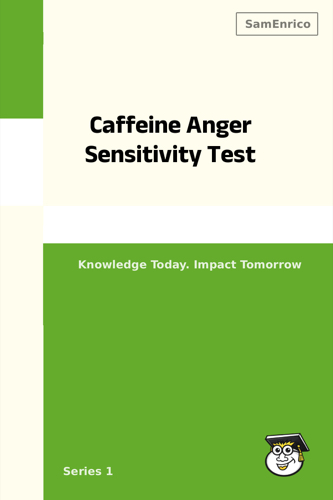
Caffeine Anger Sensitivity Test eBook
Explores how stimulant intake lowers frustration t
by Pina Hildred
Explores how stimulant intake lowers frustration tolerance and increases reactivity.
Formats
Free sample
Chapter 1: The Invisible Culprit--–- Sarah had always considered herself a patient person. As a high school teacher of fifteen years, she had weathered screaming teenagers, entitled parents, budget cuts, and a classroom with no air conditioning during a record-breaking heatwave. Her colleagues called her "the Buddha with a lesson plan." But something had shifted in the past eighteen months. She found herself snapping at students for tapping their pencils. She unleashed a furious tirade at a slow-loading attendance program.
Last Tuesday, she actually threw a dry-erase marker across the room because a student asked a question while she was explaining something else. The marker shattered against the whiteboard. Twenty-eight teenagers stared at her in stunned silence. Sarah stared back, equally stunned, and whispered, "I don't know who that was."That night, sitting alone in her parked car in the garage, she asked herself the question that had been lurking for months: Am I becoming a bad person?The answer, as this book will demonstrate, was no. Sarah was not becoming a bad person.
She was becoming a caffeinated person. And she had no idea that the two were connected.The Great Misattribution Error Every day, millions of people experience moments of disproportionate anger—road rage, snapping at partners, yelling at customer service representatives, losing patience with children over minor infractions. These moments are almost universally attributed to the same short list of causes: stress, lack of sleep, a difficult personality, a bad day, or (most vaguely) "just being tired."What almost no one considers is that these episodes might be biochemical events triggered by the most widely consumed psychoactive substance on the planet.Caffeine is used by approximately 90% of adults in North America, with average daily consumption hovering around 200-300 milligrams—roughly two to three cups of coffee. It is legal, cheap, socially celebrated, and often framed as essential to functioning. Coffee mugs bear slogans like "But first, coffee" and "Don't talk to me before I've had my coffee," which are treated as charming personality quirks rather than admissions of chemical dependence with known behavioral side effects.The phrase "Don't talk to me before I've had my coffee" is particularly telling.
It is a cultural acknowledgment—disguised as a joke—that caffeine withdrawal produces irritability. But the deeper truth is even more uncomfortable: for many people, caffeine itself produces irritability, not just its absence. The substance that supposedly makes you functional may simultaneously be making you volatile.This chapter introduces the central argument of this book: that caffeine-induced irritability (CII) is one of the most common, least recognized, and most treatable causes of anger in modern life. It is not a character flaw. It is not a permanent personality trait.
It is a biochemical state that can be measured, understood, and changed.A Brief History of the World's Favorite Drug To understand why caffeine's emotional side effects have been so thoroughly ignored, it helps to understand how caffeine became ubiquitous in the first place.Caffeine is not a modern discovery. Its use dates back to the Paleolithic era, with evidence of coca leaf and caffeine-containing plant consumption thousands of years ago. The ancient Ethiopians reportedly discovered coffee when a goat herder named Kaldi noticed his goats became unusually energetic after eating berries from a certain tree. The monks who tried the berries found they could stay awake through night prayers. By the 15th century, coffee cultivation had spread across the Arabian Peninsula, and coffeehouses—called "Schools of the Wise"—became centers of intellectual exchange.But the transformation of caffeine from niche substance to global commodity occurred during the Industrial Revolution.
Factory owners in 19th-century England and America faced a problem: workers who were exhausted from 14-hour shifts made mistakes, had accidents, and slowed production. Coffee breaks were introduced not as a kindness but as a productivity intervention. Caffeine suppressed appetite (fewer breaks for food), reduced perceived fatigue (longer shifts), and increased alertness (fewer accidents). The factory owners who provided free coffee saw their output rise by an estimated 15-20 percent.What the factory owners did not track—because no one was tracking it—was the incidence of fights, arguments, and workplace conflicts. Those were attributed to "bad attitudes" or "difficult employees." The possibility that the stimulant itself might be lowering frustration tolerance was simply not on anyone's radar.By the 20th century, coffee had been joined by tea, then soda (Coca-Cola originally contained cocaine and caffeine), then energy drinks.
Each new delivery mechanism reinforced the same message: caffeine makes you more productive, more alert, more functional. The emotional side effects were either dismissed as minimal or, more commonly, never investigated at all.The Physical vs. Emotional Side Effect Double Standard One of the most striking patterns in both medical literature and popular culture is the stark asymmetry between how we treat caffeine's physical side effects versus its emotional side effects.Nearly every adult knows that caffeine can cause jitters, insomnia, heart palpitations, digestive issues, and headaches. These physical effects are listed on medication warnings, discussed in doctor's offices, and acknowledged even by coffee enthusiasts. "I can't drink coffee after 2 PM or I won't sleep" is a normal, accepted statement.
"I can't drink coffee before a difficult conversation because I'll snap at my partner" is rarely said or even considered.This asymmetry is not accidental. Physical symptoms are objective and measurable. A heart rate of 110 beats per minute is a fact. Insomnia is verifiable. But emotional changes—irritability, lowered frustration tolerance, increased reactivity—are subjective.
They are easily dismissed as "just stress" or "just my personality" because there is no blood test for "snapped at a coworker."Furthermore, there is a moral dimension to anger that does not attach to insomnia. If caffeine keeps you awake, you blame the caffeine. If caffeine makes you irritable, you blame yourself. Anger is seen as a character flaw, a failure of self-control, a sign that you are not a good person. This moral weight prevents people from looking for external causes.
It is far easier to feel ashamed of snapping at your child than to consider that your morning coffee might have lowered your threshold for frustration by 50 percent.This book will argue that shame is an inappropriate response to a biochemical event. You would not feel shame for having a fever. You should not feel shame for caffeine-induced irritability. Both are physiological states with identifiable causes and treatable solutions.What Is Caffeine-Induced Irritability (CII)?Caffeine-Induced Irritability (CII) is the term this book introduces to describe a specific pattern of emotional reactivity caused by stimulant intake. It is characterized by five core features:1.
Disproportionate Response: The intensity of anger is significantly higher than the triggering event would normally warrant. A dropped spoon, a slow website, a innocent question—these become sources of rage rather than mild annoyance.2. Temporal Association: The irritability follows a predictable time course after caffeine consumption. For most people, onset begins 30-60 minutes after ingestion, peaks at 2-4 hours, and may persist for 6-8 hours depending on metabolism.3. Lowered Frustration Threshold: The amount of frustration required to trigger an angry response is reduced.
Events that would normally be tolerated become intolerable.4. Impaired Recovery: Once anger is triggered, the return to calm takes longer.…
This is the end of the free sample. Get the eBook to keep going. Buy now
About this book
Details
- Author
- Pina Hildred
- Publisher
- SamEnrico
- Language
- English
- Genre
- Non-Fiction, Self-Help, Dietary Psychology
- Released
- 2026-06-06
- Pages (approx.)
- 152
- Available as
- eBook, Audiobook

Read better in the ZLOADR app
Your eBooks on your phone or tablet. Sign in with your SamEnrico account and start reading.
More by Pina Hildred
 Collaborative Mind Mapping HandbookPina Hildred$11.99
 Gaming and Anxiety ConnectionPina Hildred$11.99
 Barbadian Professional OutlookPina Hildred$11.99
 Weight Loss Affirmations GuidePina Hildred$11.99
 The Silent Diplomat: How a Deaf Woman Brokered Peace in a War ZonePina Hildred$11.99
 The Paradox of the 1969 Moon Landing: Did NASA Accidentally Time Travel?Pina Hildred$11.99
 Sprouting Broccoli HarvestingPina Hildred$11.99
 Orange Data Mining GuidePina Hildred$12.99
 Life Sciences Strategic BuyersPina Hildred$12.99
 Understanding Chromosome 8 DeletionPina Hildred$17.99
 How to Become a DeveloperPina Hildred$11.99
You may also like
 Hong Kong Handover 1997Dunn Johnnie$11.99
 Zumba For Postnatal Recovery CourseNeal Christian$11.99
 Zumba for BeginnersLadner Nikia$11.99
 YouTube Comment Mining GuideHumes Pandora$12.99
 Worry Box MeditationCarlin Rudy$11.99
 Workplace Stress MeditationNguyen Lynn$11.99
 Workplace Stress and Sleep RepairHawley Ivory$11.99
 Workplace Perfectionism CureDelaney Jeffry$11.99
 Workplace Injustice Anger GuideWallen Isabelle$11.99
 Work Addiction and Burnout LinkGreenwood Ester$11.99
 Women in Yoga and WellnessBeattie Galina$11.99
 Women in Stand Up ComedyChun Evangeline$11.99