
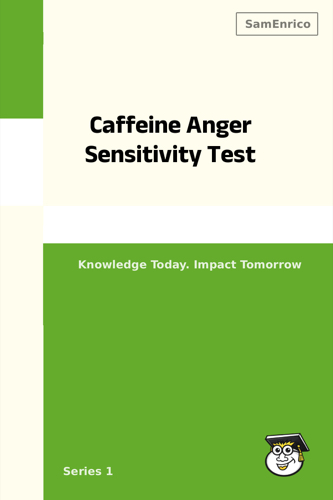
Non-FictionSelf-HelpDietary Psychology
Caffeine Anger Sensitivity Test Audiobook
Explores how stimulant intake lowers frustration t
by Pina Hildred
Explores how stimulant intake lowers frustration tolerance and increases reactivity.
Formats
Free sample
Chapter 1: The Invisible Culprit--–- Sarah had always considered herself a patient person. As a high school teacher of fifteen years, she had weathered screaming teenagers, entitled parents, budget cuts, and a classroom with no air conditioning during a record-breaking heatwave. Her colleagues called her "the Buddha with a lesson plan." But something had shifted in the past eighteen months. She found herself snapping at students for tapping their pencils. She unleashed a furious tirade at a slow-loading attendance program.
Last Tuesday, she actually threw a dry-erase marker across the room because a student asked a question while she was explaining something else. The marker shattered against the whiteboard. Twenty-eight teenagers stared at her in stunned silence. Sarah stared back, equally stunned, and whispered, "I don't know who that was."That night, sitting alone in her parked car in the garage, she asked herself the question that had been lurking for months: Am I becoming a bad person?The answer, as this book will demonstrate, was no. Sarah was not becoming a bad person.
She was becoming a caffeinated person. And she had no idea that the two were connected.The Great Misattribution Error Every day, millions of people experience moments of disproportionate anger—road rage, snapping at partners, yelling at customer service representatives, losing patience with children over minor infractions. These moments are almost universally attributed to the same short list of causes: stress, lack of sleep, a difficult personality, a bad day, or (most vaguely) "just being tired."What almost no one considers is that these episodes might be biochemical events triggered by the most widely consumed psychoactive substance on the planet.Caffeine is used by approximately 90% of adults in North America, with average daily consumption hovering around 200-300 milligrams—roughly two to three cups of coffee. It is legal, cheap, socially celebrated, and often framed as essential to functioning. Coffee mugs bear slogans like "But first, coffee" and "Don't talk to me before I've had my coffee," which are treated as charming personality quirks rather than admissions of chemical dependence with known behavioral side effects.The phrase "Don't talk to me before I've had my coffee" is particularly telling.
It is a cultural acknowledgment—disguised as a joke—that caffeine withdrawal produces irritability. But the deeper truth is even more uncomfortable: for many people, caffeine itself produces irritability, not just its absence. The substance that supposedly makes you functional…
This is the end of the free sample. Get the Audiobook to keep going. Buy now
About this book
Details
- Author
- Pina Hildred
- Publisher
- SamEnrico
- Language
- English
- Genre
- Non-Fiction, Self-Help, Dietary Psychology
- Released
- 2026-06-06
- Pages (approx.)
- 152
- Available as
- eBook, Audiobook

Listen in the VoxFlicks app
Audiobooks and audio dramas wherever you go. Sign in with your SamEnrico account and press play.
More by Pina Hildred
 Collaborative Mind Mapping HandbookPina Hildred$11.99
 Gaming and Anxiety ConnectionPina Hildred$11.99
 Barbadian Professional OutlookPina Hildred$11.99
 Weight Loss Affirmations GuidePina Hildred$11.99
 The Silent Diplomat: How a Deaf Woman Brokered Peace in a War ZonePina Hildred$11.99
 The Paradox of the 1969 Moon Landing: Did NASA Accidentally Time Travel?Pina Hildred$11.99
 Sprouting Broccoli HarvestingPina Hildred$11.99
 Orange Data Mining GuidePina Hildred$12.99
 Life Sciences Strategic BuyersPina Hildred$12.99
 Understanding Chromosome 8 DeletionPina Hildred$17.99
 How to Become a DeveloperPina Hildred$11.99
You may also like
 Hong Kong Handover 1997Dunn Johnnie$11.99
 Zumba For Postnatal Recovery CourseNeal Christian$11.99
 Zumba for BeginnersLadner Nikia$11.99
 YouTube Comment Mining GuideHumes Pandora$12.99
 Worry Box MeditationCarlin Rudy$11.99
 Workplace Stress MeditationNguyen Lynn$11.99
 Workplace Stress and Sleep RepairHawley Ivory$11.99
 Workplace Perfectionism CureDelaney Jeffry$11.99
 Workplace Injustice Anger GuideWallen Isabelle$11.99
 Work Addiction and Burnout LinkGreenwood Ester$11.99
 Women in Yoga and WellnessBeattie Galina$11.99
 Women in Stand Up ComedyChun Evangeline$11.99