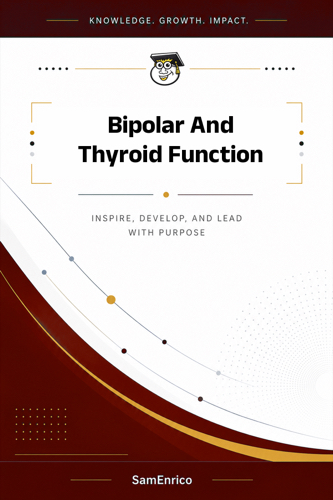
Bipolar And Thyroid Function eBook
Explores how thyroid disorders mimic or worsen bip
by Dodson Meda
Explores how thyroid disorders mimic or worsen bipolar symptoms, with screening guidelines.
Formats
Free sample
Chapter 1: The Great Masquerade...--–- The call came in at 2:17 AM on a Tuesday. Sarah, a 34-year-old attorney who had argued cases before federal judges, was found wandering a highway interchange in her nightgown, barefoot, convinced that her children had been replaced by impostors and that the headlights of oncoming cars were messages from God. She was restrained by police, sedated by paramedics, and admitted to a psychiatric intensive care unit with a working diagnosis of bipolar I disorder, current episode manic with psychotic features. It was her fifth psychiatric hospitalization in eleven years.The attending psychiatrist reviewed her chart with efficient confidence. Here was a classic presentation: grandiose delusions, pressured speech, insomnia without fatigue, and a family history of “emotional problems” (though no one had ever specified what kind).
The lithium level was subtherapeutic, so the dose was increased. An antipsychotic was added. Sarah stayed for seventeen days, stabilized enough to return home, and was discharged with a prescription for three medications and a follow-up appointment in six weeks.No one ordered a thyroid panel.No one checked her body temperature.No one asked about the cold intolerance she had mentioned to her primary care doctor two years earlier. No one connected her “bipolar depression” episodes—the ones where she slept fourteen hours a day, gained forty pounds, and complained of brain fog so dense she couldn’t remember her own phone number—to the eight-pound weight loss and heat intolerance that preceded her manic episodes. The hospital’s electronic medical record contained a single thyroid test from four years prior: TSH 4.2 m IU/L, flagged as “normal” because the reference range went up to 4.5.
No one looked at it.Sarah’s story is not rare. It is not unusual. It is, by the best available estimates, one of hundreds of thousands of similar cases currently sitting in psychiatric waiting rooms across the country, taking mood stabilizers that don’t fully work, being told they have “treatment-resistant” bipolar disorder when they have something entirely different. Something treatable. Something, in many cases, curable.This book exists because Sarah’s psychiatrist failed her.
And if you are reading these words, there is a significant chance that your psychiatrist has failed you, too.The Epidemic Within the Epidemic Let us begin with a number that will either infuriate you or give you hope, depending on how long you have been suffering: 20 to 30 percent.According to a meta-analysis published in the Journal of Clinical Psychiatry reviewing seventeen studies with over 4,200 patients, between 20 and 30 percent of patients diagnosed with bipolar disorder have significant thyroid dysfunction—either overt hypothyroidism, overt hyperthyroidism, subclinical dysfunction, or autoimmune thyroiditis. A separate study from the American Journal of Psychiatry found that patients with bipolar disorder are 3.5 times more likely to have thyroid antibodies than the general population, even when their thyroid hormone levels are “normal.”Let those numbers land. One in five. Nearly one in three.Now consider what those numbers mean in human terms. Approximately 2.8 percent of American adults—roughly 7 million people—receive a diagnosis of bipolar disorder at some point in their lives.
If 20 to 30 percent of them have significant thyroid dysfunction that is either causing their mood symptoms or dramatically worsening them, that means between 1.4 and 2.1 million people are currently being treated for bipolar disorder when their primary problem is sitting in a butterfly-shaped gland at the base of their neck.Two million people.That is a public health disaster. And it is almost entirely preventable.Why Your Psychiatrist Missed It Before you direct your anger entirely at your doctor, it is worth understanding the system that failed both of you. The average psychiatry residency program in the United States provides fewer than four hours of formal training on thyroid disorders. Four hours. Over four years.
That is less time than most residents spend learning how to complete a prior authorization form for an antipsychotic.When psychiatrists do learn about thyroid function, they are taught a dangerously simplified version of the story: Check TSH. If it is between 0.5 and 4.5, the thyroid is normal. Move on.This is wrong. It is wrong in ways that have been known to endocrinologists for decades but have never penetrated psychiatric training. The “normal” TSH range was established by studying populations that included people with undiagnosed thyroid disease.
It is a statistical artifact, not a biological truth. More importantly, TSH is a pituitary hormone, not a thyroid hormone. Checking only TSH to assess thyroid function is like checking only the thermostat to assess whether a house is warm—you learn something about what the system is trying to do, but nothing about whether the furnace is actually working.The chapter you just read (and the one you are reading now) are part of the same book. What you are holding is not a dry medical text. It is an indictment.
And it is a map.The Two Faces of Thyroid Madness To understand why thyroid disease is so frequently mistaken for bipolar disorder, you must understand that thyroid dysfunction has two distinct psychiatric personalities—one that mimics mania, one that mimics depression.Hyperthyroidism: The Mania Mimic When the thyroid gland produces too much hormone—whether from Graves’ disease, toxic nodules, or excessive medication—the body accelerates. Metabolism spikes. Heart rate rises. Body temperature increases. And the brain?
The brain races.The symptoms of hyperthyroidism overlap with mania so completely that even experienced psychiatrists cannot reliably distinguish them without blood tests. Consider the symptom list for mania from the *Diagnostic and Statistical Manual of Mental Disorders, Fifth Edition (DSM-5)* : decreased need for sleep, pressured speech, distractibility, increase in goal-directed activity, agitation, reckless behavior. Now consider the symptom list for hyperthyroidism: insomnia, talkativeness, poor concentration, restlessness, irritability, and impulsivity.They are the same list.The differences, when they exist, are subtle. In thyroid-induced “mania,” patients often report feeling physically hot, even when the room is cool. They may have a fine tremor in their outstretched hands—not the coarse tremor of antipsychotic side effects, but a rapid, almost vibrating shake.
They lose weight without trying. They have diarrhea. Their resting heart rate is above 90, sometimes above 120. They may have a visible goiter—a swelling at the base of the neck—though this is present in only about 30 percent of cases.None of these physical symptoms is required for a diagnosis of bipolar mania. And none of them is routinely asked about in psychiatric intake.Hypothyroidism: The Depression Mimic The opposite end of the spectrum is even more deceptive.
Hypothyroidism—too little thyroid hormone—produces a depression that is nearly indistinguishable from bipolar depression. Fatigue, anhedonia, hypersomnia, weight gain, cognitive slowing, brain fog, social withdrawal. The DSM-5 criteria for a major depressive episode could have been written by a patient with untreated hypothyroidism.Again, the differences are subtle but crucial. In thyroid-induced depression, patients are genuinely cold—not just emotionally cold, but physically unable to maintain body temperature. Morning temperatures below 97.5°F are a classic sign.
They lose the outer third of their eyebrows (a sign called Queen Anne’s sign, though it is rarely looked for). Their hair becomes coarse and brittle. Their voice becomes hoarse. Their reflexes are delayed—a finding that requires…
This is the end of the free sample. Get the eBook to keep going. Buy now
About this book
Details
- Author
- Dodson Meda
- Publisher
- SamEnrico
- Language
- English
- Genre
- Non-Fiction, Health & Wellness, Endocrine
- Released
- 2026-06-10
- Pages (approx.)
- 145
- Available as
- eBook, Audiobook

Read better in the ZLOADR app
Your eBooks on your phone or tablet. Sign in with your SamEnrico account and start reading.
More by Dodson Meda
 Open Source Dependency RisksDodson Meda$11.99
 The Teen Immigrant Confidence GuideDodson Meda$11.99
 Imposter Syndrome Peer SupportDodson Meda$11.99
 The Food Addiction Sleep Link GuideDodson Meda$11.99
 The Forgotten Ice Warriors: Japan's First Hockey Pioneers and the Birth of a Winter Sport (1880s)Dodson Meda$11.99
 Executive Summary Template HandbookDodson Meda$12.99
 Australia Export Green GuideDodson Meda$12.99
 Understanding Primary HyperoxaluriaDodson Meda$17.99
 A Beginners Guide to Five-a-side football (Volume 1)Dodson Meda$11.99
 Continuing Care AssistantDodson Meda$11.99