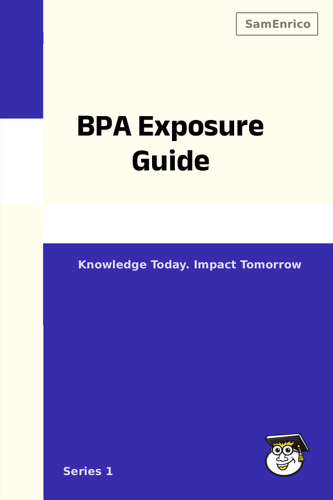
BPA Exposure Guide
Teaches avoiding bisphenol A in plastics and recei
Teaches avoiding bisphenol A in plastics and receipts.
Formats
About this book
Free sample
Chapter 1: The Shattered Miracle...--–- On a warm June afternoon in 1953, a General Electric chemist named Daniel Fox left a batch of melted resin unattended on a hot plate while he went to lunch. He was trying to create a new class of tough electrical varnishes, and like dozens of failed experiments before it, this one seemed unremarkable. When he returned, the resin had cooled into a cloudy, lumpy, unusable mess. Frustrated, he threw the glass beaker into a sink and went to wash his hands. That is when he noticed something strange.
The beaker had bounced.Not cracked. Not shattered. Bounced.Fox fished the beaker out of the sink and examined it. The material inside was no longer a lumpy mess. It had formed a clear, glasslike disc that was hard enough to resist scratching, yet flexible enough to absorb impact without breaking.
He hammered it. Nothing. He heated it. Nothing. He doused it with solvents.
Still nothing. He had, he later wrote, accidentally created a substance “as clear as a diamond and hard as steel.”He had just invented polycarbonate plastic. And the chemical that made it possible – the molecular backbone that gave this new material its seemingly magical properties – was Bisphenol A, or BPA.Within a decade, BPA-based plastics and epoxy resins had conquered the consumer world. Baby bottles no longer shattered when dropped onto kitchen floors. Military canteens no longer dented or leached metallic tastes into drinking water.
Food cans could be lined with a near-perfect barrier that prevented corrosion, eliminated metallic aftertastes, and extended shelf life from months to years. By 1980, global BPA production exceeded one million tons annually. By 2000, that number had quadrupled. It was hailed as a triumph of modern chemistry – a miracle material that made life safer, more convenient, and more affordable for billions of people.But there was a problem that no one was looking for. A problem hiding in plain sight, buried in obscure toxicology journals from the 1930s, ignored by regulators and manufacturers alike.
The same chemical properties that made BPA so useful in industry also made it biologically active in ways that the…
This is the end of the free sample. Get the eBook to keep going. Buy now
Contents
- Chapter 1
- Chapter 2
- Chapter 3
- Chapter 4
- Chapter 5
- Chapter 6
- Chapter 7
- Chapter 8
- Chapter 9
- Chapter 10
- Chapter 11
- Chapter 12
Details
- Author
- Leclair Susann
- Publisher
- SamEnrico
- Language
- English
- Genre
- Non-Fiction, Health & Wellness, Endocrine
- Released
- 2026-06-06
- Pages (approx.)
- 134
- Available as
- eBook, Audiobook

Read better in the ZLOADR app
Your eBooks on your phone or tablet. Sign in with your SamEnrico account and start reading.
More by Leclair Susann
 Ancient Ayurvedic Daily RoutineLeclair Susann$11.99
 Trafficked Across BordersLeclair Susann$11.99
 Social Anxiety And BullyingLeclair Susann$11.99
 Caregiving For Veteran ParentLeclair Susann$11.99
 Acne and Skin Esteem GuideLeclair Susann$11.99
 Sugar Withdrawal Symptom ManagementLeclair Susann$11.99
 The Anger and Sleep DeprivationLeclair Susann$11.99
 The Clown of Cologne: How Forensics Caught a KillerLeclair Susann$11.99
 Breakdance Revolution: The Underground Movement That Shaped a Generation (1980-2000)Leclair Susann$11.99
 Mastering The Art of Yau Kung Moon (软功門) Flexible-power StyleLeclair Susann$11.99
 A Collector's Handbook to the Ford ConsulLeclair Susann$11.99
 Switzerland Cheap Master's GuideLeclair Susann$12.99