
Non-FictionBusiness BriefMachine Learning
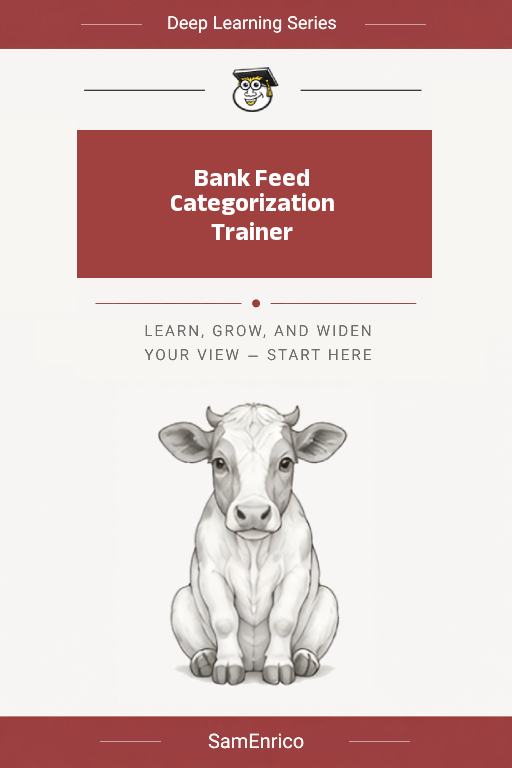
Bank Feed Categorization Trainer Audiobook
Train AI to learn your business's unique categoriz
Train AI to learn your business's unique categorization rules. Improve accuracy over time as the system learns from your corrections and preferences.
Formats
Free sample
Chapter 1: The $47,000 Mistake...--It was 3:47 PM on a Tuesday when Maria, the owner of a thriving boutique bakery chain, discovered that her bookkeeping software had been lying to her for three years.Not intentionally, of course. Software doesn't lie. But it had been quietly, methodically miscategorizing a single recurring transaction: the purchase of commercial flour from a vendor whose bank descriptor kept changing. One month it was "Cargill Flour Co." The next, "Cargill Inc. – Invoice 402." Then "Cargill B2B PAYMENT." Each time the descriptor shifted, her static accounting rule—"If 'Cargill' then 'Cost of Goods Sold'"—failed silently.
The transactions fell into a default category: "Office Supplies."Three years. One thousand two hundred and forty-seven transactions. Total miscategorized value: $47,000. The actual damage: a cascading series of disasters that nearly bankrupted her.First, her profit and loss statement showed artificially low COGS, making her business look 18% more profitable than it actually was. She expanded too fast, opening two new locations based on numbers that were, quite literally, fictional.
Second, her sales tax filings underreported her deductions, costing her $12,000 in overpaid taxes. Third—and this was the killer—her loan application for the expansion was denied because the bank's algorithm detected "inconsistent expense classification patterns" and flagged her file for manual review. The review never happened. The loan never came.Maria is not alone. She is every small business owner, every bookkeeper, every finance manager who has ever stared at a bank feed and thought, "This can't be right."The Dirty Secret of Bank Feeds Let me tell you something that the software companies won't.
Bank feeds—whether they come as OFX, QFX, CSV, or through a shiny API—are designed for one purpose and one purpose only: bank reconciliation. That is, matching the bank's record of money moving in and out with your own internal records. They are not, repeat not, designed for accounting.What's the difference? Reconciliation asks: "Does the amount match?" Accounting asks: "What does this mean for my business?"When you download a bank feed, you receive a set of transactions stripped of nearly all business context. Consider this real example I pulled from a client's file last week:text Copy Download POS PUR 12/05 15:34 AMZN Mktplace *U5X8K2E1 WAA human with experience might decode: "December 5th, Amazon purchase, Washington state." But what was bought?
Was it:A Kindle book (Office Supplies or Dues & Subscriptions)?A new monitor for the graphic designer (Computer Equipment, a Balance…
This is the end of the free sample. Get the Audiobook to keep going. Buy now
About this book
Details
- Author
- Greathouse Tonisha
- Publisher
- SamEnrico
- Language
- English
- Genre
- Non-Fiction, Business Brief, Machine Learning
- Released
- 2026-06-01
- Pages (approx.)
- 150
- Available as
- eBook, Audiobook

Listen in the VoxFlicks app
Audiobooks and audio dramas wherever you go. Sign in with your SamEnrico account and press play.
More by Greathouse Tonisha
 Hypnosis for Smoking Cessation GuideGreathouse Tonisha$11.99
 Stress Management for LibrariansGreathouse Tonisha$11.99
 The IKEA Effect in BusinessGreathouse Tonisha$11.99
 Omega 3 Mood Support GuideGreathouse Tonisha$11.99
 How to Produce Arts and EntertainmentGreathouse Tonisha$11.99
 How to Become a Paper CoaterGreathouse Tonisha$11.99
 BursarGreathouse Tonisha$11.99
You may also like
 Hong Kong Handover 1997Dunn Johnnie$11.99
 Zumba For Postnatal Recovery CourseNeal Christian$11.99
 Zumba for BeginnersLadner Nikia$11.99
 YouTube Comment Mining GuideHumes Pandora$12.99
 Worry Box MeditationCarlin Rudy$11.99
 Workplace Stress MeditationNguyen Lynn$11.99
 Workplace Stress and Sleep RepairHawley Ivory$11.99
 Workplace Perfectionism CureDelaney Jeffry$11.99
 Workplace Injustice Anger GuideWallen Isabelle$11.99
 Work Addiction and Burnout LinkGreenwood Ester$11.99
 Women in Yoga and WellnessBeattie Galina$11.99
 Women in Stand Up ComedyChun Evangeline$11.99