
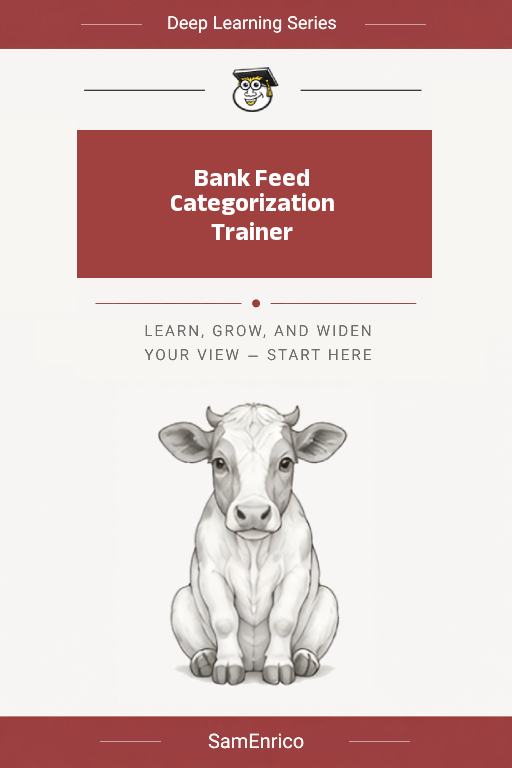
Non-FictionBusiness BriefMachine Learning
Bank Feed Categorization Trainer eBook
Train AI to learn your business's unique categoriz
Train AI to learn your business's unique categorization rules. Improve accuracy over time as the system learns from your corrections and preferences.
Formats
Free sample
Chapter 1: The $47,000 Mistake...--It was 3:47 PM on a Tuesday when Maria, the owner of a thriving boutique bakery chain, discovered that her bookkeeping software had been lying to her for three years.Not intentionally, of course. Software doesn't lie. But it had been quietly, methodically miscategorizing a single recurring transaction: the purchase of commercial flour from a vendor whose bank descriptor kept changing. One month it was "Cargill Flour Co." The next, "Cargill Inc. – Invoice 402." Then "Cargill B2B PAYMENT." Each time the descriptor shifted, her static accounting rule—"If 'Cargill' then 'Cost of Goods Sold'"—failed silently.
The transactions fell into a default category: "Office Supplies."Three years. One thousand two hundred and forty-seven transactions. Total miscategorized value: $47,000. The actual damage: a cascading series of disasters that nearly bankrupted her.First, her profit and loss statement showed artificially low COGS, making her business look 18% more profitable than it actually was. She expanded too fast, opening two new locations based on numbers that were, quite literally, fictional.
Second, her sales tax filings underreported her deductions, costing her $12,000 in overpaid taxes. Third—and this was the killer—her loan application for the expansion was denied because the bank's algorithm detected "inconsistent expense classification patterns" and flagged her file for manual review. The review never happened. The loan never came.Maria is not alone. She is every small business owner, every bookkeeper, every finance manager who has ever stared at a bank feed and thought, "This can't be right."The Dirty Secret of Bank Feeds Let me tell you something that the software companies won't.
Bank feeds—whether they come as OFX, QFX, CSV, or through a shiny API—are designed for one purpose and one purpose only: bank reconciliation. That is, matching the bank's record of money moving in and out with your own internal records. They are not, repeat not, designed for accounting.What's the difference? Reconciliation asks: "Does the amount match?" Accounting asks: "What does this mean for my business?"When you download a bank feed, you receive a set of transactions stripped of nearly all business context. Consider this real example I pulled from a client's file last week:text Copy Download POS PUR 12/05 15:34 AMZN Mktplace *U5X8K2E1 WAA human with experience might decode: "December 5th, Amazon purchase, Washington state." But what was bought?
Was it:A Kindle book (Office Supplies or Dues & Subscriptions)?A new monitor for the graphic designer (Computer Equipment, a Balance Sheet asset)?A case of protein bars for the breakroom (Meals – Employee, a non-deductible expense under IRS Section 274(k))?A gift card for a client (Meals & Entertainment, 50% deductible)?A replacement part for a delivery vehicle (Repairs & Maintenance)?The bank feed doesn't know. The bank feed doesn't care. The bank feed's job is done the moment the amount clears.The Three Lies Your Accounting Software Told You Most accounting platforms—Quick Books, Xero, Net Suite, you name it—offer something they call "bank rules." These are simple if/then statements. You tell the software: "If the description contains 'AMAZON,' then categorize as 'Office Supplies.'" And for a while, it works. Until it doesn.Let me count the ways this fails.Lie #1: "Vendor names are stable."They aren't.
Venders change their bank descriptors constantly. Amazon alone has over 200 distinct transaction strings: AMZN Mktplace, Amazon Prime, Amazon Digital, AMZN MKTP US, Amazon Web Services AWS, and the ever-popular AMZN*. Each time they change, your rule breaks.Lie #2: "One vendor equals one category."Meet your local office supply store. You walk in, spend $500, and buy:A new ergonomic keyboard for an employee ($80 – Office Supplies)A case of paper ($45 – Office Supplies)A $375 external hard drive for the server (Computer Equipment – Asset)A $15 birthday cake for a departing employee (Meals & Entertainment – 50% deductible)One transaction. Four categories.
Your simple rule—"If 'Office Depot' then 'Office Supplies'"—just lied to your financial statements.Lie #3: "Rules don't need maintenance."I consulted for a manufacturing company that had 1,200 active bank rules. The finance manager who built them had left two years prior. No one knew why most of the rules existed. New rules were added on top of old rules. Some contradicted each other.
The system was a house of cards, and it fell apart completely when they switched bank accounts and all the transaction formatting changed. They spent three months manually recategorizing 6,000 transactions.Static rules are a trap. They feel like automation. They feel like progress. But they are, at best, a temporary Band-Aid on a permanent wound.What If Your Software Actually Learned?Imagine, for a moment, a different world.You sit down at your computer on Monday morning.
Your bank feed has pulled in 200 new transactions from the weekend. Instead of staring at a screen full of question marks, you see that 187 of them—93.5%—are already categorized correctly. The software learned from every correction you made last week. It remembered that when you wrote "Client lunch at The Capital Grille" in the memo, it meant "Meals & Entertainment," but when you wrote "Employee training pizza," it meant "Meals – Employee" with a non-deductible flag.The remaining 13 transactions are highlighted in yellow. These are the ones where the software is uncertain.
Maybe the vendor is new. Maybe the amount is unusual. Maybe the memo contains a word it hasn't seen before. You review these 13 in seven minutes. Your corrections are fed back into the system instantly, making it smarter for tomorrow.This is not science fiction.
This is adaptive intelligence applied to bank feed categorization. And the core of this book is teaching you exactly how to build, train, and maintain such a system.But first, we need to understand the enemy. And the enemy is not technology. The enemy is entropy.The True Cost of Miscategorization Let me be specific about the damage. Miscategorized transactions do not just annoy you.
They actively harm your business in four measurable ways.Damage #1: Distorted Profitability If a capital expense (like that $375 hard drive) is miscategorized as an office supply (an operating expense), your profit for that month appears lower than it actually is. You think you're losing money when you're not. Conversely, if an operating expense is miscategorized as an asset, your profit appears artificially high. You think you're profitable when you're bleeding cash. Both errors lead to bad decisions.Damage #2: Tax Filing Errors The IRS has very specific rules about what is deductible and what isn't.
Meals are 50% deductible, but only if they're business-related. Client entertainment is 0% deductible under the TCJA (Tax Cuts and Jobs Act) unless it qualifies as a business meal. Vehicle expenses can be deducted via actual costs or standard mileage, but you must be consistent. Miscategorization triggers audits. Audits cost time, money, and sleep.
I've seen a 200miscategorizedmealtriggera200 miscategorized meal trigger a 200miscategorizedmealtriggera15,000 professional fee to defend against an audit.Damage #3: Broken Forecasting Predictive models—whether for cash flow, inventory, or staffing—depend on clean historical data. If your categories are wrong, your forecasts are wrong. Garbage in, garbage out. I worked with a logistics company that kept miscategorizing fuel purchases as maintenance expenses. Their cash flow forecast predicted a maintenance spike every quarter that never came, and missed the steady drain of fuel costs that was actually…
This is the end of the free sample. Get the eBook to keep going. Buy now
About this book
Details
- Author
- Greathouse Tonisha
- Publisher
- SamEnrico
- Language
- English
- Genre
- Non-Fiction, Business Brief, Machine Learning
- Released
- 2026-06-01
- Pages (approx.)
- 150
- Available as
- eBook, Audiobook

Read better in the ZLOADR app
Your eBooks on your phone or tablet. Sign in with your SamEnrico account and start reading.
More by Greathouse Tonisha
 Hypnosis for Smoking Cessation GuideGreathouse Tonisha$11.99
 Stress Management for LibrariansGreathouse Tonisha$11.99
 The IKEA Effect in BusinessGreathouse Tonisha$11.99
 Omega 3 Mood Support GuideGreathouse Tonisha$11.99
 How to Produce Arts and EntertainmentGreathouse Tonisha$11.99
 How to Become a Paper CoaterGreathouse Tonisha$11.99
 BursarGreathouse Tonisha$11.99
You may also like
 Hong Kong Handover 1997Dunn Johnnie$11.99
 Zumba For Postnatal Recovery CourseNeal Christian$11.99
 Zumba for BeginnersLadner Nikia$11.99
 YouTube Comment Mining GuideHumes Pandora$12.99
 Worry Box MeditationCarlin Rudy$11.99
 Workplace Stress MeditationNguyen Lynn$11.99
 Workplace Stress and Sleep RepairHawley Ivory$11.99
 Workplace Perfectionism CureDelaney Jeffry$11.99
 Workplace Injustice Anger GuideWallen Isabelle$11.99
 Work Addiction and Burnout LinkGreenwood Ester$11.99
 Women in Yoga and WellnessBeattie Galina$11.99
 Women in Stand Up ComedyChun Evangeline$11.99