
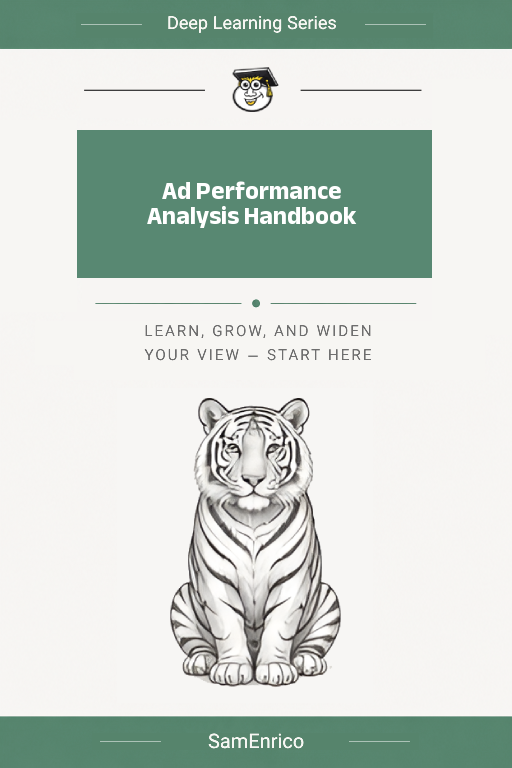
Non-FictionFirst 30 DaysPaid SocialAnalytics Guide
Ad Performance Analysis Handbook eBook
Read CTR, CPC, ROAS, and frequency metrics to opti
by Stoll Aline
Read CTR, CPC, ROAS, and frequency metrics to optimize your first campaigns. Includes A/B test worksheets, budget allocation rules, and when to kill underperforming ads.
Formats
Free sample
Chapter 1: The Silent Math--You are currently losing money on at least one ad in your account, and you do not know which one.This is not a guess. It is a statistical certainty. Every active advertiser runs at least one ad that appears profitable on the surface but is actually destroying value. The dashboard says one thing. The bank account says another.
And the gap between them is filled with bad math, misunderstood metrics, and the quiet creep of frequency fatigue.I have reviewed hundreds of ad accounts over the past several years. Not one of them was free of this problem. Not one. The best accounts had only one or two silent money-losers. The worst accounts had entire campaigns that looked successful in the platform dashboard while bleeding cash in real life.This chapter exists to fix that gap.Before you can analyze ad performance, you must understand what each metric actually represents—not the textbook definition, but the behavioral, economic, and algorithmic reality behind the numbers.
More importantly, you must understand how these metrics work together as a diagnostic chain. Most beginners look at four numbers—CTR, CPC, ROAS, and frequency—and freeze. They do not know which metric to fix first. Or worse, they fix the wrong one and make everything worse.I have watched this happen hundreds of times. An advertiser sees low ROAS and immediately changes their creative.
Or they see high CPC and narrow their targeting until no one sees the ad. Or they chase a beautiful CTR until their bank account empties because clicks do not pay the bills. Every single one of these reactions comes from the same misunderstanding: treating metrics as isolated scores rather than interconnected signals.By the end of this chapter, you will be able to look at any ad dashboard for ten seconds and tell exactly where the problem lives—creative, targeting, or offer. You will never again optimize the wrong metric at the wrong time. And you will understand why frequency is the most ignored metric in advertising and why ignoring it is slowly draining your profit.Let us start with a truth that most books dance around: advertising metrics have a hierarchy.
If you violate that hierarchy, you will chase your tail forever.The Hierarchy That Changes Everything Imagine you are a mechanic diagnosing a car that will not start. You check the battery. It is dead. Do you then check the fuel pump? Do you test the spark plugs?
No. You solve the battery problem first because nothing else matters until the car has power.Advertising metrics work the same way.Every metric in your dashboard belongs to a specific level of the customer journey. And you cannot fix a lower-level problem until you have stabilized the level above it. Here is the hierarchy you must memorize:Level One: CTR and Hook Rate These metrics tell you whether your creative stops the scroll. They answer one question: "Does anyone care enough to engage?" If your CTR is low, nothing else matters.
You can have the best product, the best offer, the best landing page in the world, and no one will see any of it because they never clicked. CTR is the gatekeeper. It rules the first forty-eight hours of any campaign.Level Two: CPCThis metric tells you how efficiently you are buying attention. It answers the question: "Is the platform charging me fairly for these clicks?" High CPC does not automatically kill a campaign, but it changes the math entirely. A two-dollar CPC might be profitable for a one-hundred-dollar product and catastrophic for a twenty-dollar product.
CPC sits below CTR in the hierarchy because you cannot meaningfully analyze CPC until you know your CTR is acceptable.Level Three: ROAS and CPAThese metrics tell you whether the clicks turned into money. They answer the question: "Did the ad actually work?" ROAS is the ultimate scoreboard, but it is also the slowest metric to stabilize. You cannot judge ROAS in the first twenty-four hours of a campaign—sometimes not even in the first seventy-two hours—because the platform is still learning who to show your ad to. ROAS rules the bank account, but it is a lagging indicator. By the time you see bad ROAS, you have already spent the money.Level Four: Frequency This metric tells you how many times the same person has seen your ad.
It answers the question: "Are we annoying our audience?" Frequency is the thief that no one watches. It quietly erodes every other metric without ever triggering an alert. A campaign with great CTR, reasonable CPC, and healthy ROAS can die slowly over two weeks as frequency climbs, and the advertiser will blame the algorithm instead of their own failure to refresh creative.Here is the rule that will save you thousands of dollars: never optimize ROAS before stabilizing CTR. Never optimize CPC before confirming your creative works. And never ignore frequency just because your other metrics look good.The rest of this chapter teaches you how to apply this hierarchy to real data.The Hook, The Click, and The Buy Before we dive into individual metrics, you need a framework for understanding what each metric represents in human behavior.
I call this framework "The Hook, The Click, and The Buy."The Hook is measured by CTR and, for video ads, by Hook Rate—the percentage of impressions that result in a three-second view. The hook answers one question: did the creative stop the scroll? In a feed where the average user spends 1.7 seconds on a piece of content before scrolling, your hook has less time than it takes to read this sentence. The hook is not about persuasion. It is about interruption.
It is about making someone pause their infinite scroll long enough to register that your ad exists.Most advertisers get the hook wrong because they try to persuade before they have earned attention. They lead with the product name, the brand logo, or a long explanation. On a smartphone screen in 2026, no one reads your logo first. They look at the image, the first three words of the headline, and the visual contrast. That is your hook.
Everything else is secondary.The Click is measured by the click itself—the moment someone decides that your ad is worth interrupting their day to learn more. But here is what most people misunderstand: a click is not an endorsement. It is not a conversion. It is curiosity at best, accidental at worst. A click means someone was interested enough to take a single, low-commitment action.
That is all.The click is where the Clickbait Trap lives. You can get a beautiful 5% CTR by promising something you cannot deliver. "You will not believe what happens next." "This one trick doubles your income." "Doctors hate this simple secret." These hooks work for a few hours or days. Then the algorithm notices that people are clicking, bouncing immediately, and never converting. The algorithm responds by raising your CPC and showing your ad to fewer people.
A high CTR that does not lead to conversions is not a win. It is a warning.The Buy is measured by ROAS and CPA. The buy…
This is the end of the free sample. Get the eBook to keep going. Buy now
About this book
Details
- Author
- Stoll Aline
- Publisher
- SamEnrico
- Language
- English
- Genre
- Non-Fiction, First 30 Days, Paid Social, Analytics Guide
- Released
- 2026-06-01
- Pages (approx.)
- 141
- Available as
- eBook, Audiobook

Read better in the ZLOADR app
Your eBooks on your phone or tablet. Sign in with your SamEnrico account and start reading.
More by Stoll Aline
 Therapy For Albinism In SchoolsStoll Aline$11.99
 Gobi Desert Expedition DiaryStoll Aline$11.99
 Meth Pipe Burns GuideStoll Aline$11.99
 Intergenerational Body Talk GuideStoll Aline$11.99
 The Silk Road Heist: When a Caravan Vanished into the SandsStoll Aline$11.99
 The Pearl Diver's Secret: Unveiling the Ancient Wonders of the Andaman SeaStoll Aline$11.99
 Graffiti Removal (Chemical Safety)Stoll Aline$11.99
 Understanding Hirschsprung Nail Hypoplasia DysmorphismStoll Aline$17.99
 2026-2030 AI Customer ServiceStoll Aline$12.99
 How to Become a Trolley OperatorStoll Aline$11.99
You may also like
 Hong Kong Handover 1997Dunn Johnnie$11.99
 Zumba For Postnatal Recovery CourseNeal Christian$11.99
 Zumba for BeginnersLadner Nikia$11.99
 YouTube Comment Mining GuideHumes Pandora$12.99
 Worry Box MeditationCarlin Rudy$11.99
 Workplace Stress MeditationNguyen Lynn$11.99
 Workplace Stress and Sleep RepairHawley Ivory$11.99
 Workplace Perfectionism CureDelaney Jeffry$11.99
 Workplace Injustice Anger GuideWallen Isabelle$11.99
 Work Addiction and Burnout LinkGreenwood Ester$11.99
 Women in Yoga and WellnessBeattie Galina$11.99
 Women in Stand Up ComedyChun Evangeline$11.99