
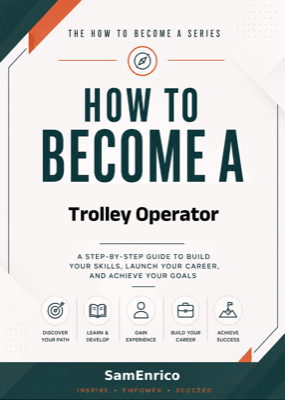
How to Become a Trolley Operator
How to Become a Trolley Operator
by Stoll Aline
How to Become a Trolley Operator
Formats
About this book
Free sample
Chapter 1: The Last Streetcar--The overhead wire hummed at a frequency that felt less like electricity and more like a warning. It was 11:47 on a Tuesday night in the summer of 1987, and Frank Delgado had just finished his third round trip on the F-Market line in San Francisco. His hands, calloused from thirty-one years of pulling the master controller, rested on his knees as the last passengers trickled off the car. A young woman in a denim jacket paused at the door and turned back.“Is it true they’re shutting you down?” she asked.Frank looked at the worn wooden benches, the brass bell pull, the faded ad for a department store that had closed before she was born. “Not tonight,” he said.
“Tonight, we’re still moving.”She stepped off. The doors closed with a hiss of aged pneumatics. Frank advanced the controller to notch one, then two, and the streetcar lurched forward into the dark, its single headlight cutting a narrow path through the fog. He didn’t know it then, but he was driving the last generation of trolley operators into extinction—or so everyone believed.Thirty-seven years later, Frank’s granddaughter, Maya, completed her training as a light rail operator on the same city’s modern T-Third line. She sat in a climate-controlled cab with digital displays, automatic train stops, and a dead man’s pedal that monitored her presence continuously.
The overhead wire hummed at the same frequency. The track gauge was identical. But everything else had changed—and nothing had.Between Frank’s final run and Maya’s first lay the longest funeral the transit industry ever held. From 1987 to 2002, more than forty American streetcar systems closed their doors. Tracks were paved over.
Overhead wires were cut down for scrap. The motorman—that proud, peculiar title—became a relic of history books and museum weekends. But then something unexpected happened. The cities that had ripped out their tracks began paying millions to put them back. Portland, Seattle, Dallas, Detroit, Cincinnati, Milwaukee, Oklahoma City—one by one, they returned to the rail.
Not out of nostalgia, though nostalgia helped. They returned because trolleys did something buses could never do: they told the…
This is the end of the free sample. Get the eBook to keep going. Buy now
Contents
- Chapter 1
- Chapter 2
- Chapter 3
- Chapter 4
- Chapter 5
- Chapter 6
- Chapter 7
- Chapter 8
- Chapter 9
- Chapter 10
- Chapter 11
- Chapter 12
Details
- Author
- Stoll Aline
- Publisher
- SamEnrico
- Language
- English
- ISBN
- 9781506055169
- Genre
- Non-Fiction, Informative, Educational
- Released
- 2026-04-25
- Pages (approx.)
- 142
- Available as
- eBook, Paperback, Audiobook

Read better in the ZLOADR app
Your eBooks on your phone or tablet. Sign in with your SamEnrico account and start reading.
More by Stoll Aline
 Therapy For Albinism In SchoolsStoll Aline$11.99
 Gobi Desert Expedition DiaryStoll Aline$11.99
 Meth Pipe Burns GuideStoll Aline$11.99
 Intergenerational Body Talk GuideStoll Aline$11.99
 The Silk Road Heist: When a Caravan Vanished into the SandsStoll Aline$11.99
 The Pearl Diver's Secret: Unveiling the Ancient Wonders of the Andaman SeaStoll Aline$11.99
 Graffiti Removal (Chemical Safety)Stoll Aline$11.99
 Understanding Hirschsprung Nail Hypoplasia DysmorphismStoll Aline$17.99
 Ad Performance Analysis HandbookStoll Aline$12.99
 2026-2030 AI Customer ServiceStoll Aline$12.99