
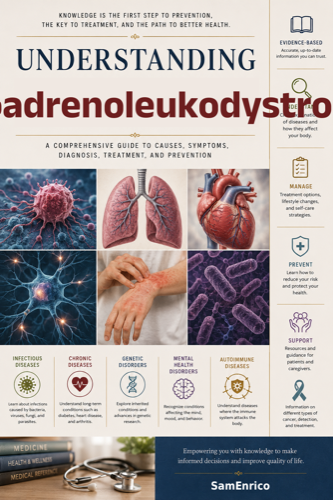
Non-FictionInformativeEducational
Understanding Pseudoadrenoleukodystrophy eBook
This disease publication, published by SamEnrico,
by Odell Ava
This disease publication, published by SamEnrico, covers Understanding Pseudoadrenoleukodystrophy
Formats
Free sample
Chapter 1: The Cell's Graveyard...--–- Every human body performs a quiet miracle thousands of times per second, invisible and unacknowledged, until the moment it fails. Inside each of your estimated 37 trillion cells, tiny membrane-bound sacs called peroxisomes act as chemical incinerators, systematically dismantling very long-chain fatty acids—molecules so lengthy that they would otherwise poison your cellular machinery. This process, known as peroxisomal beta-oxidation, is as essential as breathing, yet most people have never heard of it. For the 37 families worldwide who have received a diagnosis of pseudoadrenoleukodystrophy (p-ALD), the failure of this microscopic process has rewritten everything they understood about life, love, and the cruel mathematics of genetic inheritance.To understand p-ALD, one must first understand the peroxisome—not as a static structure in a textbook diagram, but as a dynamic, relentless worker that begins its duties before birth and continues until the moment of death. The peroxisome was once dismissed by cell biologists as a cellular relic, an evolutionary leftover with little functional importance.
That misconception killed patients. It delayed diagnoses. It allowed children to suffer and die while clinicians searched for explanations in the wrong organelles, the wrong metabolic pathways, the wrong genes. The story of pseudoadrenoleukodystrophy is, in many ways, the story of how science learned to stop ignoring the peroxisome.The Organelle That Science Forgot The peroxisome was first described in 1954 by the Belgian cytologist Christian de Duve, who had already discovered the lysosome two years earlier. De Duve noticed a mysterious fraction in his density-gradient centrifugations of rat liver cells—particles that did not behave like mitochondria, lysosomes, or microsomes.
He named them "peroxisomes" because they contained enzymes that both produced and degraded hydrogen peroxide, a reactive oxygen species that can damage DNA if left unchecked. For the next two decades, peroxisomes were regarded as biological curiosities: interesting to biochemists, irrelevant to clinicians.This indifference shattered in the 1970s and 1980s, when researchers began identifying patients with profound neurological dysfunction who lacked detectable peroxisomes in their liver and kidney tissues. The condition, eventually named Zellweger syndrome, was uniformly fatal in the first year of life. Autopsy studies revealed not only the absence of peroxisomes but also the accumulation of very long-chain fatty acids (VLCFAs) in the brain, liver, and kidneys. Suddenly, the obscure peroxisome acquired clinical urgency.
If a missing organelle could cause such devastation, then disorders of peroxisomal function—even partial dysfunction—might explain a spectrum of previously mysterious neurological diseases.Pseudoadrenoleukodystrophy emerged from this scientific reckoning. In the late 1980s, clinicians encountered patients who presented with symptoms resembling X-linked adrenoleukodystrophy (X-ALD): progressive white matter degeneration, adrenal insufficiency, and elevated VLCFA levels. Yet these patients were not male (X-ALD is almost exclusively male), and they lacked mutations in the ABCD1 gene responsible for X-ALD. Something else was destroying their myelin. Something peroxisomal, but not a biogenesis defect.
The answer, when it came, pointed to a single enzyme: acyl-Co A oxidase, encoded by the ACOX1 gene.The Beta-Oxidation Assembly Line Imagine a recycling plant that processes only oversized items—furniture too large for standard trash compactors. The peroxisome is that specialized facility, and its primary raw material is very long-chain fatty acids: carbon chains of 22, 24, or even 26 atoms in length. These VLCFAs are essential components of cell membranes, particularly in the brain, where they contribute to the stability and function of myelin sheaths. But like any essential substance, VLCFAs become toxic when they accumulate beyond normal concentrations. The body must constantly synthesize, use, and degrade them in a tightly regulated cycle.Peroxisomal beta-oxidation is the degradation pathway.
It consists of four enzymatic steps, each catalyzed by a specific protein, repeated cyclically until the VLCFA has been shortened to a manageable length—typically 16 to 18 carbons—at which point it is exported to the mitochondria for final breakdown into energy. The first and rate-limiting step belongs to acyl-Co A oxidase (ACOX1), which removes two hydrogen atoms from the VLCFA molecule, creating a double bond and producing hydrogen peroxide as a byproduct. The hydrogen peroxide is immediately neutralized by catalase, another peroxisomal enzyme, preventing oxidative damage. The shortened fatty acid then undergoes three additional reactions—hydration, dehydrogenation, and thiolysis—before the cycle repeats.This assembly line is elegant and efficient under normal conditions. A single peroxisome can process thousands of VLCFA molecules per second.
But when ACOX1 is missing or dysfunctional—as in p-ALD—the first and most critical station on the assembly line is closed. VLCFAs accumulate in the peroxisome, unable to enter the cycle. They leak into the cytoplasm, incorporate into cell membranes where they do not belong, and begin a cascade of cellular injury that ultimately destroys the very tissues they were meant to support.The Distinction That Defines a Disease One of the most common points of confusion in clinical practice is the relationship between p-ALD and other peroxisomal disorders. The introduction to this book mapped the landscape of these conditions, but Chapter 1 must drill deeper into the distinction because it explains why p-ALD behaves differently, progresses differently, and might ultimately be treated differently than its more famous cousins.Peroxisomal disorders fall into two broad categories: biogenesis disorders and single-enzyme deficiencies. Biogenesis disorders, such as Zellweger syndrome, neonatal adrenoleukodystrophy (NALD), and infantile Refsum disease, result from mutations in PEX genes—the genes responsible for assembling the peroxisome itself.
In these conditions, the entire peroxisome is either absent or grossly dysfunctional. Multiple metabolic pathways fail simultaneously: VLCFA oxidation, plasmalogen synthesis (critical for brain development), phytanic acid oxidation, and bile acid synthesis. Patients with severe biogenesis disorders have profound dysmorphism, intractable seizures, liver failure, and typically die within the first year of life.Single-enzyme deficiencies, in contrast, affect only one protein within an otherwise intact peroxisome. p-ALD is the prototypical example, caused by isolated ACOX1 deficiency. Other single-enzyme deficiencies include D-bifunctional protein deficiency (HSD17B4 gene) and X-linked adrenoleukodystrophy (ABCD1 gene, which encodes a VLCFA transporter rather than a beta-oxidation enzyme).
Because the peroxisome itself is structurally normal in p-ALD, the clinical presentation is generally less severe than Zellweger syndrome but more variable—ranging from neonatal lethality to childhood-onset neurodegeneration, depending on the residual enzyme activity conferred by specific ACOX1 mutations.This distinction is not academic pedantry. It has direct implications for diagnosis, prognosis, and the design of future therapies. A patient with a biogenesis disorder will have absent plasmalogens and elevated phytanic acid, whereas a patient with p-ALD will have normal plasmalogens and normal phytanic acid oxidation (provided they survive past infancy, as phytanic acid accumulates slowly). A gene therapy for p-ALD would deliver a functional ACOX1 gene to existing peroxisomes; a gene therapy for Zellweger syndrome would need to reconstruct the entire peroxisomal biogenesis machinery, a vastly more complex undertaking. Understanding the peroxisome, in other words, is the first step toward understanding which therapeutic battles are worth fighting.The Biochemistry of Catastrophe When ACOX1 fails, the immediate consequence is VLCFA accumulation.
But accumulation is not the same as disease. The toxicity of VLCFAs arises from their physical properties and their interactions with cellular structures for which they were never intended.Under normal conditions, VLCFAs are confined primarily to the peroxisome during active degradation, with small amounts present in specialized membrane microdomains. When ACOX1…
This is the end of the free sample. Get the eBook to keep going. Buy now
About this book
Details
- Author
- Odell Ava
- Publisher
- SamEnrico
- Language
- English
- Genre
- Non-Fiction, Informative, Educational
- Released
- 2026-05-08
- Pages (approx.)
- 144
- Available as
- eBook, Audiobook

Read better in the ZLOADR app
Your eBooks on your phone or tablet. Sign in with your SamEnrico account and start reading.
More by Odell Ava
 Pursuer Distancer Dynamic FixOdell Ava$11.99
 Text Message Anger TriggersOdell Ava$11.99
 Rosa Parks NAACP WorkOdell Ava$11.99
 Kigali Drone Delivery GuideOdell Ava$11.99
 The Unsubscribe from Retail Email GuideOdell Ava$11.99
 The Unstoppable Kiwi: Bevan Guy's Record-Breaking Marathon of the ImpossibleOdell Ava$11.99
 How to Start a Trade Show Organizers BusinessOdell Ava$11.99
 Wix Retention GuideOdell Ava$12.99
 Expense Reimbursement TrapOdell Ava$12.99
 Director of Product ManagementOdell Ava$11.99
You may also like
 Hong Kong Handover 1997Dunn Johnnie$11.99
 Zumba For Postnatal Recovery CourseNeal Christian$11.99
 Zumba for BeginnersLadner Nikia$11.99
 YouTube Comment Mining GuideHumes Pandora$12.99
 Worry Box MeditationCarlin Rudy$11.99
 Workplace Stress MeditationNguyen Lynn$11.99
 Workplace Stress and Sleep RepairHawley Ivory$11.99
 Workplace Perfectionism CureDelaney Jeffry$11.99
 Workplace Injustice Anger GuideWallen Isabelle$11.99
 Work Addiction and Burnout LinkGreenwood Ester$11.99
 Women in Yoga and WellnessBeattie Galina$11.99
 Women in Stand Up ComedyChun Evangeline$11.99