
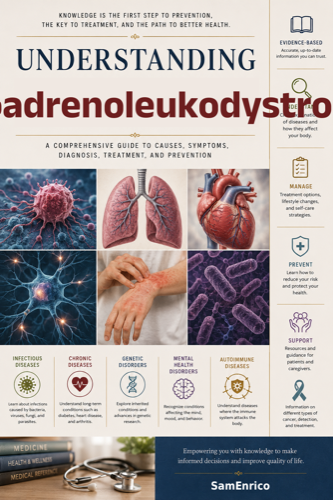
Understanding Pseudoadrenoleukodystrophy Audiobook
This disease publication, published by SamEnrico,
by Odell Ava
This disease publication, published by SamEnrico, covers Understanding Pseudoadrenoleukodystrophy
Formats
Free sample
Chapter 1: The Cell's Graveyard...--–- Every human body performs a quiet miracle thousands of times per second, invisible and unacknowledged, until the moment it fails. Inside each of your estimated 37 trillion cells, tiny membrane-bound sacs called peroxisomes act as chemical incinerators, systematically dismantling very long-chain fatty acids—molecules so lengthy that they would otherwise poison your cellular machinery. This process, known as peroxisomal beta-oxidation, is as essential as breathing, yet most people have never heard of it. For the 37 families worldwide who have received a diagnosis of pseudoadrenoleukodystrophy (p-ALD), the failure of this microscopic process has rewritten everything they understood about life, love, and the cruel mathematics of genetic inheritance.To understand p-ALD, one must first understand the peroxisome—not as a static structure in a textbook diagram, but as a dynamic, relentless worker that begins its duties before birth and continues until the moment of death. The peroxisome was once dismissed by cell biologists as a cellular relic, an evolutionary leftover with little functional importance.
That misconception killed patients. It delayed diagnoses. It allowed children to suffer and die while clinicians searched for explanations in the wrong organelles, the wrong metabolic pathways, the wrong genes. The story of pseudoadrenoleukodystrophy is, in many ways, the story of how science learned to stop ignoring the peroxisome.The Organelle That Science Forgot The peroxisome was first described in 1954 by the Belgian cytologist Christian de Duve, who had already discovered the lysosome two years earlier. De Duve noticed a mysterious fraction in his density-gradient centrifugations of rat liver cells—particles that did not behave like mitochondria, lysosomes, or microsomes.
He named them "peroxisomes" because they contained enzymes that both produced and degraded hydrogen peroxide, a reactive oxygen species that can damage DNA if left unchecked. For the next two decades, peroxisomes were regarded as biological curiosities: interesting to biochemists, irrelevant to clinicians.This indifference shattered in the 1970s and 1980s, when researchers began identifying patients with profound neurological dysfunction who lacked detectable peroxisomes in their liver and kidney tissues. The condition, eventually named Zellweger syndrome, was uniformly fatal in the first year of life. Autopsy studies revealed not only the absence of peroxisomes but also the accumulation of very long-chain fatty acids (VLCFAs) in the brain, liver, and kidneys. Suddenly, the obscure peroxisome acquired clinical urgency.
If a missing organelle could cause such devastation, then disorders of peroxisomal function—even partial dysfunction—might explain a spectrum of previously…
This is the end of the free sample. Get the Audiobook to keep going. Buy now
About this book
Details
- Author
- Odell Ava
- Publisher
- SamEnrico
- Language
- English
- Genre
- Non-Fiction, Informative, Educational
- Released
- 2026-05-08
- Pages (approx.)
- 144
- Available as
- eBook, Audiobook

Listen in the VoxFlicks app
Audiobooks and audio dramas wherever you go. Sign in with your SamEnrico account and press play.
More by Odell Ava
 Pursuer Distancer Dynamic FixOdell Ava$11.99
 Text Message Anger TriggersOdell Ava$11.99
 Rosa Parks NAACP WorkOdell Ava$11.99
 Kigali Drone Delivery GuideOdell Ava$11.99
 The Unsubscribe from Retail Email GuideOdell Ava$11.99
 The Unstoppable Kiwi: Bevan Guy's Record-Breaking Marathon of the ImpossibleOdell Ava$11.99
 How to Start a Trade Show Organizers BusinessOdell Ava$11.99
 Wix Retention GuideOdell Ava$12.99
 Expense Reimbursement TrapOdell Ava$12.99
 Director of Product ManagementOdell Ava$11.99