
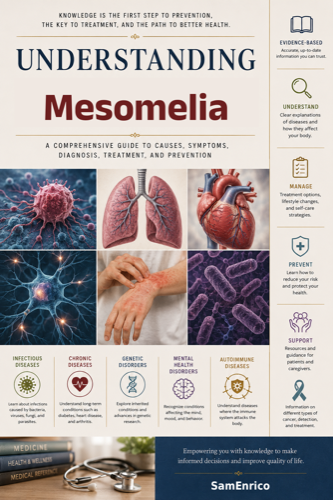
Non-FictionInformativeEducational
Understanding Mesomelia eBook
This disease publication, published by SamEnrico,
This disease publication, published by SamEnrico, covers Understanding Mesomelia
Formats
Free sample
Chapter 1: Beyond the Mirror...--–- The first time three-year-old Liam tried to reach for a cookie on the kitchen counter, his mother noticed something she couldn’t quite name. His arms didn’t stretch the way his older brother’s did. The forearm seemed… shorter. Not dramatically—not in a way that would alarm a pediatrician during a routine checkup—but just enough that she found herself watching him more closely. When Liam started kindergarten, he held his pencil with a tight fist, and his teacher noted that he struggled to fasten his own buttons.
By age seven, his wrist had begun to tilt slightly inward, like a tree bending toward the light. No one used the word “mesomelia.” Instead, doctors mentioned “growth variants” and “maybe nothing to worry about.” It took another five years and a curious orthopedist who ordered an X-ray of the entire arm—not just the hand—to finally give Liam’s condition a name.That name changed everything. And nothing at all.This book is for the parents who watch their children from the doorway of an exam room, for the adults who grew up knowing their bodies were different but never understood why, and for the clinicians who want to move beyond vague reassurances and provide real answers. Understanding Mesomelia is not a dry medical textbook. It is a guide, a companion, and in some chapters, a map through territory that remains unfamiliar even to many specialists.
We will cover genetics, radiology, orthopedic decisions, daily living strategies, and the emotional landscape of growing up with a visible difference. But before we dive into the science of growth plates or the ethics of limb lengthening, we must start with a more fundamental question: What exactly is mesomelia, and why does it matter so much to the people who live with it?The Architecture of the Human Limb To understand mesomelia, you must first appreciate the elegant design of a normal human limb. Each arm and leg develops as three distinct segments. The proximal segment—closest to the body—consists of the humerus in the arm and the femur in the leg. This is the segment affected in achondroplasia, the most common form of dwarfism, where the upper arms and thighs are disproportionately short.
The distal segment—farthest from the body—includes the hands and feet. Isolated shortening here is called acromelia, and it appears in conditions like brachydactyly (short fingers) or acrodysostosis.Between these two lies the middle segment: the radius and ulna in the forearm, and the tibia and fibula in the lower leg. Mesomelia literally means “middle limb” (from the Greek mesos, middle, and melos, limb). When a person has mesomelia, these middle bones are shorter relative to the rest of the limb. The humerus may be completely normal in length, and the hands may be perfectly formed, but the forearm—from elbow to wrist—falls short of expected proportions.
The same pattern occurs in the legs: normal thighs, normal feet, but a shortened segment between the knee and the ankle.This pattern creates a distinctive silhouette. In a person with isolated mesomelia, if you look at them from the side, the upper arm appears to drop down to a wrist that sits higher than expected. The elbow may seem unusually prominent because the forearm does not extend as far. In the leg, the knee may appear lower relative to the torso, and the ankle may ride higher than typical. These differences are subtle enough that many children go undiagnosed for years—sometimes decades—because no single measurement falls dramatically outside normal ranges.
Instead, the proportions are off in a way that parents often describe as “something I couldn’t put my finger on.”But mesomelia rarely travels alone. In most cases, the shortening of the middle segment is accompanied by other skeletal changes. The most common of these is the Madelung deformity, a progressive malformation of the wrist that we will explore in detail in later chapters. Others include bone fusions (synostoses) in the forearm or ankle, bowing of the tibia, and abnormalities of the elbow or knee joints. When mesomelia appears as part of a larger syndrome—such as Leri-Weill dyschondrosteosis or mesomelia-synostoses syndrome—the clinical picture becomes richer and more complex.
But at its core, the defining feature remains the same: the middle segment is not keeping pace with the rest of the limb.A Spectrum, Not a Single Diagnosis One of the most important concepts to grasp from the outset is that mesomelia is not a single disease. It is a physical finding—an anatomical pattern—that can arise from multiple genetic causes and express itself with widely varying severity. Think of it as a fever: a fever tells you that something is wrong, but it does not tell you whether the underlying cause is a virus, a bacterial infection, or an autoimmune condition. Similarly, mesomelia tells you that the middle segments of the limbs have failed to achieve their expected length, but the specific syndrome, prognosis, and treatment options depend entirely on the underlying genetics.This is why the diagnostic journey is so critical and, unfortunately, so often delayed. A child with mild mesomelia and no other obvious abnormalities may be labeled a “late bloomer” or simply “small for their age.” A teenager with wrist pain may be treated for repetitive strain injury without anyone ever measuring the ratio of forearm to upper arm length.
A short adult may go through life believing they have “familial short stature” when in fact they have a recognizable genetic condition with implications for their children and their long-term joint health.In clinical practice, mesomelia falls along a continuum. At the mildest end, a person may have subtle shortening of the forearms and lower legs, normal stature, and no functional limitations. They may never see a doctor about their limb proportions and may only discover the finding incidentally on an X-ray taken for another reason. At the moderate end—exemplified by Leri-Weill dyschondrosteosis—the mesomelia is accompanied by the Madelung wrist deformity, which can cause pain, limited range of motion, and progressive deformity over time. Adult height is typically reduced but still within the range of “short stature” rather than “dwarfism” (often between 140 and 160 centimeters, or roughly 4 feet 7 inches to 5 feet 3 inches).
At the severe end of the spectrum lies Langer mesomelic dysplasia, where the shortening is extreme, adult height rarely exceeds 120 centimeters (about 3 feet 11 inches), and the wrists and elbows may be so abbreviated that typical surgical interventions are not even feasible.Between these poles exist even rarer conditions: mesomelia-synostoses syndrome with its characteristic bone fusions, Nievergelt syndrome with its bizarre triangular tibiae, and acromesomelic dysplasias that combine mesomelia with shortening of the hands and feet. Each has its own genetic signature, its own natural history, and its own set of management priorities. The chapters that follow will dissect each of these syndromes with the precision they deserve. For now, the key takeaway is this: do not leave a doctor’s office with only the word “mesomelia.” The question to ask is, “Which mesomelia?”Isolated Versus Syndromic: Why It Matters A second critical distinction separates isolated mesomelia from syndromic mesomelia.…
This is the end of the free sample. Get the eBook to keep going. Buy now
About this book
Details
- Author
- Canales Criselda
- Publisher
- SamEnrico
- Language
- English
- Genre
- Non-Fiction, Informative, Educational
- Released
- 2026-06-03
- Pages (approx.)
- 152
- Available as
- eBook, Audiobook

Read better in the ZLOADR app
Your eBooks on your phone or tablet. Sign in with your SamEnrico account and start reading.
More by Canales Criselda
 Work Life Integration Burnout CourseCanales Criselda$11.99
 Stoma Self Esteem WorkbookCanales Criselda$11.99
 Premature Baby Sleep GuideCanales Criselda$11.99
 Dwan Western PulpCanales Criselda$11.99
 Navigating Layoff and Firing ConversationsCanales Criselda$11.99
 The Vanishing Vermeer: The 1932 Heist That Shook the Art WorldCanales Criselda$11.99
 How to Become a Needle-loom TenderCanales Criselda$11.99
 Systems SupportCanales Criselda$11.99
 Value Proposition Design PromptsCanales Criselda$12.99
 UAE Data Protection Law GuideCanales Criselda$12.99
You may also like
 Hong Kong Handover 1997Dunn Johnnie$11.99
 Zumba For Postnatal Recovery CourseNeal Christian$11.99
 Zumba for BeginnersLadner Nikia$11.99
 YouTube Comment Mining GuideHumes Pandora$12.99
 Worry Box MeditationCarlin Rudy$11.99
 Workplace Stress MeditationNguyen Lynn$11.99
 Workplace Stress and Sleep RepairHawley Ivory$11.99
 Workplace Perfectionism CureDelaney Jeffry$11.99
 Workplace Injustice Anger GuideWallen Isabelle$11.99
 Work Addiction and Burnout LinkGreenwood Ester$11.99
 Women in Yoga and WellnessBeattie Galina$11.99
 Women in Stand Up ComedyChun Evangeline$11.99