
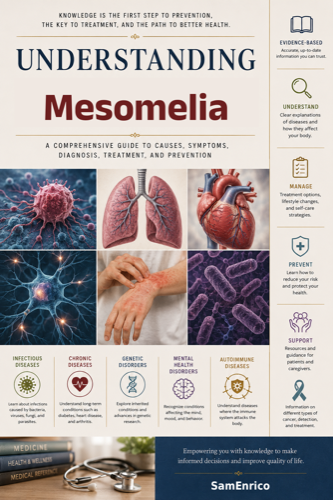
Non-FictionInformativeEducational
Understanding Mesomelia Audiobook
This disease publication, published by SamEnrico,
This disease publication, published by SamEnrico, covers Understanding Mesomelia
Formats
Free sample
Chapter 1: Beyond the Mirror...--–- The first time three-year-old Liam tried to reach for a cookie on the kitchen counter, his mother noticed something she couldn’t quite name. His arms didn’t stretch the way his older brother’s did. The forearm seemed… shorter. Not dramatically—not in a way that would alarm a pediatrician during a routine checkup—but just enough that she found herself watching him more closely. When Liam started kindergarten, he held his pencil with a tight fist, and his teacher noted that he struggled to fasten his own buttons.
By age seven, his wrist had begun to tilt slightly inward, like a tree bending toward the light. No one used the word “mesomelia.” Instead, doctors mentioned “growth variants” and “maybe nothing to worry about.” It took another five years and a curious orthopedist who ordered an X-ray of the entire arm—not just the hand—to finally give Liam’s condition a name.That name changed everything. And nothing at all.This book is for the parents who watch their children from the doorway of an exam room, for the adults who grew up knowing their bodies were different but never understood why, and for the clinicians who want to move beyond vague reassurances and provide real answers. Understanding Mesomelia is not a dry medical textbook. It is a guide, a companion, and in some chapters, a map through territory that remains unfamiliar even to many specialists.
We will cover genetics, radiology, orthopedic decisions, daily living strategies, and the emotional landscape of growing up with a visible difference. But before we dive into the science of growth plates or the ethics of limb lengthening, we must start with a more fundamental question: What exactly is mesomelia, and why does it matter so much to the people who live with it?The Architecture of the Human Limb To understand mesomelia, you must first appreciate the elegant design of a normal human limb. Each arm and leg develops as three distinct segments. The proximal segment—closest to the body—consists of the humerus in the arm and the femur in the leg. This is the segment affected in achondroplasia, the most common form of dwarfism, where the upper arms and thighs are disproportionately short.
The distal segment—farthest from the body—includes the hands and feet. Isolated shortening here is called acromelia, and it appears in conditions…
This is the end of the free sample. Get the Audiobook to keep going. Buy now
About this book
Details
- Author
- Canales Criselda
- Publisher
- SamEnrico
- Language
- English
- Genre
- Non-Fiction, Informative, Educational
- Released
- 2026-06-03
- Pages (approx.)
- 152
- Available as
- eBook, Audiobook

Listen in the VoxFlicks app
Audiobooks and audio dramas wherever you go. Sign in with your SamEnrico account and press play.
More by Canales Criselda
 Work Life Integration Burnout CourseCanales Criselda$11.99
 Stoma Self Esteem WorkbookCanales Criselda$11.99
 Premature Baby Sleep GuideCanales Criselda$11.99
 Dwan Western PulpCanales Criselda$11.99
 Navigating Layoff and Firing ConversationsCanales Criselda$11.99
 The Vanishing Vermeer: The 1932 Heist That Shook the Art WorldCanales Criselda$11.99
 How to Become a Needle-loom TenderCanales Criselda$11.99
 Systems SupportCanales Criselda$11.99
 Value Proposition Design PromptsCanales Criselda$12.99
 UAE Data Protection Law GuideCanales Criselda$12.99
You may also like
 Hong Kong Handover 1997Dunn Johnnie$11.99
 Zumba For Postnatal Recovery CourseNeal Christian$11.99
 Zumba for BeginnersLadner Nikia$11.99
 YouTube Comment Mining GuideHumes Pandora$12.99
 Worry Box MeditationCarlin Rudy$11.99
 Workplace Stress MeditationNguyen Lynn$11.99
 Workplace Stress and Sleep RepairHawley Ivory$11.99
 Workplace Perfectionism CureDelaney Jeffry$11.99
 Workplace Injustice Anger GuideWallen Isabelle$11.99
 Work Addiction and Burnout LinkGreenwood Ester$11.99
 Women in Yoga and WellnessBeattie Galina$11.99
 Women in Stand Up ComedyChun Evangeline$11.99