
Non-FictionInformativeEducational
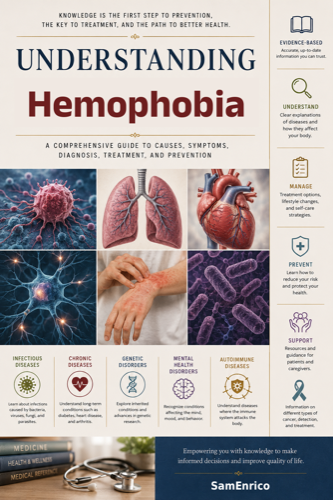
Understanding Hemophobia eBook
This disease publication, published by SamEnrico,
This disease publication, published by SamEnrico, covers Understanding Hemophobia
Formats
Free sample
Chapter 1: The Hidden Wound...–- Sarah had not visited a doctor in eleven years. Not because she was healthy—she suffered from chronic fatigue, unexplained bruising, and a persistent cough that kept her neighbors awake. She had simply decided, somewhere in her twenties, that the risk of fainting in a sterile room surrounded by needles and vials of red liquid was worse than any disease she might be harboring. When her partner finally dragged her to an urgent care after she coughed blood into a tissue, Sarah made the phlebotomist sign a waiver. She lay flat on the examination table, eyes squeezed shut, headphones blasting white noise, and still, the moment the tourniquet tightened around her arm, her body betrayed her.
The room went gray. Then black. She woke on the floor with a swollen lip where she had struck the edge of a metal stool. The blood draw had not even begun.Sarah has hemophobia. But more than that, she has the silent, shaming version of it—the kind that does not announce itself with screaming or running away.
Her fear wears a mask of practicality. "I'll get around to it." "I don't need that test." "I feel fine." These are the lies that hemophobia tells, and millions of people believe them every single day.The Fear That Hides in Plain Sight Let us begin with a confession: this book is not for everyone. If you are reading these words and you have never felt your vision tunnel at the sight of a Band-Aid, never made an excuse to leave a room when someone mentioned a blood test, never calculated the exact number of years until your next recommended physical and felt relief at how far away it was—then you may be reading out of curiosity. Welcome. What you will learn may surprise you.But if you are reading because something in Sarah's story echoes in your own chest, because you have cancelled appointments, lied to loved ones, or driven past a hospital with your heart racing for no logical reason, then this chapter is for you.
And here is the first truth you need to hear: you are not weak. You are not childish. You are not broken.Hemophobia—the clinical term for an extreme, irrational fear of blood—affects approximately three to four percent of the global population. That is roughly 300 million people. In the United States alone, nearly ten million adults meet the diagnostic criteria for a specific phobia of the blood-injection-injury type, commonly abbreviated as BII phobia.
To put that number in perspective, more people suffer from hemophobia than from obsessive-compulsive disorder, more than from panic disorder, and nearly as many as from social anxiety disorder. Yet hemophobia remains one of the most underdiagnosed and undertreated mental health conditions in existence.Why? Because it is easy to hide. A person with agoraphobia cannot easily explain why they never leave their apartment. A person with social anxiety cannot fully conceal their trembling hands during a presentation.
But a person with hemophobia can simply say, "I don't like needles," and the conversation ends. They can schedule their blood work and cancel the night before. They can change the subject when a friend mentions their cholesterol test. They can construct an entire life around avoidance without ever uttering the word phobia.Beyond Disgust: What Hemophobia Actually Is Before we go any further, we must dismantle a persistent misunderstanding. Many people—including some mental health professionals—conflate hemophobia with simple disgust.
They assume that the person who faints at the sight of blood is merely more squeamish than average, that their reaction is an extreme but otherwise ordinary extension of the universal human aversion to bodily fluids.This is wrong. And the difference matters enormously for treatment.Disgust is a protective emotion. It evolved to keep us away from sources of contamination—rotten food, feces, infectious wounds. Disgust activates a specific neural circuit centered in the insular cortex and the basal ganglia. It produces a characteristic facial expression (the wrinkled nose, the raised upper lip), a distinctive physiological response (nausea, slowed heart rate), and a behavioral script (rejection, avoidance, sometimes vomiting).
Disgust says: This is filthy. Do not let it touch you.Fear is different. Fear activates the amygdala, the hypothalamus, and the sympathetic nervous system. It produces a racing heart, rapid breathing, dilated pupils, and a surge of adrenaline. Fear says: This is dangerous.
Fight or flee. And for most phobias—spiders, heights, enclosed spaces—that sympathetic response is exactly what happens.But hemophobia is different from both. And that is what makes it so confusing, both for sufferers and for the people who love them.A person with hemophobia does not experience a sustained sympathetic response. They experience what researchers call a diphasic reaction. First, a brief spike of sympathetic activation: the heart races, the palms sweat, the body prepares for action.
Then, within seconds to minutes, the parasympathetic nervous system overrides everything. The heart rate plummets. Blood vessels widen dramatically. Blood pressure drops. The brain, starved of oxygen, shuts down into a faint.
This is vasovagal syncope—the medical term for fainting caused by a sudden drop in heart rate and blood pressure.Here is the critical insight: the person who faints at the sight of blood is not having a more intense version of the disgust response. They are having a different physiological reaction entirely. And that is why standard advice to "calm down" or "breathe deeply" actually makes hemophobia worse. Relaxation techniques lower blood pressure. Lowering blood pressure when your body is already crashing toward a faint is like stepping on the brake pedal when you are already skidding on ice.The Diagnostic Criteria: When Does a Fear Become a Phobia?Not everyone who dislikes blood has hemophobia.
The clinical distinction matters because it determines who needs treatment and what kind of treatment will work.The Diagnostic and Statistical Manual of Mental Disorders, Fifth Edition, Text Revision (DSM-5-TR)—the standard reference used by mental health professionals worldwide—classifies hemophobia under the category of Specific Phobia, Blood-Injection-Injury Type. The diagnostic criteria are precise and demanding.To receive this diagnosis, a person must experience all of the following:First, marked fear or anxiety about a specific object or situation. In the case of hemophobia, that object is blood—either seeing it on oneself, seeing it on another person, or sometimes even seeing it in a photograph or video. The fear must be out of proportion to the actual danger posed by the object. (Blood, objectively, is not dangerous.
The diseases blood can carry are dangerous, but the substance itself is neutral.)Second, the phobic object almost always provokes immediate fear or anxiety. This is not a subtle response. It is not mild discomfort. It is a visceral, automatic reaction that occurs within seconds of exposure. For some people, this reaction includes fainting.
For others, it includes intense nausea, dizziness, or a sense of unreality. But the key is immediacy: the fear does not build gradually over hours. It hits like a wave.Third, the person actively avoids the phobic object or endures it with intense fear or anxiety. This is the behavioral hallmark of any…
This is the end of the free sample. Get the eBook to keep going. Buy now
About this book
Details
- Author
- Hargrove Elvis
- Publisher
- SamEnrico
- Language
- English
- Genre
- Non-Fiction, Informative, Educational
- Released
- 2026-06-02
- Pages (approx.)
- 140
- Available as
- eBook, Audiobook

Read better in the ZLOADR app
Your eBooks on your phone or tablet. Sign in with your SamEnrico account and start reading.
More by Hargrove Elvis
 Self Esteem And Emotional DependencyHargrove Elvis$11.99
 The MBSR for Trauma GuideHargrove Elvis$11.99
 Legacy Visualization GuideHargrove Elvis$11.99
 Behavioral Addiction MindfulnessHargrove Elvis$11.99
 The Forbidden Summit: A Jesuit’s Love and the Lost Kingdom of the AndesHargrove Elvis$11.99
 Kali's Dance of Destruction: The Dark Goddess and the Demon KingHargrove Elvis$11.99
 RabbitsHargrove Elvis$11.99
 How to Become a Classification ClerkHargrove Elvis$11.99
 E-Commerce Platform Market OutlookHargrove Elvis$12.99
 Employer-Respected Online Credential PrimerHargrove Elvis$12.99
You may also like
 Hong Kong Handover 1997Dunn Johnnie$11.99
 Zumba For Postnatal Recovery CourseNeal Christian$11.99
 Zumba for BeginnersLadner Nikia$11.99
 YouTube Comment Mining GuideHumes Pandora$12.99
 Worry Box MeditationCarlin Rudy$11.99
 Workplace Stress MeditationNguyen Lynn$11.99
 Workplace Stress and Sleep RepairHawley Ivory$11.99
 Workplace Perfectionism CureDelaney Jeffry$11.99
 Workplace Injustice Anger GuideWallen Isabelle$11.99
 Work Addiction and Burnout LinkGreenwood Ester$11.99
 Women in Yoga and WellnessBeattie Galina$11.99
 Women in Stand Up ComedyChun Evangeline$11.99