
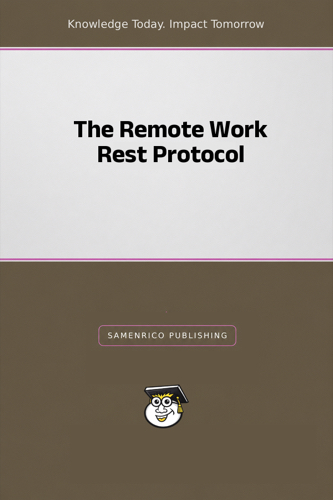
The Remote Work Rest Protocol eBook
Scheduled breaks for eye rest and stretching.
Scheduled breaks for eye rest and stretching.
Formats
Free sample
Chapter 1: The Creeping Toll...--–- The morning routine had not changed in eighteen months. Wake at 7:15 AM, stumble to the home office in pajamas, open the laptop before the first sip of coffee had cooled. The commute was twelve feet and the first email arrived before the spine had fully uncurled from sleep. This was efficiency. This was modern work.
And this was quietly dismantling the remote worker's body, one micro-movement at a time.The problem was not that remote work was inherently harmful. The problem was that the human body had evolved over two hundred thousand years to move constantly, and the home office had accidentally become a machine for stillness. In a traditional workplace, the body was forced into variety: the walk to the printer, the turn of the head to ask a colleague a question, the stand-up meeting, the stairwell to the third floor, the coffee run, the bathroom on the other side of the building. None of these were exercise. But together, they formed an invisible symphony of micro-movements that kept joints lubricated, muscles active, and eyes shifting focus between distances.Remote work had deleted that symphony.
In its place was a single, sustained posture held for nine hours, interrupted only by the occasional trip to the refrigerator. The body was not designed for this. And the evidence was showing up in doctors' offices, physical therapy clinics, and optometrist waiting rooms at an alarming rate.The Great Unspoken Crisis of Remote Work By 2024, remote work had become a permanent fixture for nearly thirty percent of the workforce in developed economies. The benefits were well-documented: no commute, flexible hours, more time with family, increased productivity for deep-focus tasks. But beneath these advantages, a quieter crisis was building.
It did not make headlines. It did not trigger policy debates. It simply showed up as a dull ache in the lower back, a persistent headache behind the eyes, a numb pinky finger that would not go away.This chapter dismantles three myths that have allowed this crisis to flourish. The first myth: that knowing the rules of ergonomics is enough. The second myth: that remote work naturally leads to more breaks because there is no boss watching.
The third myth: that the lunch break is still happening. All three are false. And understanding why they are false is the first step toward building a protocol that actually works.Myth One: The 20/20/20 Rule Is Enough (If You Can Remember It)In optometry circles, the 20/20/20 rule has been standard advice for nearly two decades. Every twenty minutes, look at something twenty feet away for twenty seconds. The science behind it is sound.
The ciliary muscles inside the eye, which contract to focus the lens on near objects, need regular relaxation to avoid fatigue and spasm. Without these breaks, the eyes struggle to refocus at distance, leading to a condition called accommodative dysfunction. Symptoms include blurred vision, headaches, eye strain, and difficulty shifting focus between the screen and the window.The problem is not the rule itself. The problem is that knowing the rule and following the rule are two entirely different things. In an office environment, the rule had passive support systems built into the architecture of the day.
A colleague stopped by your desk, and you looked up at them twenty feet away. You walked to the printer, and your gaze shifted across the room. You went to a meeting in a different part of the building, and your eyes rested on distant signs and windows during the walk.Remote work removes these passive triggers. The printer is on the same desk, within arm's reach. Colleagues appear in a window that is the same focal distance as your work.
The meeting is on the same screen. Nothing in the remote work environment forces the eyes to shift focal length. The 20/20/20 rule becomes a conscious effort, a deliberate act of will, repeated dozens of times per day. And conscious effort fails. Studies on habit formation consistently show that behaviors requiring constant willpower are abandoned within weeks.
The remote worker is left with the knowledge of what they should do and the frustration of never actually doing it.The solution is not more willpower. The solution is a trigger system, which will be covered in depth in Chapter 8. For now, the key insight is simple: the absence of environmental cues means the remote worker must build artificial triggers into their workflow. The 20/20/20 rule is not useless. But without a trigger system, it might as well be.The Physiology of the Stare: Why Blinking Matters More Than You Think Before we leave the eyes, there is another phenomenon worth understanding.
When humans focus intensely on a screen, the blink rate drops dramatically. The normal resting blink rate is between fifteen and twenty blinks per minute. During sustained screen use, that rate can fall to five or six blinks per minute. A reduction of sixty-six percent.Blinking is not merely a reflex. Each blink spreads a fresh layer of tear film across the surface of the eye.
This tear film has three layers: an inner mucous layer that helps tears adhere, a middle aqueous layer that provides moisture and nutrients, and an outer lipid layer that prevents evaporation. When blinking slows, the tear film becomes unstable. Dry spots form on the cornea. The eyes become irritated, red, and gritty. Over time, chronic dry eye can develop, a condition that is uncomfortable and surprisingly difficult to reverse.The remote worker is particularly vulnerable because the home environment often has lower humidity than an office building.
Air conditioning and heating systems dry out the air. Without the humidifying effect of dozens of other people breathing in the same space, the home office becomes a desert for the eyes. The combination of reduced blink rate and dry air is a one-two punch that leaves remote workers reaching for eye drops that provide temporary relief but do not address the underlying problem.The fix is not complicated. It is a conscious blinking exercise taught in Chapter 3. But the first step is awareness.
The next time you finish a deep work session, notice how your eyes feel. Are they dry? Tired? Slightly blurred? That is not normal fatigue.
That is the physiology of the stare.Myth Two: The Home Office Is More Ergonomic Than the Cubicle There is a common assumption that remote workers have better ergonomics because they can customize their workspace. They can buy the chair they want, the desk they want, the monitor height they want. In theory, this should lead to less musculoskeletal pain. In practice, the opposite is true.The average remote worker spends less than two hundred dollars on their home office setup, according to a 2023 survey of remote workers. The average office worker, by contrast, sits in a chair that cost the employer four hundred to eight hundred dollars, at a desk that cost several hundred more, with monitors mounted at precisely calibrated heights.
The home office is often a kitchen table, a dining chair, and a laptop screen that sits six inches below eye level.But the problem is deeper than equipment quality. The problem is what ergonomists call "static loading."…
This is the end of the free sample. Get the eBook to keep going. Buy now
About this book
Details
- Author
- Maloney Christia
- Publisher
- SamEnrico
- Language
- English
- Genre
- Non-Fiction, Self-Help, Health
- Released
- 2026-06-10
- Pages (approx.)
- 128
- Available as
- eBook, Audiobook

Read better in the ZLOADR app
Your eBooks on your phone or tablet. Sign in with your SamEnrico account and start reading.
More by Maloney Christia
 Plant Based Skin Health GuideMaloney Christia$11.99
 Self Hypnosis Induction Techniques GuideMaloney Christia$11.99
 Meeting Role AssignmentMaloney Christia$11.99
 Theodore Roosevelt Conservation PresidentMaloney Christia$11.99
 Frozen Horizons: The Viking Quest for the Northwest PassageMaloney Christia$11.99
 Crown of the Storm: How a Teenage Queen Outmaneuvered EuropeMaloney Christia$11.99
 Brazil Green Tax GuideMaloney Christia$12.99
 30 Day Marketing SprintMaloney Christia$12.99
 Understanding Cutis Laxa With Joint Laxity and Retarded DevelopmentMaloney Christia$17.99
 Arsenoclasite MiningMaloney Christia$11.99
 How to Become a Checker IMaloney Christia$11.99
You may also like
 Hong Kong Handover 1997Dunn Johnnie$11.99
 Zumba For Postnatal Recovery CourseNeal Christian$11.99
 Zumba for BeginnersLadner Nikia$11.99
 YouTube Comment Mining GuideHumes Pandora$12.99
 Worry Box MeditationCarlin Rudy$11.99
 Workplace Stress MeditationNguyen Lynn$11.99
 Workplace Stress and Sleep RepairHawley Ivory$11.99
 Workplace Perfectionism CureDelaney Jeffry$11.99
 Workplace Injustice Anger GuideWallen Isabelle$11.99
 Work Addiction and Burnout LinkGreenwood Ester$11.99
 Women in Yoga and WellnessBeattie Galina$11.99
 Women in Stand Up ComedyChun Evangeline$11.99