
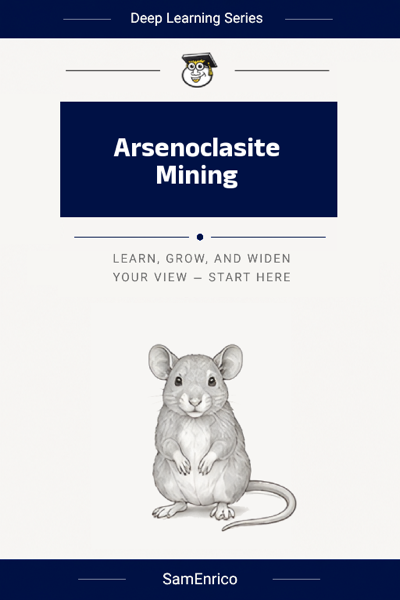
Arsenoclasite Mining
A Coursebook on Arsenoclasite Mining
A Coursebook on Arsenoclasite Mining
Formats
About this book
Free sample
Chapter 1: The Red Menace...–- The hammer fell with a dull crack, splitting the dull gray matrix to reveal a flash of crimson inside. The miner squinted, brushed away the dust, and exposed a cluster of crystals that looked like droplets of dried blood trapped in stone. He had seen red minerals before—hematite, cinnabar, perhaps even garnet—but this was different. The crystals were translucent, almost waxy, with a color that shifted from orange-red to deep brown-red as he tilted them toward the light of his headlamp. He dropped the sample into his ore bag, unaware that he was holding one of the most paradoxical substances on Earth: a mineral that could build batteries or destroy nerves, that could generate wealth or poison a watershed for generations.
That mineral was arsenoclasite. And this book is about the impossible choice it forces upon us.The Discovery That Changed Nothing (At First)In 1931, the Swedish mineralogist Gustaf Flink was examining specimens from the famous Långban iron-manganese mine in Värmland, Sweden. Långban was already legendary among mineral collectors—over 300 mineral species had been identified there, dozens of them unique to the locality. Flink thought he had found another phosphate mineral, similar to the already-known gatehouseite. But his chemical analysis told a different story.
The crystals contained no phosphorus. Instead, they held manganese, arsenic, and oxygen in a ratio that did not match any known species. He named it arsenoklasit (later anglicized to arsenoclasite) from the Greek arsenikon (arsenic) and klasis (fracture), a nod to its perfect cleavage—the way it splits along flat planes like a deck of cards.The discovery was announced in a brief paper in the journal Geologiska Föreningens i Stockholm Förhandlingar. It caused no headlines. No mining companies rushed to invest.
At the time, manganese was a bulk commodity used primarily in steelmaking, and arsenic was a dangerous impurity that smelters tried to avoid. A manganese mineral containing arsenic was not a resource; it was a nuisance. Flink's samples went into museum drawers. A few collectors acquired specimens for their beauty—the deep red…
This is the end of the free sample. Get the eBook to keep going. Buy now
Contents
- Chapter 1
- Chapter 2
- Chapter 3
- Chapter 4
- Chapter 5
- Chapter 6
- Chapter 7
- Chapter 8
- Chapter 9
- Chapter 10
- Chapter 11
- Chapter 12
Details
- Author
- Maloney Christia
- Publisher
- SamEnrico
- Language
- English
- Genre
- Non-Fiction, Informative, Educational
- Released
- 2026-05-11
- Pages (approx.)
- 150
- Available as
- eBook, Audiobook

Read better in the ZLOADR app
Your eBooks on your phone or tablet. Sign in with your SamEnrico account and start reading.
More by Maloney Christia
 The Remote Work Rest ProtocolMaloney Christia$11.99
 Plant Based Skin Health GuideMaloney Christia$11.99
 Self Hypnosis Induction Techniques GuideMaloney Christia$11.99
 Meeting Role AssignmentMaloney Christia$11.99
 Theodore Roosevelt Conservation PresidentMaloney Christia$11.99
 Frozen Horizons: The Viking Quest for the Northwest PassageMaloney Christia$11.99
 Crown of the Storm: How a Teenage Queen Outmaneuvered EuropeMaloney Christia$11.99
 Brazil Green Tax GuideMaloney Christia$12.99
 30 Day Marketing SprintMaloney Christia$12.99
 Understanding Cutis Laxa With Joint Laxity and Retarded DevelopmentMaloney Christia$17.99
 How to Become a Checker IMaloney Christia$11.99