
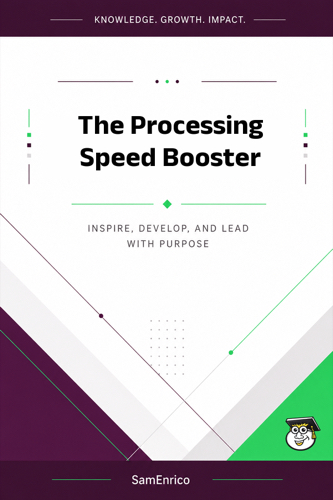
The Processing Speed Booster eBook
Increase the rate at which you can manipulate info
Increase the rate at which you can manipulate information mentally.
Formats
Free sample
Chapter 1: The Million-Dollar Pause--–- The meeting had been going perfectly. Sarah, a thirty-two-year-old product director at a fast-growing tech company, had prepared for weeks. She knew her numbers. She knew her market. She knew her competitors.
She had rehearsed her pitch until it felt like a song she’d sung a thousand times. But then, in the final five minutes, the CEO asked a question she had not anticipated.–- “Sarah, if we pull the trigger on this feature next quarter instead of this quarter, what happens to our customer retention curve over the following six months? And show your work—walk me through the trade-offs in real time.”–- The room went quiet. Twelve executives turned to look at her. Sarah knew the data.
She had reviewed the retention spreadsheet that morning. She knew that retention dropped 8% when feature releases were delayed by a quarter. She knew that customer acquisition cost increased by 15% when retention fell below a certain threshold. She knew the launch window for the marketing campaign. She had all the pieces.–- But she could not put them together fast enough.–- She tried to hold the retention number (8%) in her head while simultaneously calculating the acquisition cost increase (15% on a $500 CPA meant $75) while also factoring in the six-month curve (which required remembering a trend line from a chart she had seen three hours ago) while also considering the CEO’s implicit question about opportunity cost.
Her mental workspace—her working memory—had four slots. She was trying to juggle six variables. Something had to drop.–- What dropped was her ability to speak coherently. She paused. She said “um.” She started a sentence, stopped, and started again.
The pause stretched from one second to three seconds to five seconds. In that silence, the CEO did not see a thoughtful analyst weighing options. He saw someone who did not know her product. He moved on to the next person.–- Sarah did not lose her job that day. But she lost something worse: the perception of competence.
And in a technology company where perception drives promotion, that five-second pause cost her the lead role on the company’s flagship project. The role went to a colleague who, by Sarah’s own admission, knew less about the data but could manipulate it faster under pressure.–- Sarah’s story is not uncommon. It happens in boardrooms, emergency rooms, courtrooms, classrooms, and living rooms. It happens every time you know the answer but cannot assemble the pieces quickly enough to express it. It happens when you freeze.
When you forget what you were about to say. When you reread the same sentence three times. When you stare at a spreadsheet and feel your brain turn to cotton.–- These moments are not failures of intelligence. They are not failures of preparation. They are failures of processing speed—specifically, the ability to manipulate information mentally, in real time, under social or time pressure.–- The good news—and the entire reason this book exists—is that processing speed is not a fixed trait.
It is a trainable skill. And the transformation begins with understanding one simple, powerful, life-changing distinction.The Distinction That Changes Everything–- Most people believe that thinking involves two steps: you learn something, and then you remember it. If you cannot answer a question quickly, you assume you forgot the answer. You assume the problem is storage or retrieval.–- This is wrong.–- The real bottleneck for almost all high-stakes thinking is not memory recall. It is mental manipulation.
And these two operations—recall and manipulation—are as different as parking a car and racing a car. Both involve a vehicle. Both involve movement. But they require entirely different skills.–- Let me prove this to you with a thirty-second experiment. Do not skip this.
The single biggest insight of this book is hidden inside this exercise.–- The Recall vs. Manipulation Test–- Step 1 (Recall): What is your home address? Your full street address, including city and zip code. Do not look it up. Just recall it.
Got it? That probably took you two or three seconds. You retrieved a stored memory and delivered it unchanged. This is pure recall.–- Step 2 (Manipulation): Take that same address. Now reverse the order of every word and number in the address.
If your address were “123 Main Street, Springfield, 98765,” you would reverse to “56789, Springfield, Street Main 321.” Do not write anything down. Do not use your fingers. Do it entirely in your head.–- How did that feel? For almost everyone, Step 2 takes five to twenty times longer than Step 1. Some people cannot do it at all without external aids.
But here is the crucial realization: you did not forget your address. You recalled it instantly in Step 1. The difficulty in Step 2 was not memory—it was manipulation. You had to hold the address in working memory, transform its structure, inhibit the original order from interfering, and produce a new sequence. That is a different cognitive operation entirely.–- This is the core skill this book trains.Defining Mental Manipulation–- Mental manipulation is the ability to take raw information, hold it in your awareness, and change its form—in real time, without external aids—through one or more of the following operations:–- Synthesis: Combining separate pieces of information into a new whole.
Example: Seeing customer churn data, acquisition cost data, and feature release dates, then realizing they form a causal chain that no single report shows.–- Calculation: Transforming numbers through arithmetic, percentages, ratios, or comparisons. Example: “If this $47 item is 30% off and I have a $10 coupon, what is the final price?”–- Reordering: Changing the sequence, priority, or structure of items. Example: Mentally sorting a ten-item to-do list by urgency rather than by the order in which the tasks arrived.–- Comparison: Holding two or more items simultaneously and evaluating their differences, similarities, or relative value. Example: “Which of these three job offers is best when I balance salary, commute, and growth potential?”–- Transformation: Changing the representational format. Example: Converting a paragraph of text into a bulleted list, a verbal argument into a logical syllogism, or a spreadsheet column into a mental trend line.–- Every time you freeze, hesitate, or feel that frustrating sense of “I know this but I cannot put it together fast enough,” you are experiencing a manipulation bottleneck.
And the solution is not to learn more information. The solution is to learn how to manipulate the information you already have.Your Brain’s Hidden Architecture–- To understand why manipulation is slow and how to speed it up, you need a simple mental model of how your brain handles information. This model—which we will use throughout the book—draws on decades of cognitive science research, but it can be explained in two sentences and a metaphor.–- Your brain has two memory systems:–- Long-term memory (LTM) is like a hard drive. It is vast, permanent, and slow to access. Everything you have ever learned lives here: your mother’s face, the capital of France, how to tie your shoes, the lyrics to songs you have not heard in a decade.…
This is the end of the free sample. Get the eBook to keep going. Buy now
About this book
Details
- Author
- Mackey Tillie
- Publisher
- SamEnrico
- Language
- English
- Genre
- Non-Fiction, Self-Help
- Released
- 2026-06-07
- Pages (approx.)
- 145
- Available as
- eBook, Audiobook

Read better in the ZLOADR app
Your eBooks on your phone or tablet. Sign in with your SamEnrico account and start reading.
More by Mackey Tillie
 Child Loss Photography MemoryMackey Tillie$11.99
 Nipping Negotiation AnchorsMackey Tillie$11.99
 Daily Sobriety Maintenance ManualMackey Tillie$11.99
 HIIT Periodization GuideMackey Tillie$11.99
 Funeral Planning With PurposeMackey Tillie$11.99
 The Quiet Professional Confidence CourseMackey Tillie$11.99
 No Kids Divorce RecoveryMackey Tillie$11.99
 The Windward Crown: How the Dutch Ruled the WavesMackey Tillie$11.99
 The Storming of the Yuan: Kublai Khan's Last Stand at XiangyangMackey Tillie$11.99
 How to Produce Motor Vehicle TowingMackey Tillie$11.99
 How to Produce Laser EquipmentMackey Tillie$11.99
 A Collector's Handbook to the Riley 1300Mackey Tillie$11.99
You may also like
 Hong Kong Handover 1997Dunn Johnnie$11.99
 Zumba For Postnatal Recovery CourseNeal Christian$11.99
 Zumba for BeginnersLadner Nikia$11.99
 YouTube Comment Mining GuideHumes Pandora$12.99
 Worry Box MeditationCarlin Rudy$11.99
 Workplace Stress MeditationNguyen Lynn$11.99
 Workplace Stress and Sleep RepairHawley Ivory$11.99
 Workplace Perfectionism CureDelaney Jeffry$11.99
 Workplace Injustice Anger GuideWallen Isabelle$11.99
 Work Addiction and Burnout LinkGreenwood Ester$11.99
 Women in Yoga and WellnessBeattie Galina$11.99
 Women in Stand Up ComedyChun Evangeline$11.99