
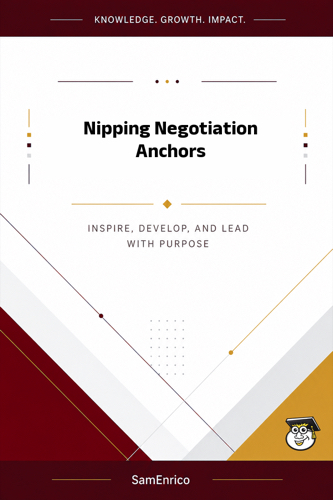
Non-FictionBusiness BriefAnchoring
Nipping Negotiation Anchors
Teaches countering first offers using principled s
Teaches countering first offers using principled standards not emotion.
Formats
About this book
Free sample
Chapter 1: The $41,435 Gorilla--–- The number arrived on a Tuesday afternoon, embedded in a three-page PDF that took less than four seconds to download. The buyer—a twenty-nine-year-old procurement specialist with seven years of experience and a recent certification in strategic sourcing—read the figure once, then again, then set down his coffee. $41,435. The vendor had quoted $41,435 for a piece of industrial equipment that, according to every internal estimate, should have cost between $32,000 and $36,000. The buyer knew the number was wrong.
He knew it was arbitrary. He knew, because he had been trained in cognitive biases during his MBA program, that he should simply ignore it and respond with his own counter-offer based on market data.He could not ignore it.For the next three weeks, every conversation, every email, every internal meeting circled back to $41,435. The vendor refused to budge from the number. The buyer refused to pay it. But notice what had happened: the buyer was now negotiating against $41,435, not for his own $32,000 to $36,000 target.
The anchor had done its work. It had shifted the entire frame of the negotiation. The buyer was no longer asking, "What is this equipment worth?" He was asking, "How do I get them down from $41,435?"This is the invisible trap. And it catches everyone.The Experiment You Cannot Unlearn In 1974, the psychologists Amos Tversky and Daniel Kahneman conducted a simple experiment that would change how we understand human judgment. They built a wheel of fortune—not a sophisticated one, but a crude device painted with numbers from 0 to 100.
The wheel was rigged. It would stop on either 10 or 65, no matter how hard or softly it was spun. The researchers then gathered a group of University of Oregon students and asked them to spin the wheel. After the wheel stopped, each student was asked a question: "What percentage of the United Nations' member nations are African?"The students who saw the wheel stop on 10 guessed an average of 25 percent. The students who saw the wheel stop on 65 guessed an average of 45 percent.Let that land.
A completely random, obviously arbitrary number—produced by a rigged wheel that the students had just spun themselves—shifted their estimates by…
This is the end of the free sample. Get the eBook to keep going. Buy now
Contents
- Chapter 1
- Chapter 2
- Chapter 3
- Chapter 4
- Chapter 5
- Chapter 6
- Chapter 7
- Chapter 8
- Chapter 9
- Chapter 10
- Chapter 11
- Chapter 12
Details
- Author
- Mackey Tillie
- Publisher
- SamEnrico
- Language
- English
- Genre
- Non-Fiction, Business Brief, Anchoring
- Released
- 2026-06-10
- Pages (approx.)
- 137
- Available as
- eBook, Audiobook

Read better in the ZLOADR app
Your eBooks on your phone or tablet. Sign in with your SamEnrico account and start reading.
More by Mackey Tillie
 Child Loss Photography MemoryMackey Tillie$11.99
 Daily Sobriety Maintenance ManualMackey Tillie$11.99
 HIIT Periodization GuideMackey Tillie$11.99
 Funeral Planning With PurposeMackey Tillie$11.99
 The Processing Speed BoosterMackey Tillie$11.99
 The Quiet Professional Confidence CourseMackey Tillie$11.99
 No Kids Divorce RecoveryMackey Tillie$11.99
 The Windward Crown: How the Dutch Ruled the WavesMackey Tillie$11.99
 The Storming of the Yuan: Kublai Khan's Last Stand at XiangyangMackey Tillie$11.99
 How to Produce Motor Vehicle TowingMackey Tillie$11.99
 How to Produce Laser EquipmentMackey Tillie$11.99
 A Collector's Handbook to the Riley 1300Mackey Tillie$11.99
You may also like
 Hong Kong Handover 1997Dunn Johnnie$11.99
 Zumba For Postnatal Recovery CourseNeal Christian$11.99
 Zumba for BeginnersLadner Nikia$11.99
 YouTube Comment Mining GuideHumes Pandora$12.99
 Worry Box MeditationCarlin Rudy$11.99
 Workplace Stress MeditationNguyen Lynn$11.99
 Workplace Stress and Sleep RepairHawley Ivory$11.99
 Workplace Perfectionism CureDelaney Jeffry$11.99
 Workplace Injustice Anger GuideWallen Isabelle$11.99
 Work Addiction and Burnout LinkGreenwood Ester$11.99
 Women in Yoga and WellnessBeattie Galina$11.99
 Women in Stand Up ComedyChun Evangeline$11.99