
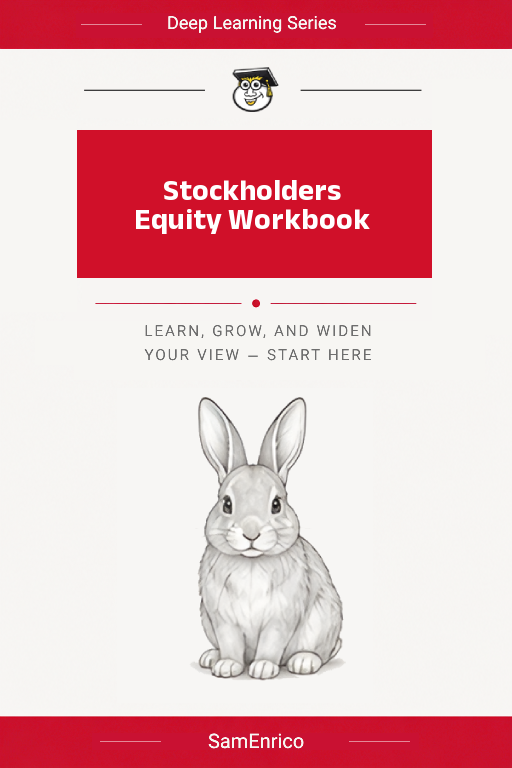
Stockholders Equity Workbook
Calculate retained earnings, treasury stock, and a
Calculate retained earnings, treasury stock, and additional paid in capital. Apply formulas to stock issuance, dividends, and splits.
Formats
About this book
Free sample
Chapter 1: The Equity Mirror--–- Imagine standing before a full-length mirror that reflects not your face, but the financial soul of a corporation. On the left side, you see everything the company owns—its cash, buildings, inventory, and patents. On the right side, you see debts and obligations. But somewhere in the middle, often overlooked, is a residual figure that represents ownership, risk, and ultimately, value. That figure is stockholders' equity.
It is the accounting equivalent of asking: "If we sold everything and paid everyone we owe, what would remain for the owners?"For most students and professionals, equity accounting feels abstract, legalistic, and disconnected from real decision-making. Terms like "additional paid-in capital" sound like bureaucratic filler. "Retained earnings" seems like a savings account that never gets touched. "Treasury stock" conjures images of gold bullion locked in a vault. This chapter dismantles those misconceptions.
By the time you finish these pages, you will see equity as a dynamic scoreboard of corporate decisions—financings, buybacks, dividends, and retained profits—each transaction leaving a visible mark on the balance sheet.More importantly, this chapter establishes the permanent reference tools you will use throughout this workbook. Every subsequent chapter will refer back to the master table you build here. No concept will be re-explained from scratch. By the end of Chapter 12, you will have a single, integrated understanding of stockholders' equity that matches what the top ten best-selling accounting books teach, but with far less repetition and far more hands-on application.1.1 Debt Versus Equity: The Fundamental Distinction Before recording a single journal entry, you must understand why equity exists at all. A corporation raises money in two primary ways: debt and equity.
Debt involves borrowing. The lender receives a legal promise of repayment, usually with interest, and has no ownership claim beyond that contract. Equity involves selling ownership shares. Shareholders are not creditors; they are residual claimants.Key differences that drive accounting rules:Repayment obligation: Debt must be repaid on a specific schedule. Equity has no repayment date.
Shareholders get their money back only if they sell their shares to someone else or if the company liquidates.Legal claim…
This is the end of the free sample. Get the eBook to keep going. Buy now
Contents
- Chapter 1
- Chapter 2
- Chapter 3
- Chapter 4
- Chapter 5
- Chapter 6
- Chapter 7
- Chapter 8
- Chapter 9
- Chapter 10
- Chapter 11
- Chapter 12
Details
- Author
- Escalante Leda
- Publisher
- SamEnrico
- Language
- English
- Genre
- Non-Fiction, Student's Shortcut, Equity Accounting
- Released
- 2026-06-01
- Pages (approx.)
- 156
- Available as
- eBook, Audiobook

Read better in the ZLOADR app
Your eBooks on your phone or tablet. Sign in with your SamEnrico account and start reading.
More by Escalante Leda
 Career Transition for IntrovertsEscalante Leda$11.99
 Curse Of The Child Star MythEscalante Leda$11.99
 Fiverr Order Management WorkbookEscalante Leda$11.99
 Assertiveness When DatingEscalante Leda$11.99
 UK VAT Penalties and Appeals First Month GuideEscalante Leda$11.99
 Scott Peterson Interrogation TapesEscalante Leda$11.99
 Letting Go Of ResentmentEscalante Leda$11.99
 Couples Therapy Stress GuideEscalante Leda$11.99
 Citation Rules Exam Prep ManualEscalante Leda$11.99
 The Puppet Masters of Wall Street: How the Fed Secretly Shaped the 2008 CrisisEscalante Leda$11.99
 Storm Over the Dunes: The Art of War in the DesertEscalante Leda$11.99
 The Glass Ceiling: How One Leak Exposed the World’s Most Secretive CompanyEscalante Leda$11.99