
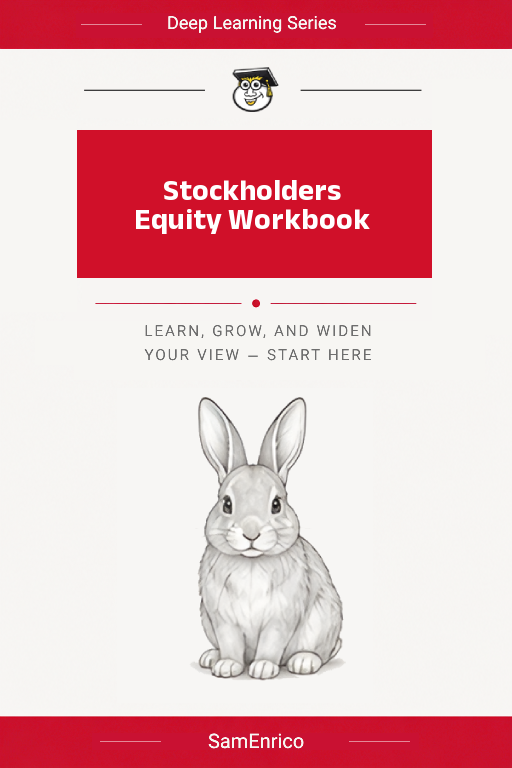
Non-FictionStudent's ShortcutEquity Accounting
Stockholders Equity Workbook eBook
Calculate retained earnings, treasury stock, and a
Calculate retained earnings, treasury stock, and additional paid in capital. Apply formulas to stock issuance, dividends, and splits.
Formats
Free sample
Chapter 1: The Equity Mirror--–- Imagine standing before a full-length mirror that reflects not your face, but the financial soul of a corporation. On the left side, you see everything the company owns—its cash, buildings, inventory, and patents. On the right side, you see debts and obligations. But somewhere in the middle, often overlooked, is a residual figure that represents ownership, risk, and ultimately, value. That figure is stockholders' equity.
It is the accounting equivalent of asking: "If we sold everything and paid everyone we owe, what would remain for the owners?"For most students and professionals, equity accounting feels abstract, legalistic, and disconnected from real decision-making. Terms like "additional paid-in capital" sound like bureaucratic filler. "Retained earnings" seems like a savings account that never gets touched. "Treasury stock" conjures images of gold bullion locked in a vault. This chapter dismantles those misconceptions.
By the time you finish these pages, you will see equity as a dynamic scoreboard of corporate decisions—financings, buybacks, dividends, and retained profits—each transaction leaving a visible mark on the balance sheet.More importantly, this chapter establishes the permanent reference tools you will use throughout this workbook. Every subsequent chapter will refer back to the master table you build here. No concept will be re-explained from scratch. By the end of Chapter 12, you will have a single, integrated understanding of stockholders' equity that matches what the top ten best-selling accounting books teach, but with far less repetition and far more hands-on application.1.1 Debt Versus Equity: The Fundamental Distinction Before recording a single journal entry, you must understand why equity exists at all. A corporation raises money in two primary ways: debt and equity.
Debt involves borrowing. The lender receives a legal promise of repayment, usually with interest, and has no ownership claim beyond that contract. Equity involves selling ownership shares. Shareholders are not creditors; they are residual claimants.Key differences that drive accounting rules:Repayment obligation: Debt must be repaid on a specific schedule. Equity has no repayment date.
Shareholders get their money back only if they sell their shares to someone else or if the company liquidates.Legal claim: Creditors have priority over assets. Shareholders receive whatever remains after creditors are paid in full. This is the "residual" nature of equity.Tax treatment: Interest on debt is tax-deductible. Dividends to shareholders are not.Control: Debt holders generally have no voting rights. Common shareholders elect the board of directors and vote on major corporate actions.Why this matters for accounting: Every equity transaction must be tracked separately from debt because the legal rights and obligations are fundamentally different.
Confusing the two is one of the most common errors in financial accounting. A loan payable is a liability. Common stock is equity. They never mix.Workbook Exercise 1.1 (Classification Drill): Below is a list of seven financing transactions. For each, indicate whether it creates debt or equity.
Answers are at the end of this chapter.A bank lends $1 million to the corporation, secured by a building.Investors pay $500,000 for 10,000 shares of common stock.The corporation issues preferred shares that pay a fixed 6% dividend but have no maturity date.A supplier provides $100,000 of inventory on 30-day payment terms.The corporation issues bonds payable due in 10 years.Existing shareholders reinvest $200,000 of dividends to purchase additional shares.A venture capital firm provides $2 million in exchange for 40% of the company's common stock.1.2 The Equity Section: Four Core Accounts Every corporation's balance sheet shows stockholders' equity as a distinct section, typically broken into four main accounts. Memorize these now because every chapter that follows will reference them.Common Stock: This account records the par value or stated value of issued shares. Par value is a legal artifact—often 0.01or0.01 or 0.01or1 per share—that has almost no relationship to market value. Its primary purpose is to define legal capital (the minimum amount that cannot be distributed as dividends). When a company issues shares, the par value portion goes into Common Stock.
Anything received above par goes into the next account.Additional Paid-In Capital (APIC): This is the excess over par value that investors pay when they buy shares directly from the corporation. If par value is 1pershareandaninvestorpays1 per share and an investor pays 1pershareandaninvestorpays20 per share, APIC receives $19 per share. APIC also accumulates certain adjustments from treasury stock transactions and stock dividends. In this workbook, we treat APIC as a single master account that you will track using the APIC Master Template introduced in Chapter 5.Retained Earnings (RE): This represents the cumulative net income that the corporation has earned over its entire life, minus all dividends declared. Retained earnings is not cash.
It is an accounting measure of profits that have been reinvested in the business or simply not yet distributed. A common mistake is to assume that large retained earnings means large cash balances. It does not. The cash may have been spent on buildings, inventory, or paying down debt.Treasury Stock: When a corporation buys back its own shares from investors, those shares become treasury stock. Treasury stock is a contra-equity account, meaning it carries a debit balance (unlike normal equity accounts which have credit balances).
It reduces total stockholders' equity. Treasury shares have no voting rights and do not receive dividends. They can be reissued later or retired.Visual Reference (Equation Form):Total Stockholders' Equity = Common Stock + APIC + Retained Earnings – Treasury Stock Note the minus sign before Treasury Stock. This is the only equity component that reduces total equity.Workbook Exercise 1.2 (Account Identification): For each transaction below, identify which of the four equity accounts is affected and whether it increases or decreases.a. The company issues 1,000 shares of 1parcommonstockfor1 par common stock for 1parcommonstockfor15 per share.b.
The company reports net income of 500,000fortheyear.c.Thecompanybuysback500ofitsownsharesfor500,000 for the year. c. The company buys back 500 of its own shares for 500,000fortheyear.c.Thecompanybuysback500ofitsownsharesfor20 per share.d. The company declares and pays a cash dividend of 50,000.e.Investorsexercisestockoptions,paying50,000. e.
Investors exercise stock options, paying 50,000.e.Investorsexercisestockoptions,paying10 per share when par value is $1.1.3 Authorized, Issued, and Outstanding: The Share Lifecycle One of the most confusing distinctions for new learners is the difference between authorized, issued, and outstanding shares. These three numbers are rarely equal.Authorized shares: The maximum number of shares the corporation is legally permitted to issue, as stated in its corporate charter. Authorized shares can be increased only by shareholder vote. Most corporations authorize far more shares than they initially issue to preserve flexibility for future financings, employee stock plans, and acquisitions.Issued shares: The number of shares that have actually been sold or given to shareholders. Issued shares include both shares held by outside investors and shares held by the corporation itself as treasury stock.
Once a share is issued, it remains issued forever unless formally retired.Outstanding shares: The number of shares currently held by outside investors (the public, institutional investors, employees). Outstanding shares exclude treasury shares. This is the number used to calculate earnings per share (EPS) and dividends per share.The Master Formula (used throughout this workbook):Shares Outstanding = Shares Issued – Treasury Shares Why this formula appears in multiple chapters: You will use this formula in Chapter 6 (treasury stock transactions), Chapter…
This is the end of the free sample. Get the eBook to keep going. Buy now
About this book
Details
- Author
- Escalante Leda
- Publisher
- SamEnrico
- Language
- English
- Genre
- Non-Fiction, Student's Shortcut, Equity Accounting
- Released
- 2026-06-01
- Pages (approx.)
- 156
- Available as
- eBook, Audiobook

Read better in the ZLOADR app
Your eBooks on your phone or tablet. Sign in with your SamEnrico account and start reading.
More by Escalante Leda
 Career Transition for IntrovertsEscalante Leda$11.99
 Curse Of The Child Star MythEscalante Leda$11.99
 Fiverr Order Management WorkbookEscalante Leda$11.99
 Assertiveness When DatingEscalante Leda$11.99
 UK VAT Penalties and Appeals First Month GuideEscalante Leda$11.99
 Scott Peterson Interrogation TapesEscalante Leda$11.99
 Letting Go Of ResentmentEscalante Leda$11.99
 Couples Therapy Stress GuideEscalante Leda$11.99
 Citation Rules Exam Prep ManualEscalante Leda$11.99
 The Puppet Masters of Wall Street: How the Fed Secretly Shaped the 2008 CrisisEscalante Leda$11.99
 Storm Over the Dunes: The Art of War in the DesertEscalante Leda$11.99
 The Glass Ceiling: How One Leak Exposed the World’s Most Secretive CompanyEscalante Leda$11.99
You may also like
 Hong Kong Handover 1997Dunn Johnnie$11.99
 Zumba For Postnatal Recovery CourseNeal Christian$11.99
 Zumba for BeginnersLadner Nikia$11.99
 YouTube Comment Mining GuideHumes Pandora$12.99
 Worry Box MeditationCarlin Rudy$11.99
 Workplace Stress MeditationNguyen Lynn$11.99
 Workplace Stress and Sleep RepairHawley Ivory$11.99
 Workplace Perfectionism CureDelaney Jeffry$11.99
 Workplace Injustice Anger GuideWallen Isabelle$11.99
 Work Addiction and Burnout LinkGreenwood Ester$11.99
 Women in Yoga and WellnessBeattie Galina$11.99
 Women in Stand Up ComedyChun Evangeline$11.99