
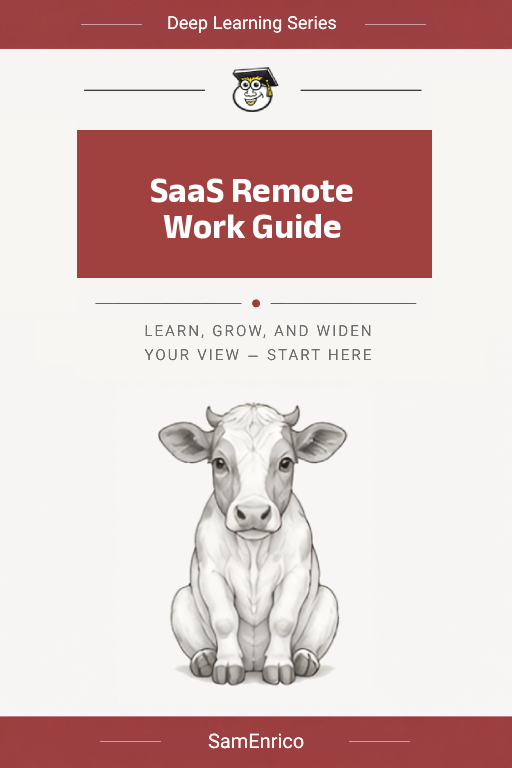
SaaS Remote Work Guide eBook
Analyze distributed workforce enablement software
Analyze distributed workforce enablement software for async collaboration and productivity tracking.
Formats
Free sample
Chapter 1: The Virtual Commute--–- In 2020, the world’s knowledge workers conducted an experiment no boardroom would have approved. Without warning, planning, or budget, hundreds of millions of employees were told to take their laptops and go home. The office closed on Friday; on Monday, they logged in from kitchen tables, bedroom corners, and basement offices. The experiment was called “remote work,” and by most surface-level metrics, it succeeded. Companies stayed operational, products shipped, and customers were served.
But beneath that veneer of success, something insidious took root. The physical commute—the train, the bus, the drive through traffic—did not disappear. It was merely replaced by a new, more exhausting commute: the endless procession of back-to-back Zoom calls, the Slack ping that arrived before you could finish your coffee, and the calendar Tetris that stretched from 8 a.m. to 6 p.m. with barely a bathroom break in between.
This chapter diagnoses that hidden cost, introduces the framework for escaping it, and makes the case that the future of distributed work depends not on better video conferencing but on its deliberate, strategic reduction.The Zoom Hangover: A Medical Condition in All but Name The term “Zoom fatigue” entered the lexicon sometime in 2020, but it was always too gentle a phrase for what people were experiencing. Fatigue suggests tiredness—the kind you recover from with a good night’s sleep. What millions of distributed workers actually suffered was closer to a cognitive hangover: a persistent, low-grade malaise characterized by fuzzy thinking, irritability, and a deep aversion to yet another video call. The author of this book has personally witnessed engineering directors who could debug production outages at 2 a.m. without breaking a sweat reduced to mute, camera-off zombies by their fifth consecutive hour of back-to-back meetings.The scientific explanation for this phenomenon is straightforward but rarely discussed in management literature.
Video calls demand more cognitive processing than in-person conversations. Your brain must work harder to interpret facial expressions through pixelated compression, to reconcile the slight delay between audio and video, to process the fact that you are looking at your own face while also tracking seven other faces arranged in a grid, and to maintain the artificial eye contact required to appear engaged. Add to this the absence of the normal non-verbal cues that regulate conversation—the subtle lean forward that signals you want to speak, the glance away that indicates you are thinking—and you have a recipe for exhaustion.But the Zoom hangover is not merely a neurological curiosity. It is a business problem with measurable costs. A 2021 study of remote workers found that those with more than five hours of video calls per day reported significantly lower levels of creative thinking, problem-solving ability, and willingness to generate novel ideas.
Another study correlated high meeting volume with employee turnover, particularly among high performers who had options elsewhere. The pattern is unmistakable: organizations that treat video calls as the default interaction mechanism are systematically burning out their best people while suppressing the very innovation that supposedly justifies all those meetings.The Meeting Creep: How Synchronous Culture Colonized the Calendar Understanding how we arrived at this point requires a brief history lesson. The agile revolution, which began in software development and spread to virtually every knowledge work domain, was designed for co-located teams. The daily standup, the sprint planning session, the retrospective, the backlog refinement meeting—every ceremony in the agile playbook assumes that team members are physically present in the same room, or at least available during overlapping hours. When those same ceremonies were translated to remote work without modification, the results were predictable.
Fifteen-minute standups became thirty-minute calls as people waited for late joiners and suffered through audio issues. Sprint planning, already a cognitively demanding exercise, stretched into multi-hour marathons as distributed teams struggled to align on priorities without the benefit of whiteboards and side conversations.The author has a name for this phenomenon: meeting creep. It is the tendency for synchronous interactions to expand in both frequency and duration when teams lack the discipline or tooling to work asynchronously. Meeting creep is not caused by malicious managers or lazy employees. It is caused by the absence of an alternative.
When the only way to get an answer is to ask live, people schedule meetings. When the only way to align on a decision is to discuss in real time, people schedule meetings. When the only way to feel connected to colleagues is to see their faces, people schedule meetings. And then they schedule follow-up meetings to discuss what was decided in the first meeting.The economics of meeting creep are devastating. Consider a team of eight people earning an average fully-loaded cost of 100perhour.Asingleone−hourmeetingcoststheorganization100 per hour.
A single one-hour meeting costs the organization 100perhour.Asingleone−hourmeetingcoststheorganization800 in labor, not counting the context-switching cost before and after. If that team has just ten such meetings per week—a conservative estimate for many organizations—the weekly cost exceeds 8,000.Overayear,thatismorethan8,000. Over a year, that is more than 8,000.Overayear,thatismorethan400,000 spent on meetings alone, before any actual work has been done. And that calculation excludes the highest cost of all: the work that never happens because everyone is too busy in meetings to do it.Distributed Versus Remote: A Distinction That Matters Before proceeding further, the author must introduce a distinction that will shape the remainder of this book. The term “remote work” is often used as a catch-all for any work done outside a traditional office, but this imprecision hides a critical difference.
Remote work, as defined in this book, refers to working from home or another non-office location while remaining tethered to the headquarters time zone, calendar, and synchronous expectations. Remote workers are still expected to be available during “business hours,” still attend meetings at specific times, and still operate largely as if the office were merely a Zoom window away.Distributed work, by contrast, refers to teams whose members work from different locations and, crucially, different time zones, with no expectation of synchronous availability. Distributed teams embrace asynchronous communication as their default mode, using meetings only for carefully selected purposes. A distributed team might have members in New York, London, Bangalore, and Sydney. No single time zone can accommodate a daily standup for all of them, so they do not try.
They document, they record, they write, and they review—but they rarely gather live.This book is primarily about distributed work, because distributed work is the future. Remote work, as defined above, is merely a transitional state—an awkward halfway house between the office and true distribution. Organizations that remain in the remote work model will eventually either return to the office or evolve into distributed teams. Those that attempt to stay in the middle will suffer the worst of both worlds: the isolation of working from home combined with the synchronous pressure of office culture. Throughout this book, the term “distributed” will be used to encompass both scenarios for simplicity, but readers should understand that the tools and techniques described here are most powerful when applied to teams that have genuinely embraced asynchronous defaults.Case Study: The Startup That Collapsed Under Meeting Creep To make these concepts concrete…
This is the end of the free sample. Get the eBook to keep going. Buy now
About this book
Details
- Author
- Forrester Suzanna
- Publisher
- SamEnrico
- Language
- English
- Genre
- Non-Fiction, Forecast & Outlook, Remote SaaS
- Released
- 2026-06-01
- Pages (approx.)
- 149
- Available as
- eBook, Audiobook

Read better in the ZLOADR app
Your eBooks on your phone or tablet. Sign in with your SamEnrico account and start reading.
More by Forrester Suzanna
 Pet Cremation MemorialsForrester Suzanna$11.99
 Grief Informed Burnout Recovery WorkbookForrester Suzanna$11.99
 Saint Augustine BishopForrester Suzanna$11.99
 Body Image and Chronic Illness GuideForrester Suzanna$11.99
 Hand Gestures Interpretation GuideForrester Suzanna$11.99
 Merlin's Last Song: The Enchanter’s Forgotten MelodyForrester Suzanna$11.99
 Arbitration SpecialistForrester Suzanna$11.99
 Later Visual Content PlannerForrester Suzanna$12.99
 Understanding Kozlowski–celermajer SyndromeForrester Suzanna$17.99
 A Beginners Guide to Downfall (Volume 1)Forrester Suzanna$11.99