
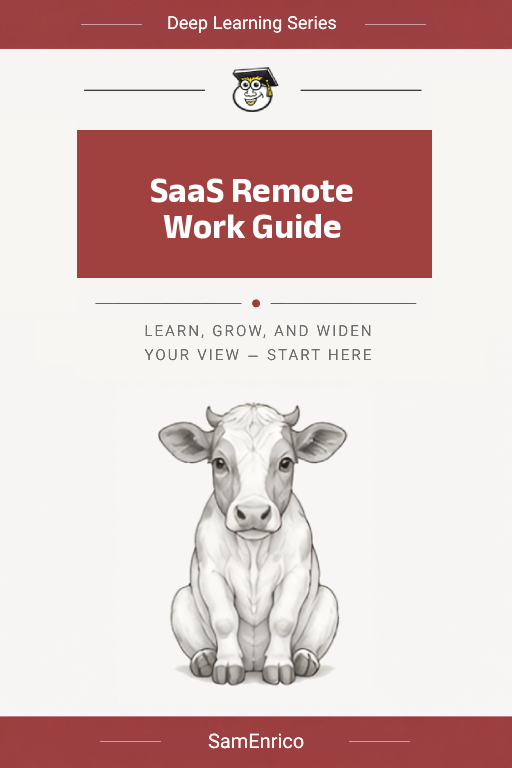
SaaS Remote Work Guide
Analyze distributed workforce enablement software
Analyze distributed workforce enablement software for async collaboration and productivity tracking.
Formats
About this book
Free sample
Chapter 1: The Virtual Commute--–- In 2020, the world’s knowledge workers conducted an experiment no boardroom would have approved. Without warning, planning, or budget, hundreds of millions of employees were told to take their laptops and go home. The office closed on Friday; on Monday, they logged in from kitchen tables, bedroom corners, and basement offices. The experiment was called “remote work,” and by most surface-level metrics, it succeeded. Companies stayed operational, products shipped, and customers were served.
But beneath that veneer of success, something insidious took root. The physical commute—the train, the bus, the drive through traffic—did not disappear. It was merely replaced by a new, more exhausting commute: the endless procession of back-to-back Zoom calls, the Slack ping that arrived before you could finish your coffee, and the calendar Tetris that stretched from 8 a.m. to 6 p.m. with barely a bathroom break in between.
This chapter diagnoses that hidden cost, introduces the framework for escaping it, and makes the case that the future of distributed work depends not on better video conferencing but on its deliberate, strategic reduction.The Zoom Hangover: A Medical Condition in All but Name The term “Zoom fatigue” entered the lexicon sometime in 2020, but it was always too gentle a phrase for what people were experiencing. Fatigue suggests tiredness—the kind you recover from with a good night’s sleep. What millions of distributed workers actually suffered was closer to a cognitive hangover: a persistent, low-grade malaise characterized by fuzzy thinking, irritability, and a deep aversion to yet another video call. The author of this book has personally witnessed engineering directors who could debug production outages at 2 a.m. without breaking a sweat reduced to mute, camera-off zombies by their fifth consecutive hour of back-to-back meetings.The scientific explanation for this phenomenon is straightforward but rarely discussed in management literature.
Video calls demand more cognitive processing than in-person conversations. Your brain must work harder to interpret facial expressions through pixelated compression, to reconcile the slight delay between audio and video, to process the fact that you are looking at your own…
This is the end of the free sample. Get the eBook to keep going. Buy now
Contents
- Chapter 1
- Chapter 2
- Chapter 3
- Chapter 4
- Chapter 5
- Chapter 6
- Chapter 7
- Chapter 8
- Chapter 9
- Chapter 10
- Chapter 11
- Chapter 12
Details
- Author
- Forrester Suzanna
- Publisher
- SamEnrico
- Language
- English
- Genre
- Non-Fiction, Forecast & Outlook, Remote SaaS
- Released
- 2026-06-01
- Pages (approx.)
- 149
- Available as
- eBook, Audiobook

Read better in the ZLOADR app
Your eBooks on your phone or tablet. Sign in with your SamEnrico account and start reading.
More by Forrester Suzanna
 Pet Cremation MemorialsForrester Suzanna$11.99
 Grief Informed Burnout Recovery WorkbookForrester Suzanna$11.99
 Saint Augustine BishopForrester Suzanna$11.99
 Body Image and Chronic Illness GuideForrester Suzanna$11.99
 Hand Gestures Interpretation GuideForrester Suzanna$11.99
 Merlin's Last Song: The Enchanter’s Forgotten MelodyForrester Suzanna$11.99
 Arbitration SpecialistForrester Suzanna$11.99
 Later Visual Content PlannerForrester Suzanna$12.99
 Understanding Kozlowski–celermajer SyndromeForrester Suzanna$17.99
 A Beginners Guide to Downfall (Volume 1)Forrester Suzanna$11.99