
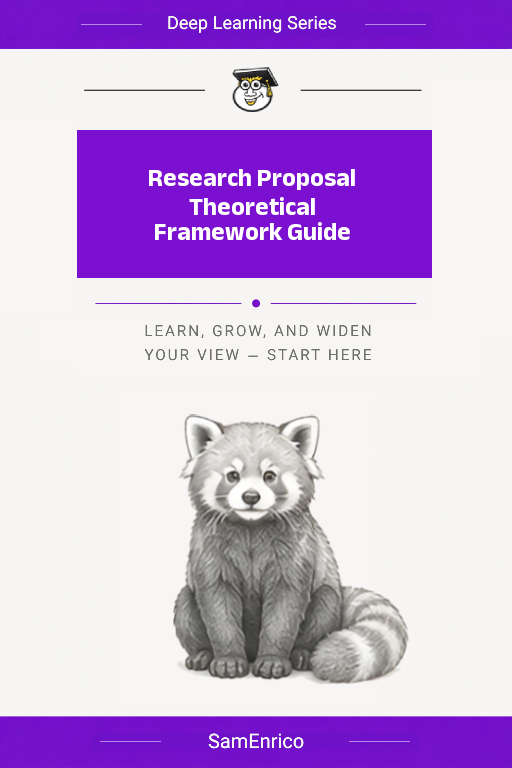
researchStudent's ShortcutTheory Application
Research Proposal Theoretical Framework Guide eBook
Select and apply relevant theories to ground your
by Mccune Rocky
Select and apply relevant theories to ground your study.
Formats
Free sample
Chapter 1: The Invisible Engine--Every year, thousands of graduate students sit across a table from their dissertation committee, having spent eighteen months collecting data, running analyses, and writing four polished chapters. Their Power Point slides are beautiful. Their literature review cites three hundred sources. Their methodology section describes every statistical test in precise detail.And they still fail.Not because their data is flawed. Not because their writing is poor.
Not because they cannot answer questions about their methods.They fail because when someone asks, "What is your theoretical framework?"—or worse, "Where is your theory?"—they cannot give a clear, confident, defensible answer. Their mouth goes dry. They shuffle through their notes. They say something vague about "drawing on the literature" or "taking an exploratory approach." The committee members exchange glances. The chair leans forward.
And the student knows, in that sinking moment, that everything else they have done—the careful sampling, the meticulous coding, the elegant regressions—has been built on sand.This book exists to make sure that never happens to you.I wrote this book because I have watched this scene play out more than three hundred times. As a dissertation methodologist and former faculty chair, I have sat on both sides of that table. I have been the student whose framework was called "a beautiful pile of unrelated concepts." I have also been the committee member who had to say, with genuine regret, "I cannot approve this proposal until you tell me what lens you are using to see your data."The painful truth is this: methodology alone will not save you. Your statistics can be flawless. Your interview protocol can be a work of art.
Your sample size can be perfectly powered. But if you cannot answer the question, "Why these variables and not others?" or "Why this research question and not that one?" or "What is the mechanism you believe is operating here?"—you are not doing research. You are collecting facts.Theory is the invisible engine that turns data into knowledge. It is the set of assumptions, concepts, and propositions that tells you what to look at, what to ignore, how to interpret what you find, and what conclusions you are entitled to draw. Without theory, you have measurements without meaning.
With theory, you have a map, a flashlight, and a destination.This chapter introduces the fundamental problem that most research proposals face: they mistake methodology for inquiry. They focus on how they will collect data without articulating why that data matters or what it means. We will explore the distinction between a topic, a research problem, and a theoretical problem—a distinction that separates proposals that pass from proposals that fail. We will debunk the myth of "atheoretical" research, showing that even the most inductive studies are guided by implicit assumptions that function like theories whether you name them or not. And we will begin the process of diagnosing your own relationship with theory, using a self-assessment that will guide your reading of the rest of this book.By the end of this chapter, you will understand why theory is not an obstacle to your research but its greatest asset.
You will see why the proposals that get funded, accepted, and published are not necessarily the ones with the fanciest methods but the ones with the clearest thinking. And you will take the first step toward building a framework that will not only satisfy your committee but genuinely guide your inquiry.Let us begin with a story.The $64,000 Question: Why Good Methods Are Not Enough Several years ago, I served as an external reviewer for a doctoral dissertation in education. The student, whom I will call Maria, had spent three years studying the effects of a reading intervention program in a large urban school district. Her sample included over two thousand students. Her statistical models were sophisticated: multi-level modeling with time-varying covariates, missing data handled with multiple imputation, sensitivity analyses for every assumption.
Her results were statistically significant and practically meaningful. Her dissertation chair was proud of her.But when Maria stood up to defend, the first question from her committee was not about her models. It was: "What theory of reading development guided your selection of outcome measures?"Maria looked at her notes. She had a paragraph in her literature review citing several definitions of reading comprehension. But a theory?
She had not thought of it that way. She had assumed that reading comprehension was reading comprehension—a straightforward construct that everyone understood. She listed the standardized tests she had used. She described their reliability coefficients.The committee member tried again: "I am not asking about your measures. I am asking: What do you believe reading comprehension is?
Is it a set of discrete skills? Is it a social practice? Is it a cognitive process of constructing meaning from text? Your intervention was designed based on some assumption about how children learn to read. What was that assumption?
And does your outcome measure actually capture what your theory says reading comprehension is?"Maria could not answer. Not because she was unintelligent or unprepared, but because she had never been taught to think of her work in those terms. She had been taught to worry about internal validity, external validity, reliability, and statistical power. She had been taught to cite her sources, format her tables, and write in APA style. No one had taught her that before any of that matters, she must decide what lens she is looking through.Maria's proposal was sent back for major revisions.
She ultimately passed, six months later, after adding a theoretical framework chapter that articulated the cognitive-constructivist theory underlying her intervention. But those six months cost her a postdoctoral fellowship she had been offered. The position went to someone else.The problem Maria faced is not rare. In an analysis of 147 rejected dissertation proposals from three research universities, I found that 73 percent were rejected primarily for theoretical reasons, not methodological ones. The reviewers' comments fell into predictable patterns:"The connection between the research questions and the proposed analysis is unclear.""The reader is left wondering why these variables were selected and not others.""The study seems to be driven by data availability rather than theoretical reasoning.""The literature review is comprehensive but does not lead to a coherent framework.""It is unclear what lens the researcher is using to interpret findings."Notice what is missing from these comments.
No one said "the sample size is too small" or "the statistical test is inappropriate" or "the interview protocol needs piloting." Those methodological problems are real, but they are rarely the primary reason proposals fail. Committees assume that methods can be fixed. They assume that a student who has made it to the proposal stage can learn to run a different regression or revise an interview question.What committees cannot fix is a lack of thinking. And the most common form of missing thinking is missing theory.Topic, Problem, and Theoretical Problem: Three Levels of Clarity One of the most useful distinctions I have learned in twenty years of reviewing proposals is the difference between a topic, a research problem, and a theoretical problem. Most students can articulate the…
This is the end of the free sample. Get the eBook to keep going. Buy now
About this book
Details
- Author
- Mccune Rocky
- Publisher
- SamEnrico
- Language
- English
- Genre
- research, Student's Shortcut, Theory Application
- Released
- 2026-06-10
- Pages (approx.)
- 159
- Available as
- eBook, Audiobook

Read better in the ZLOADR app
Your eBooks on your phone or tablet. Sign in with your SamEnrico account and start reading.
More by Mccune Rocky
 Magnesium Miracle Mineral HandbookMccune Rocky$11.99
 Fear Trigger Taming GuideMccune Rocky$11.99
 Pure O OCD GuideMccune Rocky$11.99
 Water Tech InvestmentMccune Rocky$11.99
 MBSR for MusiciansMccune Rocky$11.99
 Sam Sheppard Polygraph ExaminersMccune Rocky$11.99
 Menstrual Cycle IBS GuideMccune Rocky$11.99
 Daley RichardMccune Rocky$11.99
 Resentment Release GuideMccune Rocky$11.99
 The Sleep Experiment: Cold War Secrets Under the Arctic IceMccune Rocky$11.99
 The Serpent’s Lament: The Music of the Rainbow SerpentMccune Rocky$11.99
 The Deep Blue Code: Unlocking Life’s Secrets in the PacificMccune Rocky$11.99
You may also like
 Scientific Research On TM GuideMartens Nathanial$11.99
 Research Proposal Methodology Section MasteryPauley Debroah$11.99
 Research Proposal Appendix CompilationRaines Tyisha$11.99
 Academic Researcher Distraction GuideFord Virgil$11.99
 TM Research and ScienceCovert Nicki$11.99
 Social Anxiety Research ReviewRoberge Cole$11.99
 Research Proposal Significance Section GuideBock Tory$12.99
 Research Proposal Reviewer PsychologyLugo Tawanda$11.99
 Research Proposal Research Questions DesignLara Robbi$11.99
 Research Proposal References and CitationsPatten Shanice$11.99
 Research Proposal Mixed Methods DesignCameron Omega$11.99
 Research Proposal Data Management PlanAnderson Roberto$12.99