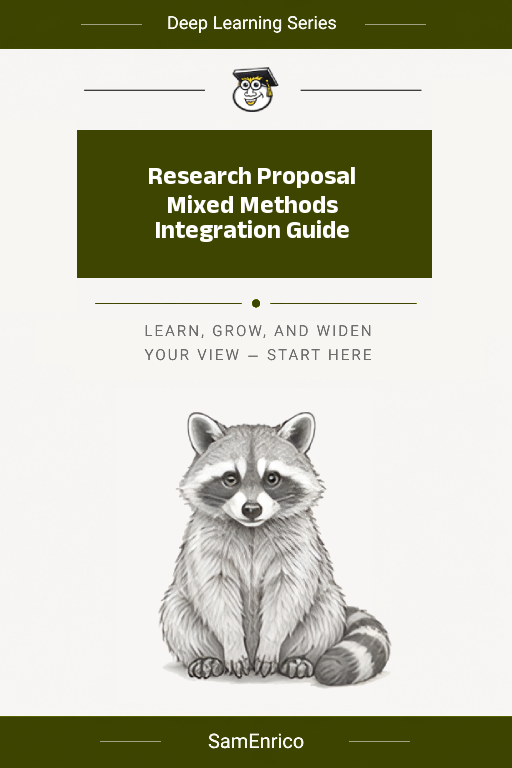
Research Proposal Mixed Methods Design
Integrate qualitative and quantitative approaches
Integrate qualitative and quantitative approaches coherently.
Formats
About this book
Free sample
Chapter 1: Beyond Either-Or--–- The most dangerous sentence in research methodology is not “I don’t know” or “My hypothesis was wrong.” It is this: “I’ll just do both.”On its surface, the phrase seems harmless, even sensible. If qualitative research provides depth and quantitative research provides breadth, why not simply combine them? Why not interview a few people and survey a few hundred, then call it a day?Because “just doing both” is not mixed methods. It is the methodological equivalent of putting a bicycle wheel on a car and expecting the vehicle to fly. The parts may be fine individually, but they were never designed to work together.
And without intentional design, they never will.This chapter dismantles the “just do both” fallacy and replaces it with something far more useful: a philosophical and practical framework for deciding whether mixed methods is necessary, what form it should take, and how to defend that decision to skeptical reviewers. By the end of this chapter, you will understand the three worldviews that make integration possible, the five-question test that separates necessary mixing from decorative mixing, and the single most important shift in thinking that separates successful proposals from rejected ones.The False Promise of Methodological Pluralism In the 1970s and 1980s, the social sciences were consumed by the “Paradigm Wars.” On one side stood the positivists, who argued that only measurable, quantifiable data could produce legitimate knowledge. On the other side stood the interpretivists, who insisted that meaning, context, and subjective experience were irreducible to numbers. Each side accused the other of producing incomplete, distorted, or simply wrong accounts of social reality.For nearly two decades, doctoral students were forced to choose allegiance. Journals published only pure studies.
Methodological pluralism—the idea that different methods could coexist—was considered intellectually weak, a failure of philosophical nerve.Then came the pragmatists.Pragmatism, as articulated by Charles Sanders Peirce, William James, and later John Dewey, offered a radical proposition: the truth of a belief is measured by its practical consequences. In research terms, this means: choose methods based on their utility for answering your research…
This is the end of the free sample. Get the eBook to keep going. Buy now
Contents
- Chapter 1
- Chapter 2
- Chapter 3
- Chapter 4
- Chapter 5
- Chapter 6
- Chapter 7
- Chapter 8
- Chapter 9
- Chapter 10
- Chapter 11
- Chapter 12
Details
- Author
- Cameron Omega
- Publisher
- SamEnrico
- Language
- English
- Genre
- research, Student's Shortcut, Mixed Methods
- Released
- 2026-06-11
- Pages (approx.)
- 158
- Available as
- eBook, Audiobook

Read better in the ZLOADR app
Your eBooks on your phone or tablet. Sign in with your SamEnrico account and start reading.
More by Cameron Omega
 MRI Claustrophobia MockCameron Omega$11.99
 Joshua Tree Lost CasesCameron Omega$11.99
 The Medicare and Self Esteem GuideCameron Omega$11.99
 Sector for VeteransCameron Omega$11.99
 Cross Elasticity ApplicationsCameron Omega$11.99
 Wrestling Weight Cut HypnosisCameron Omega$11.99
 Deepening Script TechniquesCameron Omega$11.99
 Anansi Weaves the World: The Spider’s Cosmic TrickeryCameron Omega$11.99
 Tracy Chapman: Fast Car, Far HorizonsCameron Omega$11.99
 The Sword and the Scroll: Charlemagne's Carolingian GambitCameron Omega$11.99
 How to Become a Buckle-wire InserterCameron Omega$11.99
 Growing DioonCameron Omega$11.99