
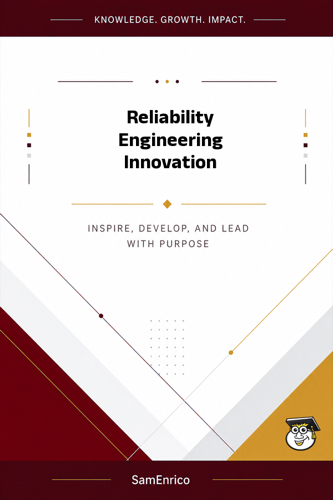
Non-FictionSelf-HelpReliability Engineering
Reliability Engineering Innovation eBook
Apply creative approaches to failure prevention an
by Wiles Mandi
Apply creative approaches to failure prevention and system longevity.
Formats
Free sample
Chapter 1: The Paradox of Success--–- On January 28, 1986, the space shuttle Challenger broke apart seventy-three seconds after launch, killing all seven astronauts aboard. The investigation that followed revealed something that disturbed engineers far more than any single technical flaw: the warning signs had been abundant. For years, O-ring erosion had been documented. For years, engineers had raised concerns. For years, the shuttle had flown successfully despite these known issues.
That unbroken string of successes was not evidence of robustness. It was evidence of accumulated risk, hidden beneath the surface of apparent reliability.–- This is the paradox of success. When systems operate without failure for extended periods, a dangerous form of complacency sets in. Assumptions about robustness go untested. Minor degradation goes unnoticed.
Safety margins that were once questioned become accepted as adequate. And then, often without warning, the system fails catastrophically.–- The paradox is not limited to space shuttles. It appears in every domain where reliability matters: commercial aviation, nuclear power, medical devices, automotive manufacturing, and software systems. The very absence of failure becomes the enemy of continued reliability. Success breeds the illusion of invulnerability.
And that illusion, more than any technical limitation, is what ultimately leads to disaster.The Anatomy of a Paradox–- To understand why success breeds failure, we must first understand how engineers think about reliability. The classical definition, which we will carry throughout this book, is straightforward: reliability is the probability that a system will perform its intended function without failure for a specified period under specified conditions. This is a statistical concept, grounded in probability distributions, life data analysis, and confidence intervals. It is also, as we shall see, dangerously incomplete.–- The paradox of success emerges from the gap between statistical reliability and genuine resilience. A system can have a high statistical probability of surviving a given mission while simultaneously being fragile in ways that statistics cannot capture.
Consider the space shuttle again. The statistical models predicted a failure rate of approximately one in one hundred thousand launches. The actual failure rate, based on the full history of the program, was closer to one in fifty launches of the first shuttle, and one in sixty-seven across the fleet. The statistical models were off by three orders of magnitude.–- Why? Because the models assumed that past performance predicted future performance.
They assumed that the absence of failure indicated the absence of risk. They did not account for the slow accumulation of degradation, the gradual normalization of deviance, or the systematic biases that lead engineers to underestimate hazards they have not personally witnessed.–- This is the first lesson of the paradox: statistical reliability is backward-looking. It tells you how often failures have occurred. It does not tell you how close you have come to failure without crossing the threshold. And as any engineer knows, the distance between "never failed" and "failed catastrophically" can be terrifyingly small.Reliability Versus Resilience–- Before we go further, we need to clarify two terms that will appear throughout this book.
I will use them in specific ways, and keeping them distinct will save considerable confusion later.–- Reliability, in this book, means the probability of failure-free operation over time. It is a metric. It can be calculated, predicted, and demonstrated through testing. A reliable system is one that rarely fails. This is necessary but not sufficient for long-term success.–- Resilience means the ability to absorb, recover from, and adapt to disturbances.
A resilient system learns from failures when they occur, uses that learning to improve, and returns to operation stronger than before. Resilience is not a metric. It is a capability. It emerges from culture, design choices, and feedback loops.–- The relationship between reliability and resilience is often misunderstood. Many engineers assume that high reliability automatically implies high resilience.
This is false. A system can be highly reliable under normal conditions while being brittle when conditions change. Conversely, a system can be resilient even when its baseline reliability is modest, because it recovers quickly and learns from every failure.–- The space shuttle was reliable by the standards of its era. It was also catastrophically not resilient. When the O-ring problem finally manifested as a failure, the system had no ability to recover.
There was no backup. There was no adaptive response. There was only disaster.–- The Boeing 737 MAX offers a more recent example. The aircraft was statistically reliable in the sense that its engines rarely failed and its airframe rarely cracked. But when the MCAS software received faulty sensor data, the system was not resilient.
Pilots had not been trained on the system. The redundancy was homogeneous (both sensors came from the same supplier with the same vulnerability). And the organizational culture punished engineers who raised concerns. The result was two crashes and 346 deaths.–- Resilience is not the opposite of reliability. It is the complement.
A complete reliability strategy pursues both: high probability of failure-free operation and the capability to learn from failures when they inevitably occur.The Taxonomy of Failure–- Not all failures are created equal. To move beyond the paradox of success, we need a vocabulary for distinguishing different types of failures. The taxonomy that follows will appear throughout this book, and I will refer back to it frequently.–- Early-life failures occur shortly after a system begins operation. They are typically caused by manufacturing defects, assembly errors, or design flaws that escape detection during production. These failures are sometimes called "infant mortality" because they appear early and then decrease in frequency over time.
A high rate of early-life failures usually indicates problems in quality control or production processes. We will explore how to detect and eliminate these failures in Chapters 3, 4, and 7.–- Random failures occur unpredictably throughout the useful life of a system. They are caused by external events, environmental stressors, or random variations in materials. The failure rate during this period is approximately constant, which makes it mathematically convenient to model using the exponential distribution. Random failures are the hardest to eliminate because they are not driven by a single predictable mechanism.
Instead, they require strategies like redundancy (Chapter 6) and stress testing (Chapter 7).–- Wear-out failures occur after a system has operated for an extended period. They are caused by fatigue, corrosion, wear, or other aging mechanisms. These failures increase in frequency over time, following patterns that can often be modeled with the Weibull distribution (Chapter 3). Wear-out failures are predictable in aggregate, even if individual failure times vary. This predictability enables preventive maintenance strategies (Chapter 10).–- This taxonomy is useful, but it has limitations.
It describes failures that have already occurred. It does not tell you how to prevent them. It does not tell you how to learn from them. And it certainly does not solve the paradox of success, because the taxonomy itself is backward-looking.–- What the taxonomy does provide is a shared language. When an engineer says "infant mortality," everyone knows they mean early failures caused by manufacturing issues.
When a maintenance planner says "wear-out," everyone knows they mean aging mechanisms. This shared language is the foundation for the analytical tools we will develop in Part II.Productive Failure: Learning from Intelligent Mistakes–-…
This is the end of the free sample. Get the eBook to keep going. Buy now
About this book
Details
- Author
- Wiles Mandi
- Publisher
- SamEnrico
- Language
- English
- Genre
- Non-Fiction, Self-Help, Reliability Engineering
- Released
- 2026-06-11
- Pages (approx.)
- 145
- Available as
- eBook, Audiobook

Read better in the ZLOADR app
Your eBooks on your phone or tablet. Sign in with your SamEnrico account and start reading.
More by Wiles Mandi
 Two Sided Argument InfluenceWiles Mandi$11.99
 The Whole Grain Mediterranean DietWiles Mandi$11.99
 Self-Care as a Relapse ShieldWiles Mandi$11.99
 The Curiosity Over Certainty GuideWiles Mandi$11.99
 The Bone Carvers of Samarkand: Timur's Surgeons in the Shadow of ConquestWiles Mandi$11.99
 Continuous Improvement ManagerWiles Mandi$11.99
 YC African Startup Success StoriesWiles Mandi$12.99
 VAT Exemptions and Zero RatingWiles Mandi$12.99
 Understanding Trypanosomiasis, West AfricanWiles Mandi$17.99
You may also like
 Hong Kong Handover 1997Dunn Johnnie$11.99
 Zumba For Postnatal Recovery CourseNeal Christian$11.99
 Zumba for BeginnersLadner Nikia$11.99
 YouTube Comment Mining GuideHumes Pandora$12.99
 Worry Box MeditationCarlin Rudy$11.99
 Workplace Stress MeditationNguyen Lynn$11.99
 Workplace Stress and Sleep RepairHawley Ivory$11.99
 Workplace Perfectionism CureDelaney Jeffry$11.99
 Workplace Injustice Anger GuideWallen Isabelle$11.99
 Work Addiction and Burnout LinkGreenwood Ester$11.99
 Women in Yoga and WellnessBeattie Galina$11.99
 Women in Stand Up ComedyChun Evangeline$11.99