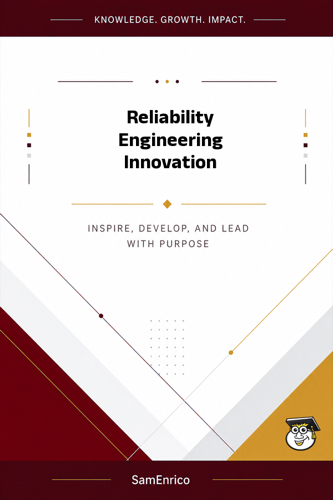
Reliability Engineering Innovation
Apply creative approaches to failure prevention an
by Wiles Mandi
Apply creative approaches to failure prevention and system longevity.
Formats
About this book
Free sample
Chapter 1: The Paradox of Success--–- On January 28, 1986, the space shuttle Challenger broke apart seventy-three seconds after launch, killing all seven astronauts aboard. The investigation that followed revealed something that disturbed engineers far more than any single technical flaw: the warning signs had been abundant. For years, O-ring erosion had been documented. For years, engineers had raised concerns. For years, the shuttle had flown successfully despite these known issues.
That unbroken string of successes was not evidence of robustness. It was evidence of accumulated risk, hidden beneath the surface of apparent reliability.–- This is the paradox of success. When systems operate without failure for extended periods, a dangerous form of complacency sets in. Assumptions about robustness go untested. Minor degradation goes unnoticed.
Safety margins that were once questioned become accepted as adequate. And then, often without warning, the system fails catastrophically.–- The paradox is not limited to space shuttles. It appears in every domain where reliability matters: commercial aviation, nuclear power, medical devices, automotive manufacturing, and software systems. The very absence of failure becomes the enemy of continued reliability. Success breeds the illusion of invulnerability.
And that illusion, more than any technical limitation, is what ultimately leads to disaster.The Anatomy of a Paradox–- To understand why success breeds failure, we must first understand how engineers think about reliability. The classical definition, which we will carry throughout this book, is straightforward: reliability is the probability that a system will perform its intended function without failure for a specified period under specified conditions. This is a statistical concept, grounded in probability distributions, life data analysis, and confidence intervals. It is also, as we shall see, dangerously incomplete.–- The paradox of success emerges from the gap between statistical reliability and genuine resilience. A system can have a high statistical probability of surviving a given mission while simultaneously being fragile in ways that statistics cannot capture.
Consider the space shuttle again. The statistical models predicted a failure rate of approximately one in one hundred thousand launches. The actual failure rate, based on the full history of the program, was…
This is the end of the free sample. Get the eBook to keep going. Buy now
Contents
- Chapter 1
- Chapter 2
- Chapter 3
- Chapter 4
- Chapter 5
- Chapter 6
- Chapter 7
- Chapter 8
- Chapter 9
- Chapter 10
- Chapter 11
- Chapter 12
Details
- Author
- Wiles Mandi
- Publisher
- SamEnrico
- Language
- English
- Genre
- Non-Fiction, Self-Help, Reliability Engineering
- Released
- 2026-06-11
- Pages (approx.)
- 145
- Available as
- eBook, Audiobook

Read better in the ZLOADR app
Your eBooks on your phone or tablet. Sign in with your SamEnrico account and start reading.
More by Wiles Mandi
 Two Sided Argument InfluenceWiles Mandi$11.99
 The Whole Grain Mediterranean DietWiles Mandi$11.99
 Self-Care as a Relapse ShieldWiles Mandi$11.99
 The Curiosity Over Certainty GuideWiles Mandi$11.99
 The Bone Carvers of Samarkand: Timur's Surgeons in the Shadow of ConquestWiles Mandi$11.99
 Continuous Improvement ManagerWiles Mandi$11.99
 YC African Startup Success StoriesWiles Mandi$12.99
 VAT Exemptions and Zero RatingWiles Mandi$12.99
 Understanding Trypanosomiasis, West AfricanWiles Mandi$17.99