
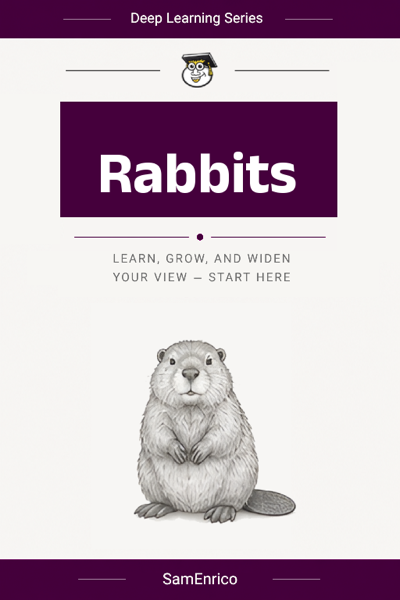
Non-FictionInformativeEducational
Rabbits eBook
A Coursebook on Rabbits
A Coursebook on Rabbits
Formats
Free sample
Chapter 1: The Eternal Trickster...--–- The rabbit does not announce itself. One moment you are walking a dewy English lane at dusk, and the next, a blur of brown and white vanishes into a hedge. The spell is cast not by the animal itself but by the space it leaves behind: the quivering leaf, the abruptly silent thrush, your own heart stumbling over a question you did not know you carried. What was that? You know, of course.
A rabbit. But the question lingers because the rabbit has never been merely a rabbit. It is a thief of gardens and a god of spring, a laboratory martyr and a child’s first friend, a symbol of cowardice and a survivor of continent-spanning invasions. No creature of comparable size has carried so much meaning on its small, twitching back. This book is an attempt to follow that vanishing blur—to catch the rabbit in all its contradictions, not to cage it but to understand why we have spent ten thousand years trying.The Animal That Refuses to Stay in Its Box If you walk into a bookstore looking for rabbits, you will be directed to two completely different sections.
In the children’s aisle, you will find Beatrix Potter’s Peter Rabbit in his little blue jacket, Margaret Wise Brown’s The Runaway Bunny, and countless board books where fluffy-tailed protagonists learn about sharing and feelings. In the agriculture or homesteading section, you will find Storey’s Guide to Raising Rabbits, Rearing Rabbits for Meat and Fur, and technical manuals on cage sanitation and weaning schedules. These two rabbits never meet. The Peter Rabbit of literature would be horrified by the New Zealand White hanging in a walk-in cooler. The homesteader, in turn, might roll their eyes at the idea of spending three hundred dollars on a spay surgery for a Netherland Dwarf named Mochi.This book is built on a simple, uncomfortable premise: both rabbits are real.
The same biological machinery that allows a wild cottontail to evade a hawk in a three-second sprint also allows a domestic doe to kindle twelve healthy kits in a nest box you built from scrap lumber. The same wide-set eyes that make a rabbit look “cute” to a human child also give that rabbit nearly 360-degree vision, because evolution designed it as prey, not a pet. And the same social intelligence that makes a rabbit a responsive companion also makes solitary confinement in a backyard hutch a form of slow cruelty. You cannot understand the rabbit by choosing one of these truths and ignoring the others. You can only understand it by holding all of them at once.This chapter, the first of twelve, lays the foundation for that holding.
We will trace the rabbit’s journey through human culture—from the cave paintings of Paleolithic Spain to the Tik Tok livestreams of house rabbits demanding treats. We will ask why this particular animal, of all the creatures humans have domesticated, has become such a powerful screen for our own hopes, fears, and contradictions. And we will arrive at a definition of the rabbit that is not a single answer but a framework: the rabbit as the eternal trickster—neither fully wild nor fully tame, neither god nor meal, but always, inconveniently, both.Before the Blue Jacket: Rabbits in the Ancient World Long before Beatrix Potter dressed a rabbit in a jacket, rabbits were already old in the human imagination. The European rabbit (Oryctolagus cuniculus) is native to the Iberian Peninsula, and the earliest known human representations of rabbits come from Spanish caves. At the Cueva de la Pileta in Málaga, Paleolithic paintings dating to 20,000 years ago include rabbits among the usual bestiary of bison, ibex, and deer.
But here is the crucial difference: the rabbits are not shown being hunted. They are shown multiplying. Scholars believe these images served fertility rituals, invoking the rabbit’s legendary fecundity to ensure the survival of the human band. The rabbit was not prey in these paintings; it was power.The classical world inherited this reverence. The Greeks, arriving on the Iberian Peninsula, were so astonished by the burrowing, breeding creatures that they named the land Hispania—from the Punic word for “hidden” or “burrow,” though the Romans later spun their own etymology linking it to span, meaning “scarcity” (of rabbits, ironically, because they were everywhere).
Greek naturalists like Aristotle classified rabbits with difficulty, noting their unusual reproductive habits but failing to place them correctly (a confusion that would persist for two thousand years, as we will see in Chapter 2). The Romans, more practical, took rabbits with them across their empire as a mobile protein source. They built enclosed warrens called leporaria and developed early breeding techniques. In Roman art, rabbits appear in two contradictory roles: as symbols of abundant life (they run through garden frescoes at Pompeii) and as emblems of the hunted (they twist in the jaws of hunting dogs in mosaic floors). This dual nature—life-giver and victim—is the oldest continuous thread in rabbit symbolism.But the trickster archetype emerged most clearly in the folklore of non-literate cultures, particularly in Africa and the Americas.
Among the Wolof and Fon peoples of West Africa, the hare (a close cousin to the rabbit, ecologically and symbolically) appears as a cunning, boundary-breaking figure who uses wit to defeat stronger predators. When enslaved Africans brought these stories to North America, the hare transformed into Br’er Rabbit, a trickster who outsmarts the wolf and the fox not through strength but through a combination of cleverness, lying, and an almost sociopathic willingness to exploit others’ vulnerabilities. These stories were survival manuals encoded as entertainment: when you are the weakest creature in the system, you survive by being the smartest and least trustworthy. Br’er Rabbit is not cute. He is dangerous.
And he wins.The Great Confusion: How the Rabbit Became Two Animals The seventeenth and eighteenth centuries saw a scientific and cultural bifurcation of the rabbit that has never fully healed. On one hand, naturalists began the slow, painful process of classifying rabbits correctly. On the other, artists and writers transformed rabbits into sentimental creatures of childhood and domesticity. These two rabbits diverged so completely that by the Victorian era, they had become almost different species—one biological, one literary.The biological rabbit struggled for taxonomic respect. As late as 1758, Carl Linnaeus classified the European rabbit under the genus Lepus, lumping it together with hares.
The error was understandable: rabbits and hares look similar, and both produce cecotropes (Chapter 2 will explain this strange digestive adaptation). But they are reproductively incompatible, behave differently, and occupy distinct ecological niches. It took another century of argument—including dissections, breeding experiments, and furious letters exchanged across national academies—to establish that rabbits belong to their own genus, Oryctolagus, from the Greek oryktes (digger) and lagos (hare). The name acknowledges what anyone who has watched a rabbit vanish into the earth already knows: the rabbit is defined by its relationship to the underground, to hiding, to the unseen.Meanwhile, the literary rabbit was undergoing an even stranger transformation. In medieval bestiaries, rabbits appeared as symbols of timidity and vulnerability—often literally trembling…
This is the end of the free sample. Get the eBook to keep going. Buy now
About this book
Details
- Author
- Hargrove Elvis
- Publisher
- SamEnrico
- Language
- English
- Genre
- Non-Fiction, Informative, Educational
- Released
- 2026-06-02
- Pages (approx.)
- 146
- Available as
- eBook, Audiobook

Read better in the ZLOADR app
Your eBooks on your phone or tablet. Sign in with your SamEnrico account and start reading.
More by Hargrove Elvis
 Self Esteem And Emotional DependencyHargrove Elvis$11.99
 The MBSR for Trauma GuideHargrove Elvis$11.99
 Legacy Visualization GuideHargrove Elvis$11.99
 Behavioral Addiction MindfulnessHargrove Elvis$11.99
 The Forbidden Summit: A Jesuit’s Love and the Lost Kingdom of the AndesHargrove Elvis$11.99
 Kali's Dance of Destruction: The Dark Goddess and the Demon KingHargrove Elvis$11.99
 Understanding HemophobiaHargrove Elvis$17.99
 How to Become a Classification ClerkHargrove Elvis$11.99
 E-Commerce Platform Market OutlookHargrove Elvis$12.99
 Employer-Respected Online Credential PrimerHargrove Elvis$12.99
You may also like
 Hong Kong Handover 1997Dunn Johnnie$11.99
 Zumba For Postnatal Recovery CourseNeal Christian$11.99
 Zumba for BeginnersLadner Nikia$11.99
 YouTube Comment Mining GuideHumes Pandora$12.99
 Worry Box MeditationCarlin Rudy$11.99
 Workplace Stress MeditationNguyen Lynn$11.99
 Workplace Stress and Sleep RepairHawley Ivory$11.99
 Workplace Perfectionism CureDelaney Jeffry$11.99
 Workplace Injustice Anger GuideWallen Isabelle$11.99
 Work Addiction and Burnout LinkGreenwood Ester$11.99
 Women in Yoga and WellnessBeattie Galina$11.99
 Women in Stand Up ComedyChun Evangeline$11.99