
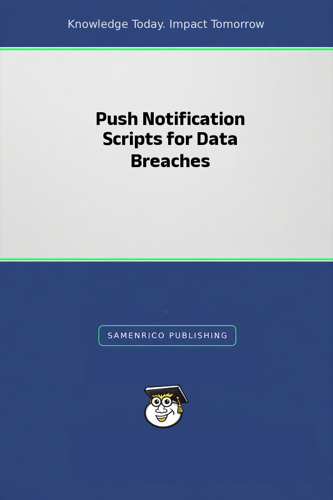
Push Notification Scripts for Data Breaches eBook
Alert customers through your mobile app after a da
by Linville Yan
Alert customers through your mobile app after a data leak using these urgent push notification templates.
Formats
Free sample
Chapter 1: The $8 Billion Mistake...--The email arrived at 9:47 AM on a Tuesday. It was short—barely two hundred words—and it began with the phrase that would haunt the company for the next three years: "We are writing to inform you of a security incident." The company had spent $12 million on its breach response plan. It had hired three law firms, two PR agencies, and a forensic accounting team. It had printed and mailed 147,000 physical letters at a cost of $1.47 per letter. And when the letters finally arrived, seven days after the breach was discovered, the company’s stock had already dropped 23 percent.
The CEO had already been fired. And the class-action lawsuit had already been filed.The problem was not the content of the letter. The content was legally flawless. It contained all five required sections: what happened, what data was involved, what the company was doing, what the customer could do, and who to contact for more information. The problem was that by the time the letter arrived, every single customer had already heard about the breach from someone else.
They had seen the headline on the morning news. They had read the thread on Reddit. They had received the text message from a friend who had seen the tweet from a security researcher. The company had lost control of the narrative not because it said the wrong thing, but because it said nothing at all for seven days.This chapter is about why the traditional breach notification letter—the five-paragraph artifact that has been the gold standard for two decades—is not just outdated but actively dangerous. It is about why push notifications have become the new front line of crisis communication, and why the first two hours after a breach are the most critical window in your entire incident response timeline.
And it is about the $8 billion mistake that companies keep making: treating breach notification as a compliance exercise rather than a human communication problem.The Anatomy of a Letter That Arrives Too Late To understand why breach letters fail, you first have to understand how they were designed. The modern data breach notification law traces its origins to California’s SB 1386, passed in 2002 and effective in 2003. That law, and the forty-seven state laws that followed it, was written in a pre-i Phone world. The notification requirements were modeled on other consumer disclosures—credit card terms and conditions, privacy policies, product recall notices—all of which assumed that written notice by mail was the gold standard. The logic was sound at the time: if you want to ensure that a person actually receives important information, you put it in a letter and send it to their home address.But the world changed.
Between 2007 and 2012, smartphone adoption in the United States went from 9 percent to over 50 percent. By 2020, the average American adult spent over four hours per day on their mobile device, and the average user unlocked their phone ninety-six times per day. The breach notification letter, meanwhile, remained unchanged. It still arrived in a physical mailbox, often ten days after a breach was discovered. It still looked like junk mail—a white envelope with a return address that the recipient did not recognize.
And it still assumed that the user would sit down, read carefully, and take methodical action in a calm state of mind.That assumption is false. By the time a breach letter arrives, the user has already experienced the breach in three distinct stages. First, there is the rumor stage. This begins within hours of the breach discovery, when a security researcher tweets about an "unauthorized access" or a journalist posts a "sources say" story. The user sees this and feels the first stirrings of anxiety.
Second, there is the confirmation stage. This occurs when the news breaks on major outlets—often twenty-four to forty-eight hours after discovery. The user now knows something bad has happened, but they do not know whether it affects them. They check their bank account. They change their password on the company’s app.
They post on social media asking if anyone else has been affected. Third, there is the resolution stage. This is when the company finally speaks—often five to ten days after discovery, when the legal team has approved the language and the letters have been printed. But by this point, the user has already formed their own narrative. They have already decided whether the company is competent or negligent.
The letter is not informing them; it is confirming what they already suspect.The Inbox Zero Principle for Crisis Management There is a concept in productivity literature called Inbox Zero, popularized by Merlin Mann in the mid-2000s. The idea is simple: every email is a decision. You either delete it, delegate it, respond to it, or defer it to a specific time. The goal is not to have zero emails; the goal is to have zero emails that are unresolved. The same principle applies to breach notifications.
Every user who receives a notification is making a decision: do I trust this company? Do I take action now, or do I wait? Do I delete this app forever?The mistake most companies make is treating the breach notification as the end of a process rather than the beginning of a conversation. They spend weeks perfecting the legal language of the letter, but they ignore the first seventy-two hours after discovery, when users are desperate for information. The Inbox Zero principle for crisis management has three components: acknowledge, assure, and act.
All within 140 characters.Acknowledge means you tell the user that something has happened. You do not need to have all the answers. You do not need to know exactly what data was taken or who is responsible. You simply need to validate the user’s experience. The worst possible response to a breach is silence, because silence is read as either incompetence or a cover-up.
The second worst response is a statement that is so vague and legalistic that it tells the user nothing.Assure means you tell the user that you are taking the incident seriously. You do not need to say "we are very sorry" (a phrase that can be construed as an admission of negligence in some jurisdictions). You need to say something that signals competence and urgency. This is where tone balancing becomes critical. Too alarming, and you trigger panic and unnecessary calls to your customer support center.
Too neutral, and users dismiss the notification as spam. The sweet spot is what crisis communication researchers call "calm urgency"—language that communicates that something serious has happened, but that there is a clear plan of action.Act means you give the user something to do. This is the most important and most overlooked component of breach notification. Users who are given a specific, simple, immediate action are significantly less likely to call customer support, less likely to post angry comments on social media, and more likely to retain trust in the company. The action must be one tap away.
It must be a deep link that opens directly to the password reset screen or the credit freeze portal. Every extra tap increases…
This is the end of the free sample. Get the eBook to keep going. Buy now
About this book
Details
- Author
- Linville Yan
- Publisher
- SamEnrico
- Language
- English
- Genre
- Non-Fiction, Crisis Management, App Communication
- Released
- 2026-06-08
- Pages (approx.)
- 137
- Available as
- eBook, Audiobook

Read better in the ZLOADR app
Your eBooks on your phone or tablet. Sign in with your SamEnrico account and start reading.
More by Linville Yan
 The Tripwire Funnel StrategyLinville Yan$11.99
 Workaholic Gratitude Practice GuideLinville Yan$11.99
 Burnout Prevention CoachingLinville Yan$11.99
 Tom Kite Consistent Legend MemoirLinville Yan$11.99Tom Kite Consistent Legend MemoirLinville Yan$11.99
 The Silk and Steel Affair: How a Spy Seduced the CIALinville Yan$11.99
 The Plague Doctor of the Silk Road: How a 19th-Century Healer Uncovered a Deadly SecretLinville Yan$11.99
 Ion ImplantationLinville Yan$11.99
 How to Start a Hobby in Make a MarionetteLinville Yan$11.99
 Lean Canvas Remote Workshop GuideLinville Yan$12.99
 Understanding Chylous AscitesLinville Yan$17.99