
Non-FictionInformativeEducational
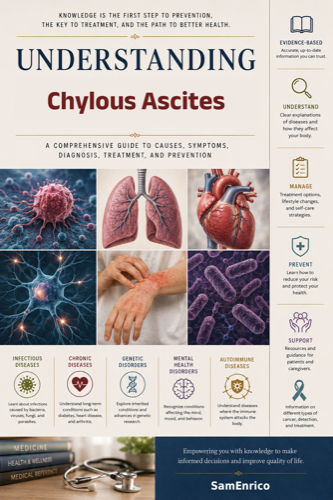
Understanding Chylous Ascites
This disease publication, published by SamEnrico,
by Linville Yan
This disease publication, published by SamEnrico, covers Understanding Chylous Ascites
Formats
About this book
Free sample
Chapter 1: The Milky Tap...--It was 3:00 AM when the emergency department called. The patient was a 47-year-old woman—let's call her Elena—who had been admitted three days earlier with what everyone assumed was decompensated cirrhosis. She had the classic look: distended abdomen, shifting dullness on exam, mild pedal edema, and a history of "social drinking" that her family whispered was more than social. The hepatology team had started diuretics. They had scheduled a paracentesis for the morning.
But Elena couldn't wait. Her respiratory rate had climbed to 32. Her oxygen saturation had dropped to 88% on room air. Her abdomen looked like she was carrying triplets at term.I walked into her room, and the first thing I noticed was not her breathing, not her distended belly, not the panicked look in her eyes. It was the syringe sitting on the bedside table.
The night nurse had already performed a diagnostic paracentesis—a wise move given the clinical deterioration. The syringe contained 15 m L of fluid. It was not straw-colored like typical cirrhotic ascites. It was not bloody like malignant ascites. It was milky.
Opaque. White as whole milk, but with a faint yellow tinge, like the cream that rises to the top of a fresh dairy bottle.I held the syringe up to the fluorescent light. The fluid didn't clear. "Chylous ascites," I said quietly, more to myself than to the nurse or the patient.Elena looked at me through half-closed eyes. "What does that mean?" she whispered.It was a fair question.
And the answer—the full answer—is what this book exists to provide.The Definition: What Exactly Is Chylous Ascites?At its simplest, chylous ascites is the accumulation of chyle—a milky, lipid-rich, lymphocyte-dense fluid—within the peritoneal cavity. But that definition, while accurate, does no justice to the clinical reality. Chyle is not just "fluid." It is the lifeblood of the immune system and the vehicle for dietary fat absorption. To lose chyle into the abdomen is to lose the ability to fight infection, to maintain nutrition, and to absorb the vitamins that keep our eyes, bones, blood, and nerves functioning.Let's start…
This is the end of the free sample. Get the eBook to keep going. Buy now
Contents
- Chapter 1
- Chapter 2
- Chapter 3
- Chapter 4
- Chapter 5
- Chapter 6
- Chapter 7
- Chapter 8
- Chapter 9
- Chapter 10
- Chapter 11
- Chapter 12
Details
- Author
- Linville Yan
- Publisher
- SamEnrico
- Language
- English
- Genre
- Non-Fiction, Informative, Educational
- Released
- 2026-05-06
- Pages (approx.)
- 160
- Available as
- eBook, Audiobook

Read better in the ZLOADR app
Your eBooks on your phone or tablet. Sign in with your SamEnrico account and start reading.
More by Linville Yan
 The Tripwire Funnel StrategyLinville Yan$11.99
 Workaholic Gratitude Practice GuideLinville Yan$11.99
 Burnout Prevention CoachingLinville Yan$11.99
 Tom Kite Consistent Legend MemoirLinville Yan$11.99Tom Kite Consistent Legend MemoirLinville Yan$11.99
 Push Notification Scripts for Data BreachesLinville Yan$11.99
 The Silk and Steel Affair: How a Spy Seduced the CIALinville Yan$11.99
 The Plague Doctor of the Silk Road: How a 19th-Century Healer Uncovered a Deadly SecretLinville Yan$11.99
 Ion ImplantationLinville Yan$11.99
 How to Start a Hobby in Make a MarionetteLinville Yan$11.99
 Lean Canvas Remote Workshop GuideLinville Yan$12.99
You may also like
 Hong Kong Handover 1997Dunn Johnnie$11.99
 Zumba For Postnatal Recovery CourseNeal Christian$11.99
 Zumba for BeginnersLadner Nikia$11.99
 YouTube Comment Mining GuideHumes Pandora$12.99
 Worry Box MeditationCarlin Rudy$11.99
 Workplace Stress MeditationNguyen Lynn$11.99
 Workplace Stress and Sleep RepairHawley Ivory$11.99
 Workplace Perfectionism CureDelaney Jeffry$11.99
 Workplace Injustice Anger GuideWallen Isabelle$11.99
 Work Addiction and Burnout LinkGreenwood Ester$11.99
 Women in Yoga and WellnessBeattie Galina$11.99
 Women in Stand Up ComedyChun Evangeline$11.99