
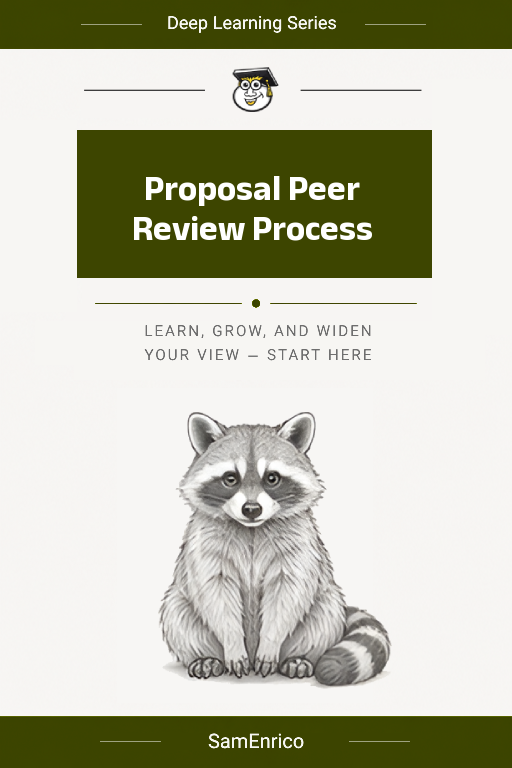
Proposal Peer Review Process
Exchange research proposals with peers for constru
by Land Tanner
Exchange research proposals with peers for constructive feedback including reviewing others' work to improve your own.
Formats
About this book
Free sample
Chapter 1: The Lonely Genius Trap--Most researchers believe that writing is a solitary act. They imagine the lone scholar, hunched over a laptop in a quiet library, emerging weeks later with a polished proposal that springs fully formed from their singular brilliance. This image is not only romanticized – it is professionally dangerous. The truth, revealed by decades of research on high-performing teams and confirmed by best-selling works like Adam Grant's Think Again and Elias's Get Funded, is that no proposal improves in isolation. The fastest way to fix your own broken argument is to read someone else's.
And yet, the fear of sharing a draft – of exposing half-formed ideas to a peer's critical eye – paralyzes even experienced researchers. This chapter dismantles that fear and replaces it with a counterintuitive superpower: the realization that you learn more by reviewing others than by defending your own work. Welcome to the Lonely Genius Trap, and welcome to the way out.The Myth of the Solitary Scholar Walk into any university office or corporate research lab, and you will find a familiar scene. A researcher stares at a proposal draft that has been edited seventeen times. The introduction feels flat.
The methodology section has a gap they cannot name. The specific aims blur together. They have read the document so many times that the words have lost all meaning. This is not a failure of intelligence or effort. It is a failure of perspective – and perspective is something no amount of solitary staring can provide.The Lonely Genius Trap operates on a seductive lie: that great ideas emerge from great minds working alone.
From Newton's apple to Einstein's thought experiments, Western culture has celebrated the individual breakthrough. But the actual process of research proposal development tells a different story. Every funded grant, every accepted journal article, every successful book proposal has passed through multiple pairs of eyes before reaching a funder or publisher. The difference between successful researchers and struggling ones is not the quality of their first drafts. It is the quality of their feedback networks.Consider the data.
A longitudinal study of NIH grant applicants found that proposals reviewed by at least three peers before submission had a…
This is the end of the free sample. Get the eBook to keep going. Buy now
Contents
- Chapter 1
- Chapter 2
- Chapter 3
- Chapter 4
- Chapter 5
- Chapter 6
- Chapter 7
- Chapter 8
- Chapter 9
- Chapter 10
- Chapter 11
- Chapter 12
Details
- Author
- Land Tanner
- Publisher
- SamEnrico
- Language
- English
- Genre
- Non-Fiction, Student's Shortcut, Peer Review, Feedback Guide
- Released
- 2026-05-30
- Pages (approx.)
- 160
- Available as
- eBook, Audiobook

Read better in the ZLOADR app
Your eBooks on your phone or tablet. Sign in with your SamEnrico account and start reading.
More by Land Tanner
 Mezzanine Debt Terms DatabaseLand Tanner$11.99
 LBO No Shop ClauseLand Tanner$11.99
 Mobile Keyboard Addiction GuideLand Tanner$11.99
 Bariatric Surgery Portion Control GuideLand Tanner$11.99
 Lactose Free Dessert Recipe CourseLand Tanner$11.99
 The Silent Depths: Solving the Mystery of the USS ScorpionLand Tanner$11.99
 Echoes of the Iron Curtain: The Radio War That Won the Cold WarLand Tanner$11.99
 How to Start a Potato Peeling (industrial) Business (Beginners Guide)Land Tanner$11.99
 HarmonicaLand Tanner$11.99
 AI Financial Data Validation GuideLand Tanner$12.99
 Understanding Cdg SyndromeLand Tanner$17.99