
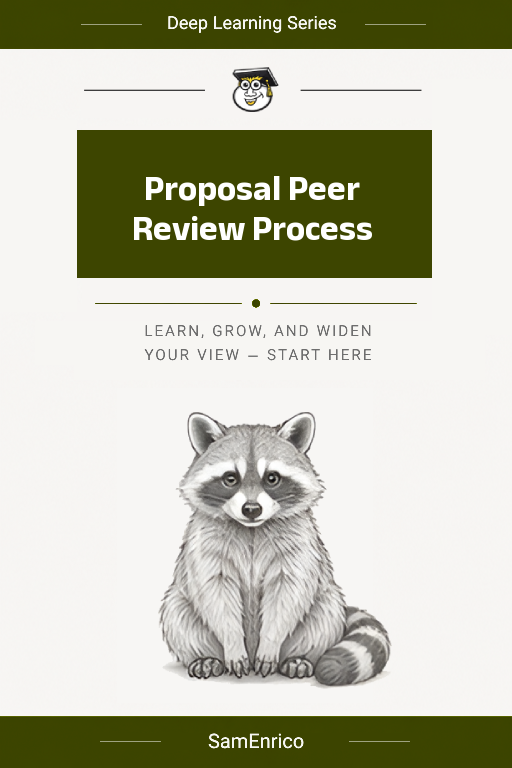
Proposal Peer Review Process eBook
Exchange research proposals with peers for constru
by Land Tanner
Exchange research proposals with peers for constructive feedback including reviewing others' work to improve your own.
Formats
Free sample
Chapter 1: The Lonely Genius Trap--Most researchers believe that writing is a solitary act. They imagine the lone scholar, hunched over a laptop in a quiet library, emerging weeks later with a polished proposal that springs fully formed from their singular brilliance. This image is not only romanticized – it is professionally dangerous. The truth, revealed by decades of research on high-performing teams and confirmed by best-selling works like Adam Grant's Think Again and Elias's Get Funded, is that no proposal improves in isolation. The fastest way to fix your own broken argument is to read someone else's.
And yet, the fear of sharing a draft – of exposing half-formed ideas to a peer's critical eye – paralyzes even experienced researchers. This chapter dismantles that fear and replaces it with a counterintuitive superpower: the realization that you learn more by reviewing others than by defending your own work. Welcome to the Lonely Genius Trap, and welcome to the way out.The Myth of the Solitary Scholar Walk into any university office or corporate research lab, and you will find a familiar scene. A researcher stares at a proposal draft that has been edited seventeen times. The introduction feels flat.
The methodology section has a gap they cannot name. The specific aims blur together. They have read the document so many times that the words have lost all meaning. This is not a failure of intelligence or effort. It is a failure of perspective – and perspective is something no amount of solitary staring can provide.The Lonely Genius Trap operates on a seductive lie: that great ideas emerge from great minds working alone.
From Newton's apple to Einstein's thought experiments, Western culture has celebrated the individual breakthrough. But the actual process of research proposal development tells a different story. Every funded grant, every accepted journal article, every successful book proposal has passed through multiple pairs of eyes before reaching a funder or publisher. The difference between successful researchers and struggling ones is not the quality of their first drafts. It is the quality of their feedback networks.Consider the data.
A longitudinal study of NIH grant applicants found that proposals reviewed by at least three peers before submission had a 43% higher funding rate than those submitted without external feedback. Similarly, an analysis of successful Marie Curie fellowships revealed that every recipient had participated in at least one structured peer review exchange prior to submission. Correlation is not causation, of course. But the pattern is unmistakable: researchers who seek feedback early and often outperform those who do not.The trap has three distinct mechanisms. First, cognitive entrenchment: after spending weeks on a proposal, your brain literally stops seeing certain errors.
Neural pathways become fixed, and what reads as clear to you reads as confusing to others. Second, ego protection: the longer you work alone, the more your identity becomes attached to the draft. Feedback begins to feel like a personal attack rather than a professional gift. Third, opportunity cost: every hour spent staring at the same paragraph is an hour not spent learning from someone else's approach. The solution to all three is the same: exchange proposals with peers.
But before you can exchange, you must first understand why the exchange works.The Reciprocity Principle: Why Reviewing Teaches More Than Writing Here is the counterintuitive heart of this book. Most researchers seek feedback because they want to improve their own proposal. That is a fine motivation, but it misses the more powerful mechanism. The real learning happens when you review someone else's work. This is the Reciprocity Principle, and it is supported by research in cognitive psychology and educational theory.When you review another person's proposal, you engage in what educational psychologists call meta-cognitive peer observation.
You are forced to articulate why something is unclear, why an argument feels weak, why a methodology seems insufficient. In the process of explaining someone else's problem, you internalize a new standard that you then unconsciously apply to your own writing. You cannot see the gap in your own literature review. But you can see it in your lab mate's draft instantly. And once you have named it in theirs, you will see it in yours.Dr.
Elena Vasquez, a computational biologist at a major research university, discovered this principle by accident. She agreed to review a junior colleague's grant proposal out of obligation, expecting to spend an hour skimming. Instead, she found herself spending three hours writing detailed feedback on the colleague's aims, structure, and evidence. Exhausted but satisfied, she returned to her own proposal – which had been stalled for two weeks – and within an hour had identified the exact same problems she had just diagnosed in her colleague's work. Her own aims were overlapping.
Her own literature review had a gap she had missed for months. The act of reviewing had taught her what no amount of solitary staring could.This is not magic. It is the transfer effect in cognitive psychology. When you explicitly name a problem in someone else's context, your brain encodes that problem as a distinct cognitive category. Later, when scanning your own work, your brain is more likely to recognize that same category.
In simple terms: you learn to see by teaching others to see. The Reciprocity Principle is why this book emphasizes the peer exchange as a two-way street. You are not doing charity by reviewing a colleague's proposal. You are investing in your own development.The Defender vs. The Discoverer: A Self-Assessment Not everyone approaches peer review with the same mindset.
Based on extensive observation of academic and professional settings, two dominant postures emerge. Take a moment to assess which one describes your default approach. Be honest – the goal is not judgment but awareness.The Defender: You share a draft reluctantly. When you receive feedback, your first instinct is to explain why the reviewer misunderstood. You mentally argue against each comment while the reviewer is still speaking.
You often feel that reviewers "just don't get it" or that their suggestions would change your original vision. After receiving feedback, you make as few changes as possible, often writing long justifications for why most comments should be ignored. You view peer review as a hurdle to be cleared, not a resource to be used.The Discoverer: You share drafts early, even when they feel messy. You actively seek out reviewers who might disagree with you. When you receive feedback, you listen first and evaluate later.
You ask clarifying questions without defensiveness. You treat each comment as a data point – some useful, some not – but you genuinely consider each one. You view peer review as a tool for discovery: other people see what you cannot see, and that is a gift, not a threat.Most researchers oscillate between these postures depending on the day, the draft, and the reviewer. But over time, a dominant pattern emerges. The research is clear: Discoverers produce better proposals, build stronger professional networks, and report lower stress during the revision process.
Defenders produce proposals that are technically correct but rarely fundable – because they have eliminated the friction that sharpens good ideas into great ones.The good news is that posture is not personality. You can learn to shift from…
This is the end of the free sample. Get the eBook to keep going. Buy now
About this book
Details
- Author
- Land Tanner
- Publisher
- SamEnrico
- Language
- English
- Genre
- Non-Fiction, Student's Shortcut, Peer Review, Feedback Guide
- Released
- 2026-05-30
- Pages (approx.)
- 160
- Available as
- eBook, Audiobook

Read better in the ZLOADR app
Your eBooks on your phone or tablet. Sign in with your SamEnrico account and start reading.
More by Land Tanner
 Mezzanine Debt Terms DatabaseLand Tanner$11.99
 LBO No Shop ClauseLand Tanner$11.99
 Mobile Keyboard Addiction GuideLand Tanner$11.99
 Bariatric Surgery Portion Control GuideLand Tanner$11.99
 Lactose Free Dessert Recipe CourseLand Tanner$11.99
 The Silent Depths: Solving the Mystery of the USS ScorpionLand Tanner$11.99
 Echoes of the Iron Curtain: The Radio War That Won the Cold WarLand Tanner$11.99
 How to Start a Potato Peeling (industrial) Business (Beginners Guide)Land Tanner$11.99
 HarmonicaLand Tanner$11.99
 AI Financial Data Validation GuideLand Tanner$12.99
 Understanding Cdg SyndromeLand Tanner$17.99