
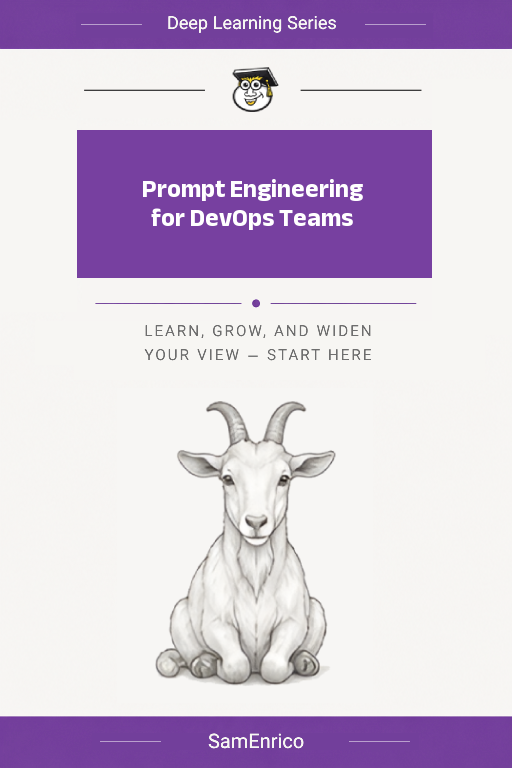
Non-FictionAI OperatorPrompt Design
Prompt Engineering for DevOps Teams eBook
Craft prompts that generate CI/CD workflows and in
Craft prompts that generate CI/CD workflows and infrastructure as code. Includes real-world examples for deployment gates, canary tests, and rollbacks.
Formats
Free sample
Chapter 1: The $200K Mistake--–- The pager woke Sarah at 2:17 AM. Not the soft buzz of a routine alert, but the full-throated scream of a production incident. She groggily reached for her phone, already knowing what she would find. A deployment that should have taken twelve minutes had been running for forty-seven. The rollback script she had promised to write last sprint—the one she documented in the ticket as "coming soon"—did not exist. She spent the next ninety-one minutes manually reverting Kubernetes manifests, fixing a botched database migration, and explaining to her incident commander why customers in the EU region saw 503 errors for almost an hour.The post-mortem revealed the truth: she had asked an LLM to "write a Terraform module for a multi-region deployment," accepted the output without validation, and applied it directly. The LLM had hallucinated an outdated resource attribute that Terraform silently ignored, causing the deployment to target the wrong availability zone. No one caught it because no one had built validation into the workflow.This chapter is about never letting that happen to you.The problem is not that LLMs are unreliable. The problem is that Dev Ops engineers approach them like search engines rather than junior engineers who need clear instructions, relevant context, and automated validation. When you ask a search engine "write Terraform for AWS," it shows you documentation. When you ask an LLM, it generates code—confidently, quickly, and sometimes catastrophically wrong. The difference between a prompt that costs your team twelve thousand dollars and a prompt that saves them two hundred thousand dollars is not luck. It is structure.This chapter introduces the three foundational patterns that every Dev Ops prompt requires: context injection, constraint declaration, and validation loops. You will learn why zero-shot prompting almost always fails in complex environments, how to build the "Dev Ops Sandwich" that feeds your LLM the right information, and why you should never trust a generated plan until it has survived automated validation. By the end of this chapter, you will have a reusable prompting framework that turns LLMs from a liability into your most productive team member.The Anatomy of a Dev Ops Prompt Disaster Before we fix the problem, we need to understand how it breaks. Consider three prompts of increasing sophistication, each asked to the same LLM.Prompt A (Zero-shot, no context): "Write Terraform for an AWS VPC."The LLM returns a generic VPC with default CIDR block 10.0.0.0/16, a single public subnet in us-east-1a, an internet gateway, and no tags. This configuration violates your company's requirement for private subnets in at least three availability zones. It ignores your tagging policy. It provisions resources that will fail your compliance scan. But the code looks valid. It runs. And that is the danger.Prompt B (Some context, weak constraints): "Write Terraform for a production VPC with private and public subnets in us-east-1, us-west-1, and eu-west-1. Use tags Environment=production and Owner=platform."Better. The LLM now generates three regions, public and private subnets in each, and the required tags. But it still makes assumptions: it chooses arbitrary CIDR ranges that might conflict with existing VPCs, it provisions default security groups that are too permissive, and it has no awareness of your existing network topology. The code will create resources, but they will not integrate with your existing infrastructure. You will spend hours manually adjusting peering connections, route tables, and NAT gateway configurations.Prompt C (Context-rich, constrained, validated): This is the prompt that works. But to understand why, we need to see what goes into it.The Dev Ops Sandwich: Three Layers of Context The most important insight in this chapter is simple: LLMs are not mind readers. They have no idea what your existing infrastructure looks like, what your compliance requirements are, or which versions of Terraform and Kubernetes you run. Every piece of information you omit, the LLM invents. And what it invents is usually wrong.The Dev Ops Sandwich solves this problem by structuring every prompt into three explicit layers, presented in order.Top Slice: System Constraints. These are the non-negotiable rules that govern every resource you create. Compliance standards (SOC2, HIPAA, PCI), cost limits (do not provision more than three t3.large instances), region restrictions (only us-east-1 and eu-west-1 for this service), required tags (Environment, Owner, Cost Center), and version pins (Terraform >=1.5, provider aws >=5.0). Put these at the top of your prompt so the LLM sees them before anything else.Middle: The Task. This is what you actually want to build. Be specific. Do not say "create a database." Say "create an RDS Postgre SQL instance with version 15.3, db.t3.medium size, 100GB gp3 storage, automated backups with 30-day retention, and deletion protection enabled." Do not say "set up networking." Say "create a VPC with CIDR 10.10.0.0/16, three public subnets and three private subnets across us-east-1a, us-east-1b, and us-east-1c, with a NAT gateway in each public subnet."Bottom Slice: Existing Config/State. This is the layer that most engineers skip, and it is the most important. The LLM needs to know what already exists so it does not recreate it or conflict with it. Feed it relevant snippets from your current Terraform state: existing VPC IDs, subnet IDs, security group IDs, IAM role ARNs, and S3 bucket names. If you are generating a Kubernetes manifest, provide the existing namespace definitions, service account names, and Config Map keys. If you are writing a pipeline, provide the existing secret names and connector IDs from your CI/CD system.The sandwich works because it mirrors how a human engineer would approach the task. You would not start writing code without knowing the constraints, the requirements, and the existing architecture. Neither should your LLM.Entity Injection: Speaking Your Infrastructure's Language Constraints and context are useless if the LLM does not know the specific names of your resources. Entity injection is the practice of explicitly naming the exact resources, connectors, secrets, and state files that the LLM should reference.Consider a Harness pipeline. A naive prompt says "add a deployment stage." An engineered prompt says: "Add a deployment stage that uses Harness Connector 'prod_aws_connector' (type: AWS, role ARN: arn:aws:iam::123456789012:role/harness-deploy-role), references Secret 'db_password' from Harness Secret Manager, and deploys to Environment 'payment-prod' which has Infrastructure Definition 'eks-payment-cluster'."Now the LLM knows exactly which connector to use, which secret to pull, and which environment to target. The generated YAML will reference the correct resource names, and the pipeline will work on the first run.Entity injection applies equally to every tool in your stack. For Git Hub Actions: "Use secret AWS_ACCESS_KEY_ID from repository secrets, self-hosted runner label 'prod-runner', and environment 'production' with required reviewers." For Terraform: "Reference remote state from s3://mycompany-terraform-state/prod/network/terraform.tfstate, output vpc_id as 'vpc-0123456789abcdef0'." For Kubernetes: "Use namespace 'payment-prod', service account 'payment-sa' with IRSA role 'payment-role', and Config Map 'payment-config' for environment variables."The pattern is always the same: name the resource, specify its type, provide its identifier. The LLM cannot guess these names. You must inject them.The Golden Prompt: Putting It All Together Here is a complete, annotated example of a golden prompt that generates a secure, multi-stage CI/CD pipeline for a production service. Read it carefully. The annotations explain why each element exists.text Copy Download[TOP SLICE: SYSTEM CONSTRAINTS]…
This is the end of the free sample. Get the eBook to keep going. Buy now
About this book
Details
- Author
- Gustafson Emelina
- Publisher
- SamEnrico
- Language
- English
- Genre
- Non-Fiction, AI Operator, Prompt Design
- Released
- 2026-06-01
- Pages (approx.)
- 132
- Available as
- eBook, Audiobook

Read better in the ZLOADR app
Your eBooks on your phone or tablet. Sign in with your SamEnrico account and start reading.
More by Gustafson Emelina
 Failure Fear in Plumbing TradeGustafson Emelina$11.99
 Emotional Intelligence In PolicingGustafson Emelina$11.99
 The Hidden Work Addiction SignsGustafson Emelina$11.99
 Kacey Musgraves Space Cowboy GuideGustafson Emelina$11.99
 Brainstorming Rules That Work GuideGustafson Emelina$11.99
 The Icebound Summit: The Unlikely Triumph of the 1955 Arctic AscentGustafson Emelina$11.99
 Understanding Fronto Nasal Malformation Cloacal ExstrophyGustafson Emelina$17.99
 Loss Leader Inflation GuideGustafson Emelina$12.99
 Admiralty (or Maritime ) LawGustafson Emelina$11.99
 How to Start a Bagging Cloth Business (Beginners Guide)Gustafson Emelina$11.99
You may also like
 Hong Kong Handover 1997Dunn Johnnie$11.99
 Zumba For Postnatal Recovery CourseNeal Christian$11.99
 Zumba for BeginnersLadner Nikia$11.99
 YouTube Comment Mining GuideHumes Pandora$12.99
 Worry Box MeditationCarlin Rudy$11.99
 Workplace Stress MeditationNguyen Lynn$11.99
 Workplace Stress and Sleep RepairHawley Ivory$11.99
 Workplace Perfectionism CureDelaney Jeffry$11.99
 Workplace Injustice Anger GuideWallen Isabelle$11.99
 Work Addiction and Burnout LinkGreenwood Ester$11.99
 Women in Yoga and WellnessBeattie Galina$11.99
 Women in Stand Up ComedyChun Evangeline$11.99