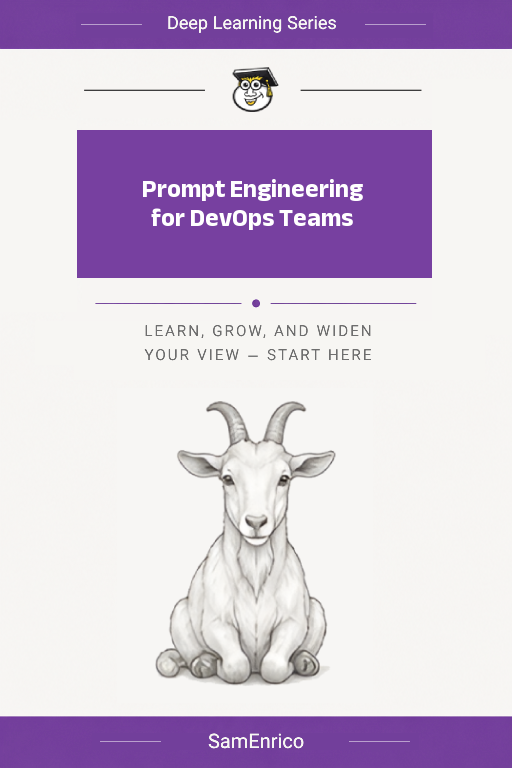
Prompt Engineering for DevOps Teams
Craft prompts that generate CI/CD workflows and in
Craft prompts that generate CI/CD workflows and infrastructure as code. Includes real-world examples for deployment gates, canary tests, and rollbacks.
Formats
About this book
Free sample
Chapter 1: The $200K Mistake--–- The pager woke Sarah at 2:17 AM. Not the soft buzz of a routine alert, but the full-throated scream of a production incident. She groggily reached for her phone, already knowing what she would find. A deployment that should have taken twelve minutes had been running for forty-seven. The rollback script she had promised to write last sprint—the one she documented in the ticket as "coming soon"—did not exist. She spent the next ninety-one minutes manually reverting Kubernetes manifests, fixing a botched database migration, and explaining to her incident commander why customers in the EU region saw 503 errors for almost an hour.The post-mortem revealed the truth: she had asked an LLM to "write a Terraform module for a multi-region deployment," accepted the output without validation, and applied it directly. The LLM had hallucinated an outdated resource attribute that Terraform silently ignored, causing the deployment to target the wrong availability zone. No one caught it because no one had built validation into the workflow.This chapter is about never letting that happen to you.The problem is not that LLMs are unreliable. The problem is that Dev Ops engineers approach them like search engines rather than junior engineers who need clear instructions, relevant context, and automated validation. When you ask a search engine "write Terraform for AWS," it shows you documentation. When you ask an LLM, it generates code—confidently, quickly, and sometimes catastrophically wrong. The difference between a prompt that costs your team twelve thousand dollars and a prompt that saves them two hundred thousand dollars is not luck. It is structure.This chapter introduces the three foundational patterns that every Dev Ops prompt requires: context injection, constraint declaration, and validation loops. You will learn why zero-shot prompting almost always fails in complex environments, how to build the "Dev Ops Sandwich" that feeds your LLM the right information, and why you should never trust a generated plan until it has survived automated validation. By the end of this chapter, you will have a reusable prompting framework that turns LLMs from a liability into your most productive team member.The…
This is the end of the free sample. Get the eBook to keep going. Buy now
Contents
- Chapter 1
- Chapter 2
- Chapter 3
- Chapter 4
- Chapter 5
- Chapter 6
- Chapter 7
- Chapter 8
- Chapter 9
- Chapter 10
- Chapter 11
- Chapter 12
Details
- Author
- Gustafson Emelina
- Publisher
- SamEnrico
- Language
- English
- Genre
- Non-Fiction, AI Operator, Prompt Design
- Released
- 2026-06-01
- Pages (approx.)
- 132
- Available as
- eBook, Audiobook

Read better in the ZLOADR app
Your eBooks on your phone or tablet. Sign in with your SamEnrico account and start reading.
More by Gustafson Emelina
 Failure Fear in Plumbing TradeGustafson Emelina$11.99
 Emotional Intelligence In PolicingGustafson Emelina$11.99
 The Hidden Work Addiction SignsGustafson Emelina$11.99
 Kacey Musgraves Space Cowboy GuideGustafson Emelina$11.99
 Brainstorming Rules That Work GuideGustafson Emelina$11.99
 The Icebound Summit: The Unlikely Triumph of the 1955 Arctic AscentGustafson Emelina$11.99
 Understanding Fronto Nasal Malformation Cloacal ExstrophyGustafson Emelina$17.99
 Loss Leader Inflation GuideGustafson Emelina$12.99
 Admiralty (or Maritime ) LawGustafson Emelina$11.99
 How to Start a Bagging Cloth Business (Beginners Guide)Gustafson Emelina$11.99