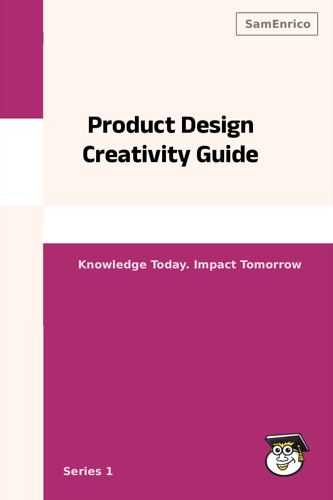
Product Design Creativity Guide
Generate novel product features using morphologica
Generate novel product features using morphological analysis and attribute listing.
Formats
About this book
Free sample
Chapter 1: The Attribute Audit--Every product designer has felt the sinking sensation. You’re sitting in a conference room with six other smart, well-intentioned people. A whiteboard stands before you, marker caps unscrewed. The facilitator writes a single word at the top: “Ideas.” Then everyone stares. Someone offers a suggestion that’s been tried before.
Someone else offers a minor variation. A third person says, “What if we made it blue?” and the room nods as if a breakthrough has occurred. Ninety minutes later, you have seventeen ideas, twelve of which are essentially the same, four are impossible, and one is illegal. The facilitator says, “Great session, team,” and you walk out knowing you’ve just participated in the most expensive form of low-yield activity in corporate life: the unstructured brainstorming meeting.This book exists because that scene is not a failure of creativity. It is a failure of method.
The raw material for innovation was always present—hiding in plain sight within the product itself. You simply didn’t know how to see it, let alone extract it, organize it, and recombine it into something genuinely new. This chapter solves the seeing problem.Before you can generate novel features, before you can build morphological boxes or run forced connections or divide attributes across time, you must first understand what your product actually is—not what it looks like or what marketing calls it, but the complete inventory of its physical, functional, and experiential dimensions. This is the Attribute Audit. And it is the single most overlooked step in systematic creativity.Most designers believe they already know their product.
They’ve worked on it for months or years. They can name its materials, describe its operation, list its specifications. But knowing a product’s specifications is not the same as seeing its attributes. A specification is a measurement (“this phone has 6.1-inch screen”). An attribute is a dimension of possibility (“screen size: 4 inches to 12 inches or none at all”).
The specification tells you what you built. The attribute tells you what you could have built instead. The gap between those two…
This is the end of the free sample. Get the eBook to keep going. Buy now
Contents
- Chapter 1
- Chapter 2
- Chapter 3
- Chapter 4
- Chapter 5
- Chapter 6
- Chapter 7
- Chapter 8
- Chapter 9
- Chapter 10
- Chapter 11
- Chapter 12
Details
- Author
- Newman Conrad
- Publisher
- SamEnrico
- Language
- English
- Genre
- Non-Fiction, Self-Help, Product Design
- Released
- 2026-06-10
- Pages (approx.)
- 126
- Available as
- eBook, Audiobook

Read better in the ZLOADR app
Your eBooks on your phone or tablet. Sign in with your SamEnrico account and start reading.
More by Newman Conrad
 Medical Test MeditationNewman Conrad$11.99
 Anger Schema TherapyNewman Conrad$11.99
 Work Environment ProcrastinationNewman Conrad$11.99
 Whole Grain LongevityNewman Conrad$11.99
 The Cathy Freeman StoryNewman Conrad$11.99
 Gut Brain Axis And ADHDNewman Conrad$11.99
 Behavioral Addiction Self AssessmentNewman Conrad$11.99
 The Silent Cartographers: Uncharted Waters of the Age of DiscoveryNewman Conrad$11.99
 Iron and Fire: The Forges of the Kushan WarriorsNewman Conrad$11.99
 The Essential Guide to ClassicNewman Conrad$11.99
 A Collector's Handbook to the Alfa Romeo 2600 BerlinaNewman Conrad$11.99
 Ultimate Handbook Guide to Irkutsk : (Russia) Travel GuideNewman Conrad$11.99