
Non-FictionSelf-HelpProduct Design
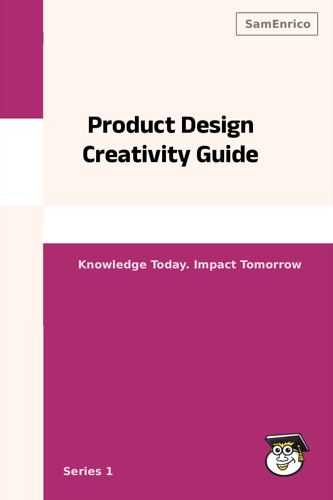
Product Design Creativity Guide eBook
Generate novel product features using morphologica
Generate novel product features using morphological analysis and attribute listing.
Formats
Free sample
Chapter 1: The Attribute Audit--Every product designer has felt the sinking sensation. You’re sitting in a conference room with six other smart, well-intentioned people. A whiteboard stands before you, marker caps unscrewed. The facilitator writes a single word at the top: “Ideas.” Then everyone stares. Someone offers a suggestion that’s been tried before.
Someone else offers a minor variation. A third person says, “What if we made it blue?” and the room nods as if a breakthrough has occurred. Ninety minutes later, you have seventeen ideas, twelve of which are essentially the same, four are impossible, and one is illegal. The facilitator says, “Great session, team,” and you walk out knowing you’ve just participated in the most expensive form of low-yield activity in corporate life: the unstructured brainstorming meeting.This book exists because that scene is not a failure of creativity. It is a failure of method.
The raw material for innovation was always present—hiding in plain sight within the product itself. You simply didn’t know how to see it, let alone extract it, organize it, and recombine it into something genuinely new. This chapter solves the seeing problem.Before you can generate novel features, before you can build morphological boxes or run forced connections or divide attributes across time, you must first understand what your product actually is—not what it looks like or what marketing calls it, but the complete inventory of its physical, functional, and experiential dimensions. This is the Attribute Audit. And it is the single most overlooked step in systematic creativity.Most designers believe they already know their product.
They’ve worked on it for months or years. They can name its materials, describe its operation, list its specifications. But knowing a product’s specifications is not the same as seeing its attributes. A specification is a measurement (“this phone has 6.1-inch screen”). An attribute is a dimension of possibility (“screen size: 4 inches to 12 inches or none at all”).
The specification tells you what you built. The attribute tells you what you could have built instead. The gap between those two things is where every novel feature lives.To bridge that gap, you need a systematic way to deconstruct your product into its constituent attributes, categorize those attributes by type and essentiality, and then audit them against what exists in the market and what users actually need. That is exactly what this chapter delivers. By the time you finish reading, you will have completed an Attribute Audit of your own product, producing a list of thirty to fifty attributes that will serve as the raw material for every subsequent method in this book.Why Deconstruction Becomes Creation The paradox of product design is that the path to novelty often runs through ruthless analysis.
You cannot creatively recombine what you cannot name. Yet most design processes skip straight to synthesis—“What if we added a camera?”—without first asking, “What attributes does our product already have, and which of those are fixed versus flexible?” This inversion produces incremental thinking disguised as innovation.Consider the kitchen blender. A typical designer sees a motor, a blade assembly, a jar, a lid, and some buttons. That’s five components. An attribute audit sees something far richer.
Physical attributes: material of jar (glass, plastic, stainless steel, ceramic), material of blade (stainless, titanium, coated), weight (one pound to fifteen pounds), thermal conductivity (cold retention, heat resistance), acoustic signature (decibels at high speed, pitch, vibration frequency). Functional attributes: rotation speed (single speed, variable, programmable), pulse capability (present or absent, adjustable intensity), timer (none, countdown, count-up, smart shutoff), safety interlock (lid sensor, jar detection, none). Experiential attributes: feedback sound (whir, hum, crunch, beep), tactile response (button click feel, lid seating resistance), visual feedback (LED ring, backlit display, no display), cleaning effort (dishwasher safe, self-cleaning cycle, hand-wash only).That’s over twenty attributes from a simple kitchen appliance. And each attribute has multiple possible states. The blender manufacturer who systematically lists these attributes will see combinations their competitors missed.
The one who skips the audit will keep changing the color and calling it innovation.The Attribute Audit forces you to confront a humbling truth: most products are under-analyzed and over-intuited. Design teams develop unconscious assumptions about which attributes are essential (“of course a blender needs a lid”) and which are variable (“we could change the jar material”). But those assumptions are often wrong. The lid might be removable for easy cleaning—but what if the product doesn’t need a lid at all? The jar might be glass for perceived quality—but what if users prefer unbreakable plastic?
The motor might be fixed—but what if the blender had no motor and relied on manual power for camping applications?This is not an exercise in nihilism. It is an exercise in possibility mapping. You cannot discover that a product attribute is optional until you explicitly list it as an attribute and then ask: “Is this essential or variable?” The act of writing it down strips away the invisible certainty that surrounds familiar products.Core Function and Jobs-to-be-Done Before you list a single attribute, you must answer two foundational questions. First: What is the product’s core function? Second: What user jobs-to-be-done does it serve?
These answers determine which attributes are truly essential and which are merely habitual.Core function is the irreducible purpose of the product. A drill’s core function is not “spinning a motor.” That is a mechanism. The core function is “making holes.” A ride-sharing app’s core function is not “matching drivers to riders.” That is an algorithm. The core function is “getting me home safely and predictably.” A coffee maker’s core function is not “heating water.” That is a subsystem. The core function is “extracting flavor from ground beans into drinkable liquid.”Why does this distinction matter?
Because when you mistake a mechanism for a function, you lock yourself into existing solutions. Spinning a motor can only be done electrically. Making holes can be done with a drill, a punch, a laser, a water jet, or a chemical etch. The moment you define core function at the right level of abstraction, the attribute space explodes with new possibilities.Jobs-to-be-done refines this further. A job is the progress a user seeks in a specific context.
For a blender, one user’s job might be “make a single-smoothie breakfast in under two minutes with no cleanup.” Another user’s job might be “purée soup for a family of six without burning my hands.” Another’s might be “crush ice for cocktails without dulling the blade.” Each job implies a different set of valued attributes. The single-smoothie user values speed and cleanup. The soup user values thermal management. The cocktail user values blade hardness and torque.The Attribute Audit must be job-aware. Listing attributes without reference to user jobs produces a technically complete but strategically useless inventory.
You need to know not only that the blender has a blade material attribute, but also which blade materials serve which jobs. This connection between attributes and outcomes becomes the filter for everything that follows in later chapters.The Three Attribute Families Every product attribute belongs to one of three…
This is the end of the free sample. Get the eBook to keep going. Buy now
About this book
Details
- Author
- Newman Conrad
- Publisher
- SamEnrico
- Language
- English
- Genre
- Non-Fiction, Self-Help, Product Design
- Released
- 2026-06-10
- Pages (approx.)
- 126
- Available as
- eBook, Audiobook

Read better in the ZLOADR app
Your eBooks on your phone or tablet. Sign in with your SamEnrico account and start reading.
More by Newman Conrad
 Medical Test MeditationNewman Conrad$11.99
 Anger Schema TherapyNewman Conrad$11.99
 Work Environment ProcrastinationNewman Conrad$11.99
 Whole Grain LongevityNewman Conrad$11.99
 The Cathy Freeman StoryNewman Conrad$11.99
 Gut Brain Axis And ADHDNewman Conrad$11.99
 Behavioral Addiction Self AssessmentNewman Conrad$11.99
 The Silent Cartographers: Uncharted Waters of the Age of DiscoveryNewman Conrad$11.99
 Iron and Fire: The Forges of the Kushan WarriorsNewman Conrad$11.99
 The Essential Guide to ClassicNewman Conrad$11.99
 A Collector's Handbook to the Alfa Romeo 2600 BerlinaNewman Conrad$11.99
 Ultimate Handbook Guide to Irkutsk : (Russia) Travel GuideNewman Conrad$11.99
You may also like
 Hong Kong Handover 1997Dunn Johnnie$11.99
 Zumba For Postnatal Recovery CourseNeal Christian$11.99
 Zumba for BeginnersLadner Nikia$11.99
 YouTube Comment Mining GuideHumes Pandora$12.99
 Worry Box MeditationCarlin Rudy$11.99
 Workplace Stress MeditationNguyen Lynn$11.99
 Workplace Stress and Sleep RepairHawley Ivory$11.99
 Workplace Perfectionism CureDelaney Jeffry$11.99
 Workplace Injustice Anger GuideWallen Isabelle$11.99
 Work Addiction and Burnout LinkGreenwood Ester$11.99
 Women in Yoga and WellnessBeattie Galina$11.99
 Women in Stand Up ComedyChun Evangeline$11.99