
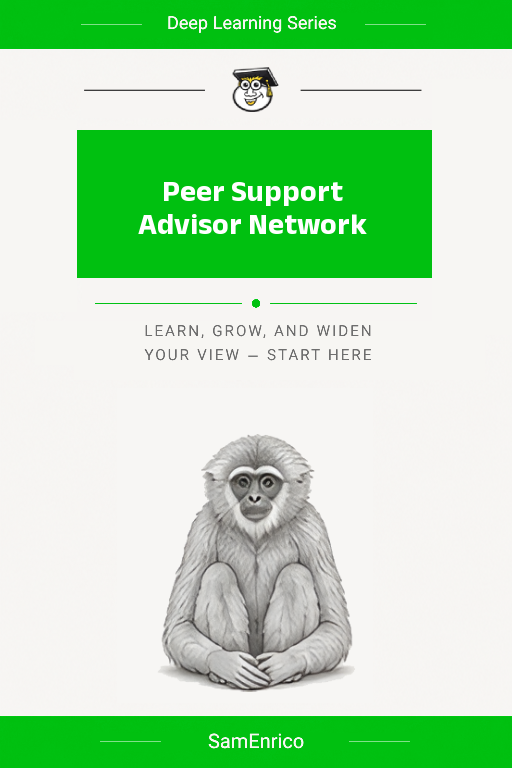
Peer Support Advisor Network eBook
Recruit trusted friends who have lived experience
Recruit trusted friends who have lived experience and can offer empathy without judgment.
Formats
Free sample
Chapter 1: The Empathy Gap--–- The first time I realized that professional help had limits, I was sitting in a well-lit office on a beige sofa, across from a kind woman with a clipboard. I had just described a grief so large it had rearranged my organs. I could feel it pressing against my ribs. She nodded, made a note, and said, "It sounds like you're experiencing complicated bereavement. Have you considered journaling?"I wanted to scream.
Not because she was wrong. She wasn't wrong. Journaling is fine. Complicated bereavement is a real diagnosis. But I had just told her that I had found my brother on the floor of his apartment, that his hand was still warm, that I had tried to do CPR even though I knew—I knew—he had been gone for hours.
And her response was a label and a suggestion.She couldn't say what I needed to hear. She wasn't allowed to. Her training forbade it. She couldn't say, "Me too." She couldn't say, "I found my sister." She couldn't say, "I don't know what to do, but I'm not leaving." She was a professional. Professionals don't say those things.
Professionals stay objective. They maintain boundaries. They offer evidence-based interventions.And I sat there, on that beige sofa, feeling like I had just handed a drowning person a pamphlet on swimming techniques.This is not an indictment of therapy. I am not anti-therapy. I have sat in many offices since that day, and I have been helped by skilled clinicians who saved my life.
But here is the truth that no one tells you: clinical mental health services are essential for diagnosis, medication, and crisis stabilization—and they are structurally incapable of providing one specific thing that human beings desperately need. That thing is sustained, horizontal, lived-experience empathy.This chapter is about that gap. It is about the difference between being treated and being held. It is about why your therapist cannot say "me too," and why that silence, however necessary, leaves a wound that only another wounded person can touch.The Three Kinds of "Feeling For" Someone Before we can understand what peer support offers that professional support cannot, we need to get precise about a word we throw around carelessly: empathy.Most people use "empathy" as a catch-all for anything that isn't cruelty. But there are actually three distinct ways we respond to another person's suffering, and they are not the same.
They exist on a vertical spectrum, from distance to fusion, and only one of them is the currency of peer support.Pity: The Vertical Distance Pity is what you feel when you look at someone from above. It contains a subtle but powerful hierarchy: "Poor you. I am not you. I am above you." Pity feels compassionate on the surface, but it is fundamentally disempowering. It says, "Your situation is sad," which implies, "I am grateful not to be in it." The person receiving pity feels seen, but seen as lesser.
Smaller. Broken.You can spot pity in the way people tilt their heads. The slight frown. The soft voice. The words "Oh, you poor thing." Pity is the emotional posture of a benefactor looking down at a beneficiary.
It is vertical. And it is exhausting to receive.Sympathy: The Horizontal Distance Sympathy is a step closer. It says, "I feel for you." Not "I feel with you"—"for you." Sympathy acknowledges suffering without claiming to share it. It is horizontal in posture but still maintains a gap. The sympathetic person is standing next to you, not inside you.Sympathy is what most professionals are trained to offer.
The therapeutic stance—warm, attentive, curious, but separate—is sympathy operationalized. The therapist feels for you. They care about your outcome. But they do not feel with you, because feeling with you would compromise their ability to see clearly.Sympathy is good. Sympathy is necessary.
Sympathy keeps therapists from burning out and clients from being engulfed. But sympathy also has a ceiling. It cannot reach the place where two people sit in the same wound.Empathy: The Shared Space Empathy is different. Empathy is not "I feel for you." Empathy is "I feel with you." It is not vertical. It is not horizontally adjacent.
It is shared. Empathy requires that the person offering it has been to the same country, if not the same address. Not the exact same experience—no one's grief is identical—but close enough that the territory is recognizable.Empathy says, "I remember that cold." It says, "I have stood where you are standing, and I did not know which way was up, and I am not going to pretend I have a map." Empathy does not fix. Empathy does not diagnose. Empathy sits down in the dark with you and says, "I'm here.
I don't know what comes next. But I'm here."This is what peers offer. This is what professionals cannot offer. And the space between what professionals can do and what peers can do is the Empathy Gap.Lived Experience Expertise: A New Kind of Credential We are used to thinking of expertise as something you learn from books. Doctors have medical expertise.
Lawyers have legal expertise. Mechanics have mechanical expertise. These are forms of knowledge acquired through study, certification, and supervised practice.But there is another form of expertise that our culture systematically undervalues. It is not learned from textbooks. It cannot be taught in a classroom.
It is not certified by any board. And yet it is just as real—sometimes more real—than anything you can get a degree in.Lived Experience Expertise (LEE) is the knowledge you gain by navigating a specific life challenge. If you have survived a divorce, you have expertise in the texture of that particular loss. If you have come through addiction, you have expertise in the cravings, the shame, the relapses, the long slow climb back. If you have buried a child, you have expertise in a grief that no textbook can convey.
If you have been through a major illness, you have expertise in the terror of your own body turning against you.Lived Experience Expertise has three defining characteristics.First, it is embodied. You do not know it with your mind alone. You know it in your bones, in your nervous system, in the way your breath catches when you smell a certain cologne or hear a certain song. This is not abstract knowledge. It is physiological.
It lives in your body because your body is where the suffering happened.Second, it is tacit. Hard to articulate. Easy to recognize. You cannot explain to someone who has never been divorced what it feels like to divide your books in half, to realize you will never see your mother-in-law again, to be legally required to calculate the value of your shared life. But when you sit across from another divorced person, you do not need to explain.
They already know. The knowledge passes between you without words.Third, it is relational. Lived Experience Expertise is only activated in connection with another sufferer. You can have all the grief in the world, but until you offer it…
This is the end of the free sample. Get the eBook to keep going. Buy now
About this book
Details
- Author
- Lunsford Hyon
- Publisher
- SamEnrico
- Language
- English
- Genre
- Non-Fiction, Mental Wealth
- Released
- 2026-06-01
- Pages (approx.)
- 132
- Available as
- eBook, Audiobook

Read better in the ZLOADR app
Your eBooks on your phone or tablet. Sign in with your SamEnrico account and start reading.
More by Lunsford Hyon
 Mother Daughter CancerLunsford Hyon$11.99
 Iodine Cognitive Function GuideLunsford Hyon$11.99
 Empathetic Leadership HandbookLunsford Hyon$11.99
 NVC for Scrum MastersLunsford Hyon$11.99
 Focus Metrics TrackingLunsford Hyon$11.99
 Tension Headache and BruxismLunsford Hyon$11.99
 Hero Archetype Dream JourneyLunsford Hyon$11.99
 Lying Body Language IndicatorsLunsford Hyon$11.99
 Kirsten Dunst InterviewLunsford Hyon$11.99
 The Phantom of the 405: The Highway Killer Who VanishedLunsford Hyon$11.99
 The Glass Ceiling Cracked: The Untold Story of the First Female Supreme Court JusticeLunsford Hyon$11.99
 The Silk Road Warriors: The Untold Story of Persia's Renaissance ArchersLunsford Hyon$11.99
You may also like
 Student Mental Health Board GuideBerg Meghann$12.99
 High Achiever Mental Health BoardRosas Synthia$12.99
 Technology Addiction AdvisorRoby Shakita$12.99
 Pet Bereavement AdvisorSam Reyna$12.99
 Peer Support Group IntegrationDuffy Renay$12.99
 Exercise Mental Health AdvisorBurnett Dewayne$12.99
 Disclosing Depression To InvestorsBadger Kazuko$12.99
 Yawn Stretch RegulationRomano Berna$12.99
 Wrist Flexion ReleaseBusch Kandace$12.99
 Workplace Mental Health AllyValentine Meta$12.99
 Workplace Mental Health AdvisorAshcraft Johnie$12.99
 Wealthy Upbringing Guilt GuideXiong Deeanna$12.99