
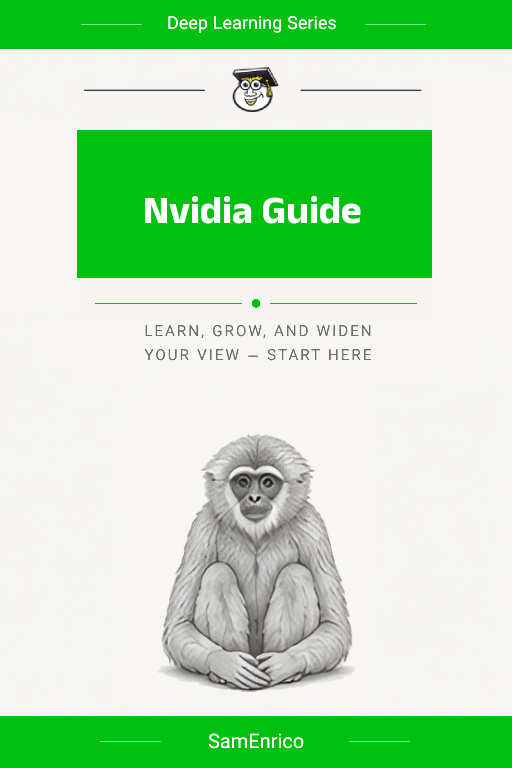
Nvidia Guide eBook
Learn domain-specific expertise, deep learning tal
Learn domain-specific expertise, deep learning talent, and academic research partnerships for R&D.
Formats
Free sample
Chapter 1: The Day the Lab Died...--–- The meeting was scheduled for 8 AM on a Tuesday, but the dread had arrived on Sunday.David Chen, Director of Advanced Battery Research at a Detroit-based automaker that had once been the pride of American manufacturing, sat in a windowless conference room on the twenty-seventh floor. The coffee was stale. The projector hummed with a faint, dying whine. Across from him sat his Chief Technology Officer, a woman named Helen whose face had acquired the gray pallor of someone who had just received devastating news from an oncologist.Behind her, on a screen that had cost $40,000 to install and was now used primarily for displaying quarterly Power Point decks, was a single bar chart.The left bar represented David's team: fifty-three Ph Ds, nine postdocs, thirty-seven engineers, a dedicated high-performance computing cluster, and a budget that had, over four years, consumed $200 million. Their mission had been to develop a new solid-state battery chemistry that could increase energy density by 40 percent while reducing charging time to fifteen minutes.
It was the kind of moonshot that had once justified the existence of corporate R&D—ambitious, risky, and potentially world-changing.The right bar represented a startup called Ion Forge. Five people. Three of them had just graduated from a master's program at a university David had never heard of. Their total funding, according to public records, was $4.2 million. They had been working on the exact same problem for exactly six months.The right bar was twice as tall as the left bar.Helen didn't say anything for a long time.
She didn't need to. The chart was a eulogy."David," she finally said, her voice flat, "I need you to explain to me how five kids with a credit card beat fifty-three Ph Ds with a supercomputer."David opened his mouth. Closed it. He had a dozen explanations—different material science approaches, different testing methodologies, different definitions of success—but they all died on his tongue because they were excuses, not explanations. The truth was simpler and more devastating: Ion Forge had done what every tired, legacy R&D organization had refused to do.
They had stopped treating artificial intelligence as a tool and started treating it as a partner."They used an LLM for hypothesis generation," David said quietly. "We didn't."Helen stared at him."That's it?""That's it."She pushed her chair back and walked out of the room without another word. Three weeks later, David's entire department was dissolved. Fifty-three Ph Ds scattered to consulting firms, universities, and startups. The high-performance computing cluster was sold for scrap.
The automaker, which had once employed more scientists than any other company in North America, no longer did internal battery research.They had outsourced their future to a startup they would eventually acquire for $900 million—a startup that had, at its core, exactly two things David's team lacked: a willingness to let AI propose hypotheses, and the domain fluency to know which hypotheses were worth testing.This book is about how to avoid becoming David.It is about a company—NVIDIA—that has built a $3 trillion valuation not primarily because it makes the best chips, but because it has fundamentally redesigned how research and development works. And it is about a framework, distilled from NVIDIA's partnerships, acquisitions, and academic collaborations between 2024 and 2026, that any organization can adopt to survive the collapse of the isolated R&D model.The old way of innovation is dead. This chapter explains why.The Graveyards of Corporate Genius To understand where R&D is going, we must first understand where it came from—and why the temples of corporate innovation became tombs.In the middle of the twentieth century, the industrial research laboratory was the crown jewel of American capitalism. Bell Labs, founded in 1925, produced eight Nobel Prizes, invented the transistor, the laser, the solar cell, and the Unix operating system. Xerox PARC, founded in 1970, birthed the graphical user interface, the computer mouse, Ethernet, and laser printing.
These were not academic institutions. They were corporate facilities, funded by monopoly profits (AT&T) and office equipment sales (Xerox), staffed by the brightest minds in physics, chemistry, and electrical engineering.The model was simple: Hire geniuses. Give them unlimited resources. Leave them alone for a decade. Profit.It worked spectacularly for about fifty years.
Then it stopped working. Not because the geniuses got dumber—they got smarter. Not because the budgets shrank—they grew. The model stopped working because the world changed in ways that the isolated lab could not adapt to.Consider the three fatal flaws of the traditional R&D model, each of which is magnified exponentially in the age of generative AI.Flaw One: Secrecy as Strategy Traditional R&D labs treated secrecy not as a tactical necessity but as a strategic virtue. The assumption was that competitive advantage came from knowledge that no one else possessed.
Therefore, the more you could hide, the more you would win.This assumption was always partially wrong—science advances through publication, and the best researchers want to share their work—but in the pre-internet, pre-open-source era, secrecy had genuine value. The cost of reverse engineering was high. The speed of information diffusion was low.Today, both assumptions are dead.In 2025, a team at Stanford published a paper demonstrating that a fine-tuned Llama 3 model, running on eight consumer GPUs, could rediscover 80 percent of the key insights from a proprietary battery chemistry dataset that had cost a Fortune 500 company $50 million to generate. The company had kept the data secret for three years. The Stanford team, using only publicly available literature and synthetic data generation, recreated its essential findings in six weeks.Secrecy, in other words, is no longer a moat.
It is a tax you pay for the privilege of moving slowly.Flaw Two: The Siloed Organization The traditional R&D lab was physically and organizationally separate from the rest of the company. This was intentional: researchers needed protection from quarterly earnings pressures, short-term thinking, and the inevitable demands of marketing and sales.But separation became isolation. Isolation became ignorance.By the 2010s, the typical corporate R&D lab had almost no connection to the university ecosystem (beyond writing checks), almost no connection to startups (beyond occasional acqui-hires), and almost no connection to open-source communities (which were dismissed as unreliable or unsafe). The lab existed in a bubble, generating knowledge that was often irrelevant to the business and rarely informed by external advances.The result was a slow-motion collapse. Between 2000 and 2020, the number of corporate R&D labs producing genuinely transformative research declined by 70 percent, according to a study by the National Bureau of Economic Research.
The labs that survived—Microsoft Research, Google's X, IBM Research—did so by aggressively abandoning the isolationist model.Flaw Three: The Decade-Long Feedback Loop Perhaps the most fatal flaw of the traditional R&D model was its relationship to time.A typical industrial research project in 1990 had a ten-year horizon. A team would spend two years on literature review and theoretical groundwork, three years on early experimentation, three years on refinement, and two years on technology transfer to product groups. This timeline was acceptable because competitors moved at similar speeds.Generative AI…
This is the end of the free sample. Get the eBook to keep going. Buy now
About this book
Details
- Author
- Otero Michiko
- Publisher
- SamEnrico
- Language
- English
- Genre
- Non-Fiction, Strategic Atlas, Talent Intelligence
- Released
- 2026-06-01
- Pages (approx.)
- 141
- Available as
- eBook, Audiobook

Read better in the ZLOADR app
Your eBooks on your phone or tablet. Sign in with your SamEnrico account and start reading.
More by Otero Michiko
 Medicine Nobel RevolutionariesOtero Michiko$11.99
 Coworker Conflict Resolution HandbookOtero Michiko$11.99
 Sally Jesse Raphael Red GlassesOtero Michiko$11.99
 The Pomodoro Time Blocking GuideOtero Michiko$11.99
 Gaming Escape Avoidance GuideOtero Michiko$11.99
 The Curse of the Corsican Bloodlines: A Century of Crime and CursesOtero Michiko$11.99
 How to Start a Chess Set Business (Beginners Guide)Otero Michiko$11.99
 Dlocal African Exporters GuideOtero Michiko$12.99
 Understanding PycnodysostosisOtero Michiko$17.99
 Form CarpenterOtero Michiko$11.99
You may also like
 Zapier GuideGallardo Alica$12.99
 Toast GuidePacheco Lorina$12.99
 Stripe Early Talent GuideHendrick Santo$12.99
 SpaceX Hiring GuideObryan Kyung$12.99
 Snap GuidePeak Berenice$12.99
 Salesforce GuideCuster Cruz$12.99
 Rippling GuideMcinnis Josefine$12.99
 Reddit GuideHolton Danyelle$12.99
 Pinterest GuideLindgren Solange$12.99
 Palantir GuideBarrera Shonda$12.99
 OpenAI GuideFay Zack$12.99
 Instacart GuideDailey Michael$12.99