
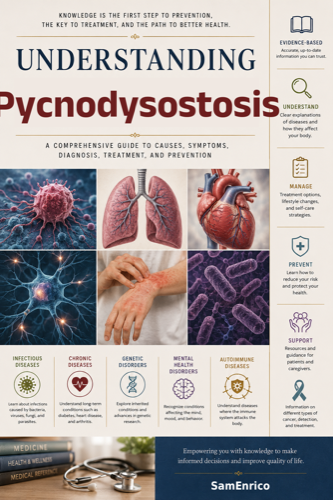
Understanding Pycnodysostosis
This disease publication, published by SamEnrico,
This disease publication, published by SamEnrico, covers Understanding Pycnodysostosis
Formats
About this book
Free sample
Chapter 1: The Artist’s Bones...--–- In the autumn of 1899, Henri de Toulouse-Lautrec stood before a mirror in his Montmartre studio, his short legs braced against the cold parquet floor, and studied the body that had betrayed him. He was thirty-five years old, five feet tall, and had already broken both femurs—the left one at age twelve, the right at fourteen—fractures that never healed properly, leaving him with a cane and a lifelong limp. His forehead sloped forward above a nose that seemed too large for his face. His jaw was so small that his teeth crowded against one another, and his upper lip barely covered them. Yet from this body, which the world called deformed, came some of the most vibrant, unflinching art of the nineteenth century—paintings of cabaret dancers, prostitutes, and absinthe drinkers that captured the raw humanity of Paris’s underworld.The question that haunted Toulouse-Lautrec’s doctors during his lifetime—and that has intrigued medical historians ever since—was simple: What was wrong with him?His mother, Adèle, had consulted physicians across France.
They offered theories: a genetic fluke, a complication of inbreeding (his parents were first cousins), a childhood injury from falling off a chair at age four—an accident that his family long blamed for his stunted growth. But the truth, which would not be discovered until sixty-one years after his death, was far more precise. Toulouse-Lautrec did not have achondroplasia, the most common form of dwarfism. He did not have osteogenesis imperfecta, the brittle bone disease that many later speculated. He had a condition so rare that it would not receive a name until 1962, when two French physicians—Drs.
Pierre Maroteaux and Maurice Lamy—coined the term pycnodysostosis, from the Greek words pycnos (thick or dense), dys (bad or disordered), and ostosis (bone).This chapter is the story of that discovery. It is also the story of why pycnodysostosis—a disease that affects approximately one to three people per million worldwide—deserves its own place in medical knowledge, separate from the conditions with which it is so often confused. And it is…
This is the end of the free sample. Get the eBook to keep going. Buy now
Contents
- Chapter 1
- Chapter 2
- Chapter 3
- Chapter 4
- Chapter 5
- Chapter 6
- Chapter 7
- Chapter 8
- Chapter 9
- Chapter 10
- Chapter 11
- Chapter 12
Details
- Author
- Otero Michiko
- Publisher
- SamEnrico
- Language
- English
- Genre
- Non-Fiction, Informative, Educational
- Released
- 2026-05-11
- Pages (approx.)
- 160
- Available as
- eBook, Audiobook

Read better in the ZLOADR app
Your eBooks on your phone or tablet. Sign in with your SamEnrico account and start reading.
More by Otero Michiko
 Medicine Nobel RevolutionariesOtero Michiko$11.99
 Coworker Conflict Resolution HandbookOtero Michiko$11.99
 Sally Jesse Raphael Red GlassesOtero Michiko$11.99
 The Pomodoro Time Blocking GuideOtero Michiko$11.99
 Gaming Escape Avoidance GuideOtero Michiko$11.99
 The Curse of the Corsican Bloodlines: A Century of Crime and CursesOtero Michiko$11.99
 How to Start a Chess Set Business (Beginners Guide)Otero Michiko$11.99
 Nvidia GuideOtero Michiko$12.99
 Dlocal African Exporters GuideOtero Michiko$12.99
 Form CarpenterOtero Michiko$11.99