
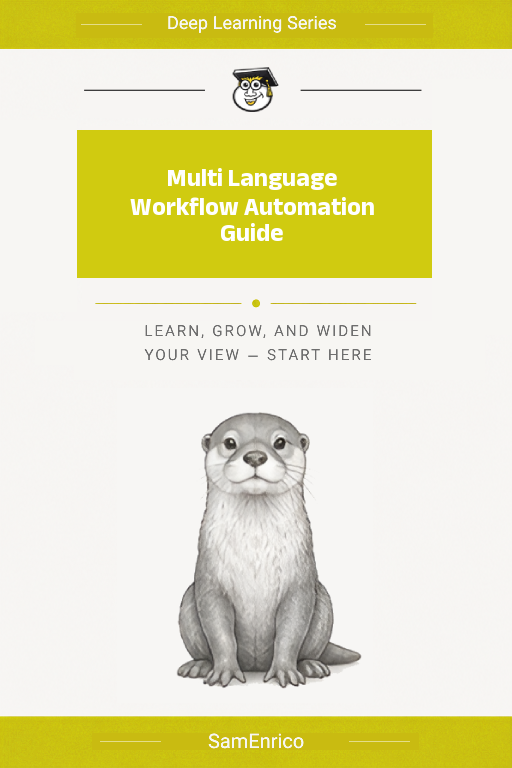
Multi Language Workflow Automation Guide eBook
Build AI-powered translation pipelines for website
Build AI-powered translation pipelines for websites, apps, and documents across 50+ languages. Includes glossary management, style guide enforcement, and quality assurance prompts.
Formats
Free sample
Chapter 1: The Orchestration Mandate--–- On a humid July morning in Austin, Texas, a senior product manager named Elena watched her company's international expansion unravel in real time. The dashboard in front of her showed green checkmarks for every service except one: translation. The Spanish landing page displayed a mix of Portuguese and English. The German checkout flow crashed when users entered their addresses because a placeholder variable had been mistranslated as static text. The Japanese app store listing promised features that didn't exist, while the Korean version omitted a legally required disclosure.
Seven languages, three weeks behind schedule, and two hundred thousand dollars over budget. Elena's board had one question: "How did we miss this?"The answer was not a single failure but a thousand small ones. A translator in Barcelona had received an outdated spreadsheet. A developer in San Francisco had hardcoded English error messages. A marketing manager in Berlin had used Google Translate for a blog post, then published it without review.
A QA engineer in Bangalore had tested only the English version because "that's what the test plan said." Individually, each mistake was minor. Collectively, they were catastrophic.Elena's company is not unique. It is not incompetent. It is not underfunded. It is, in fact, a well-run organization with smart people and modern tools.
And yet, like thousands of companies before it, it discovered that adding languages without adding orchestration is like adding lanes to a highway without adding traffic lights. The capacity increases, but so does the chaos.This chapter is about why that happens and what to do about it. It is not a technical manual—those come later. It is a strategic foundation. Before you write a single line of code or configure a single API, you must understand why traditional approaches fail, what automation actually means in a multilingual context, and why the old question "How do we translate this?" must be replaced with a new one: "How do we orchestrate trust at scale?"The Hidden Mathematics of Multilingual Chaos To understand why manual processes break, we must first understand the mathematics of complexity.
A system with one language has one state. A system with two languages has two states, each of which must be maintained, tested, and deployed. A system with fifty languages does not have fifty states. It has fifty factorial interactions between those states. Every new language multiplies the potential points of failure, does not simply add to them.Consider a simple example.
Your application has ten thousand translatable strings. Each string exists in English and must be rendered in forty-nine other languages. That is four hundred ninety thousand individual translated units. Now add versioning. Each string changes an average of twice per year.
That is nearly one million translation events annually. Now add context. The same English word—"submit," "continue," "cancel"—may have different translations depending on whether it appears on a button, a navigation menu, or an error message. Now add compliance. Legal strings require human review.
Marketing strings require brand approval. Error messages require technical validation.The spreadsheet model, even with the most diligent team, cannot survive this complexity curve. Spreadsheets have no memory of previous translations. They have no awareness of context. They have no ability to enforce consistency across files.
They are, in the most literal sense, the wrong tool for the job. Using Excel for fifty-language localization is like using a butter knife for open-heart surgery. It is possible, if you squint and ignore most of the requirements, but the outcomes are predictably poor.Yet spreadsheets remain the default. Why? Because they are familiar.
Because every localization manager knows how to use them. Because "we've always done it this way" is the most powerful force in organizational inertia. And because, for three languages and a small team, spreadsheets actually work reasonably well. The problem is that companies rarely stop at three languages. They add a fourth, then a fifth, then a tenth, and by the time they reach fifty, the process is already broken beyond repair.
But no one notices the breakage because it happens gradually, like a frog in slowly boiling water. One day, you look up, and your entire international operation is a house of cards.The False Promise of "Just Add AI"In recent years, a new temptation has emerged. As neural machine translation has improved and large language models have become accessible via API, many organizations have concluded that AI alone can solve their localization problems. The reasoning is seductive: if AI can translate quickly and cheaply, why not simply feed it all your content and publish the output? Why bother with workflows, glossaries, or human review?The answer is that AI, for all its power, does not understand context, brand voice, legal nuance, or user intent.
It understands statistical regularities in text. It can produce a grammatically correct German sentence that is completely wrong for your product. It can translate "apple" as the fruit when you meant the company. It can render a marketing slogan literally, stripping it of all cultural resonance. It can—and frequently does—hallucinate entire phrases that exist nowhere in the source text.AI is not a replacement for orchestration.
It is a component of orchestration. A very powerful component, to be sure, but one that requires guardrails, validation, and oversight. The companies that succeed with AI translation are not those that trust it blindly. They are those that integrate it into a system of glossaries, style guides, quality checks, and human escalation paths. They treat AI as a high-speed intern: capable of doing excellent work under supervision, but requiring clear instructions and regular quality audits.The promise of "just add AI" is a trap.
It leads to the same chaos as spreadsheets, but faster and with more confident errors. A human translator makes mistakes slowly and apologetically. An AI makes mistakes instantly and authoritatively. The latter is far more dangerous.What Automation Actually Means The word "automation" is overloaded. For some, it means scripts that convert file formats.
For others, it means robotic process automation that mimics human clicks. For still others, it means artificial intelligence that replaces human judgment. In this book, we mean something specific and, we hope, useful.Automation, in the context of multilingual workflows, means the systematic replacement of manual coordination with software-based orchestration. That is a dense sentence, so let us unpack it."Manual coordination" includes every activity that involves moving information between people and tools: emailing spreadsheets, uploading files to a translation management system, copying translated text back into a CMS, checking which strings have been reviewed and which are still pending, reconciling conflicting versions, and manually testing each language after deployment. These activities are not translation.
They are overhead. They consume time and attention that could be spent on higher-value work."Software-based orchestration" means that the system, not the humans, handles these coordination tasks. The system knows which content has changed. It knows which languages require translation. It knows which engine to use for each content type.
It knows which glossaries to apply. It knows which quality checks to run. It knows where to send the output. And it knows how to escalate exceptions to humans…
This is the end of the free sample. Get the eBook to keep going. Buy now
About this book
Details
- Author
- Ayres Sherron
- Publisher
- SamEnrico
- Language
- English
- Genre
- Non-Fiction, AI Operator, Language Services, Skills Guide
- Released
- 2026-05-29
- Pages (approx.)
- 148
- Available as
- eBook, Audiobook

Read better in the ZLOADR app
Your eBooks on your phone or tablet. Sign in with your SamEnrico account and start reading.
More by Ayres Sherron
 Body Image and Orthorexia Recovery GuideAyres Sherron$11.99
 Clothing and Color NonverbalAyres Sherron$11.99
 Pet Loss for TherapistsAyres Sherron$11.99
 Resume Gap Mental Health GuideAyres Sherron$11.99
 Charles Spurgeon AccountAyres Sherron$11.99
 Shadows of the Onmyōji SpyAyres Sherron$11.99
 Assistant Site ManagerAyres Sherron$11.99
 Understanding Kumar–levick SyndromeAyres Sherron$17.99
 How to Start a Hobby in Singing In ChoirAyres Sherron$11.99
 Carbon Capture Technology GuideAyres Sherron$12.99