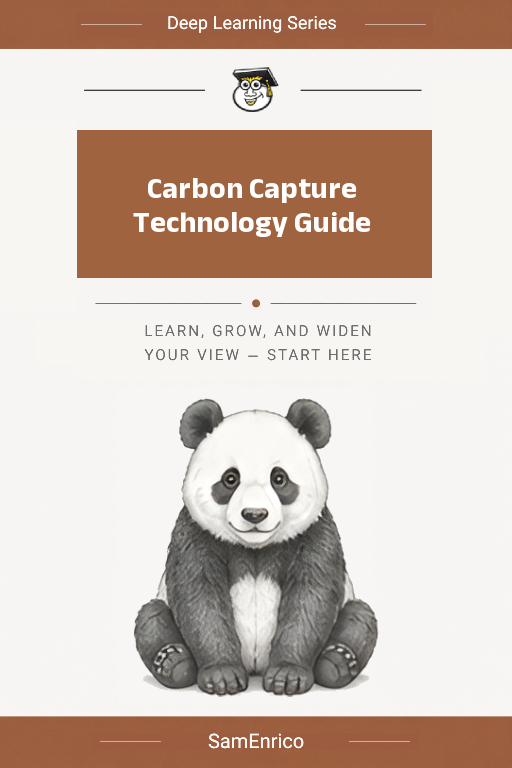
Carbon Capture Technology Guide
Discover direct air capture, point source CCS, and
Discover direct air capture, point source CCS, and utilization pathways with cost reduction trajectories.
Formats
About this book
Free sample
Chapter 1: The Invisible Mountain--–- On a clear morning, you can see for miles. The sky is blue, the clouds are white, and the air feels empty. But it is not. Every breath you take contains roughly 400 molecules of carbon dioxide out of every million molecules of gas. That invisible fraction—just 0.04 percent—is the difference between a stable climate and an unstable one.
It is the difference between ice cores showing 280 parts per million for ten thousand years of human civilization and the 420 parts per million we measured last Tuesday. And it is the reason you are holding this book.Carbon dioxide does not announce itself. It has no smell, no color, no immediate toxicity. Unlike a smokestack belching black soot or a river stained orange with acid mine drainage, CO₂ harms nothing directly in the lung. Its violence is slower, more patient, and far more consequential.
It traps heat that would otherwise escape to space. It makes oceans more acidic. It stays in the atmosphere for centuries, sometimes millennia. The CO₂ your great-grandparents emitted from their first car is still up there, still warming the planet, still dissolving into the sea.This chapter is about why we need to capture that invisible mountain. Not because we want to.
Not because it is cheap or easy. But because we have run out of better options.The Carbon Cycle That Never Asked for Help Before humans, carbon moved in a gentle loop. Volcanoes belched CO₂. Weathering rocks absorbed it. Plants pulled it from the air, animals ate the plants, and decomposers sent it back.
The ocean exchanged carbon with the atmosphere on timescales of decades to centuries. Over millennia, some carbon sank into sediments, became limestone or fossil fuels, and stayed there. The system was not perfectly balanced—ice ages and warm periods prove that—but it was slow. Changes that took ten thousand years gave life time to adapt.Then we learned to dig up the stored carbon. Coal, oil, and natural gas are ancient sunlight, compressed and cooked into energy-dense rocks and liquids.
Burning them returns that carbon to the air in seconds. A lump of coal that took three hundred million years…
This is the end of the free sample. Get the eBook to keep going. Buy now
Contents
- Chapter 1
- Chapter 2
- Chapter 3
- Chapter 4
- Chapter 5
- Chapter 6
- Chapter 7
- Chapter 8
- Chapter 9
- Chapter 10
- Chapter 11
- Chapter 12
Details
- Author
- Ayres Sherron
- Publisher
- SamEnrico
- Language
- English
- Genre
- Non-Fiction, Forecast & Outlook, Carbon Removal
- Released
- 2026-05-29
- Pages (approx.)
- 141
- Available as
- eBook, Audiobook

Read better in the ZLOADR app
Your eBooks on your phone or tablet. Sign in with your SamEnrico account and start reading.
More by Ayres Sherron
 Body Image and Orthorexia Recovery GuideAyres Sherron$11.99
 Clothing and Color NonverbalAyres Sherron$11.99
 Pet Loss for TherapistsAyres Sherron$11.99
 Resume Gap Mental Health GuideAyres Sherron$11.99
 Charles Spurgeon AccountAyres Sherron$11.99
 Shadows of the Onmyōji SpyAyres Sherron$11.99
 Assistant Site ManagerAyres Sherron$11.99
 Understanding Kumar–levick SyndromeAyres Sherron$17.99
 How to Start a Hobby in Singing In ChoirAyres Sherron$11.99
 Multi Language Workflow Automation GuideAyres Sherron$12.99