
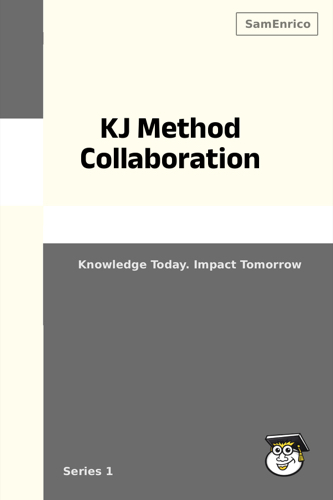
KJ Method Collaboration
Japanese affinity diagramming for chaotic ideas.
Japanese affinity diagramming for chaotic ideas.
Formats
About this book
Free sample
Chapter 1: The Nepalese Notebooks--–- In 1959, Jiro Kawakita sat on the floor of a dusty Himalayan inn, surrounded by 2,347 individual slips of paper. Each slip contained a single observation from his fieldwork on the water distribution systems of Nepal’s remote mountain villages. He had been awake for thirty-one hours. His notebooks were full. His mind was empty.
And every Western analytical framework he had brought from Tokyo had failed him completely.The problem was not a lack of data. Kawakita had more data than any anthropologist had ever collected on this region. He had documented every stream, every irrigation ditch, every dispute over water rights, every seasonal migration pattern, every ritual offering made to the mountain spirits believed to control the rain. His notebooks were overflowing with facts. But when he tried to write his final report, he discovered something terrifying: the facts did not fit together.The standard approach, taught in every university in the West, was to begin with a theoretical framework.
You selected your categories in advance—economics, kinship, religion, politics—and then sorted your observations into those pre-existing boxes. This was considered the only scientific way to proceed. Kawakita had done exactly that. He had created a beautiful set of categories before leaving Japan. And those categories had turned out to be completely wrong.The villagers did not separate economics from religion.
They did not distinguish between a political dispute and a family argument. They did not have a word for "infrastructure" that did not also mean "ancestral obligation." Kawakita’s Western categories were not just inadequate; they were actively distorting what he had witnessed. He was forcing Nepalese reality into Japanese and German and British philosophical boxes that had been designed for completely different worlds.So he did something desperate. He cut up his notebooks.The Birth of a Radical Method Kawakita took every observation, every quote, every measurement, and every description and wrote it on a separate slip of paper. He did not edit.
He did not summarize. He did not try to make the language more academic or more elegant. He wrote exactly…
This is the end of the free sample. Get the eBook to keep going. Buy now
Contents
- Chapter 1
- Chapter 2
- Chapter 3
- Chapter 4
- Chapter 5
- Chapter 6
- Chapter 7
- Chapter 8
- Chapter 9
- Chapter 10
- Chapter 11
- Chapter 12
Details
- Author
- Mclaurin Beatriz
- Publisher
- SamEnrico
- Language
- English
- Genre
- Non-Fiction, Self-Help, KJ
- Released
- 2026-06-08
- Pages (approx.)
- 135
- Available as
- eBook, Audiobook

Read better in the ZLOADR app
Your eBooks on your phone or tablet. Sign in with your SamEnrico account and start reading.
More by Mclaurin Beatriz
 Hypnotic Pain Transformation WorkbookMclaurin Beatriz$11.99
 Neck Touching ComfortMclaurin Beatriz$11.99
 Self Esteem After Career BreakMclaurin Beatriz$11.99
 Remote Work CybersecurityMclaurin Beatriz$11.99
 Design Thinking for EngineersMclaurin Beatriz$11.99
 Parental Anger at StepchildMclaurin Beatriz$11.99
 Conversation Starters for Art GalleriesMclaurin Beatriz$11.99
 Roberto Clemente: The Humanitarian Who Hit for the CycleMclaurin Beatriz$11.99
 Parisian Lights: How France Illuminated the Harlem RenaissanceMclaurin Beatriz$11.99
 A Collector's Handbook to the Star CometMclaurin Beatriz$11.99
 Wood Meadowgrass HarvestingMclaurin Beatriz$11.99
 How to Produce Optical InstrumentsMclaurin Beatriz$11.99