
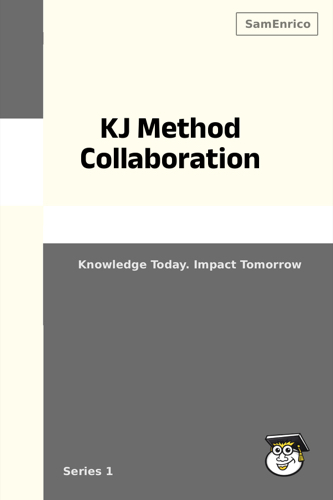
KJ Method Collaboration eBook
Japanese affinity diagramming for chaotic ideas.
Japanese affinity diagramming for chaotic ideas.
Formats
Free sample
Chapter 1: The Nepalese Notebooks--–- In 1959, Jiro Kawakita sat on the floor of a dusty Himalayan inn, surrounded by 2,347 individual slips of paper. Each slip contained a single observation from his fieldwork on the water distribution systems of Nepal’s remote mountain villages. He had been awake for thirty-one hours. His notebooks were full. His mind was empty.
And every Western analytical framework he had brought from Tokyo had failed him completely.The problem was not a lack of data. Kawakita had more data than any anthropologist had ever collected on this region. He had documented every stream, every irrigation ditch, every dispute over water rights, every seasonal migration pattern, every ritual offering made to the mountain spirits believed to control the rain. His notebooks were overflowing with facts. But when he tried to write his final report, he discovered something terrifying: the facts did not fit together.The standard approach, taught in every university in the West, was to begin with a theoretical framework.
You selected your categories in advance—economics, kinship, religion, politics—and then sorted your observations into those pre-existing boxes. This was considered the only scientific way to proceed. Kawakita had done exactly that. He had created a beautiful set of categories before leaving Japan. And those categories had turned out to be completely wrong.The villagers did not separate economics from religion.
They did not distinguish between a political dispute and a family argument. They did not have a word for "infrastructure" that did not also mean "ancestral obligation." Kawakita’s Western categories were not just inadequate; they were actively distorting what he had witnessed. He was forcing Nepalese reality into Japanese and German and British philosophical boxes that had been designed for completely different worlds.So he did something desperate. He cut up his notebooks.The Birth of a Radical Method Kawakita took every observation, every quote, every measurement, and every description and wrote it on a separate slip of paper. He did not edit.
He did not summarize. He did not try to make the language more academic or more elegant. He wrote exactly what he had seen and heard, in the words he had recorded at the time. Then he spread all 2,347 slips across the floor of his room.What happened next would change the course of business management, product design, and collaborative problem-solving for the next half-century—though Kawakita did not know it yet. He began moving the slips without speaking.
He did not think about where they should go. He simply picked up a slip, read it, and let his hand place it somewhere near other slips that felt related. He did not name the piles. He did not create categories in advance. He just moved paper.For the first hour, nothing made sense.
The floor looked like chaos. Slips about water flow rates were next to slips about wedding ceremonies. Observations about crop rotation were tangled with notes about mountain spirits. A visiting British anthropologist looked in, saw the mess, and concluded that Kawakita had suffered a breakdown.But Kawakita kept moving. And slowly, almost imperceptibly, the chaos began to organize itself.
Slips that had nothing in common logically were clustering together intuitively. A pile formed around slips that mentioned "waiting." Another pile formed around slips that mentioned "trust." A third pile, which Kawakita had never anticipated, formed around slips that mentioned "the sound of water at night."He had not imposed order on the data. The data had revealed its own order to him.The Seven Insights That Became a Method Kawakita spent the next two years refining what he had stumbled upon in that Himalayan inn. He tested the method on other fieldwork projects. He taught it to his students at the Tokyo Institute of Technology.
He wrote and rewrote the rules until they were simple enough to teach in an afternoon but deep enough to work on any chaotic problem. By 1965, he had distilled the method into seven core insights that remain the foundation of the KJ Method to this day.Insight One: The brain processes information differently when the body is involved.Kawakita noticed that when he physically moved paper, his thinking changed. The act of reaching, grasping, and placing engaged neural pathways that remained dormant when he simply looked at a list or a spreadsheet. His hands were not just carrying out commands from his brain; his hands were teaching his brain something new. This is why the KJ Method has always insisted on physical cards and physical movement.
The method is not a metaphor. It is a physical practice.Insight Two: Silence is not emptiness; it is the absence of interference.The British anthropologist who thought Kawakita had broken down was disturbed by the silence. But Kawakita had discovered that silence allowed something rare and valuable to happen: the data could speak without being interrupted by the egos, status hierarchies, and social performances that dominate most group conversations. In silence, the loudest person in the room could not dominate. The most senior executive could not signal their opinion with a sigh or a nod.
The introvert with the best idea could not be talked over. The silence was not a void. It was a protection.Insight Three: Categories are the enemy of discovery.Every time we name a pile before we have examined its contents, we stop seeing what is actually there. Kawakita called this "the tyranny of the label." Once you call a pile "customer service issues," you will stop noticing that some of the cards inside are actually about product design, some are about pricing, and some are about the weather. The label blinds you.
This is why the KJ Method forbids pre-named categories and delays the creation of headers until the piles have stabilized through silent sorting.Insight Four: The data always knows more than you do.This is the most humbling insight in the entire KJ Method. Kawakita discovered that when his analysis conflicted with his observations, the observations were always right. His theories might be elegant, his frameworks might be prestigious, his education might be impressive—but the data had actually been there. The data had seen what happened. The data did not care about his reputation.
This insight led directly to the "70% Rule" introduced earlier in this book: let the raw data speak for itself, even when it contradicts everything you believe.Insight Five: Patterns emerge only when you stop forcing them.Kawakita observed that the most important patterns in his Nepalese data appeared only after he had stopped trying to find them. For the first several hours of sorting, the piles seemed random. But if he kept moving, kept listening to the paper, kept trusting the process, the patterns would eventually reveal themselves. This required a kind of patience that most Western business cultures do not value. The KJ Method forces that patience by design.
You cannot rush the silent sort. You cannot skip to the headers. You have to wait for the data to speak.Insight Six: The outlier is not a mistake; it is a message.Every KJ session produces stray cards—cards that do not seem to belong anywhere. Most methods tell you to ignore or…
This is the end of the free sample. Get the eBook to keep going. Buy now
About this book
Details
- Author
- Mclaurin Beatriz
- Publisher
- SamEnrico
- Language
- English
- Genre
- Non-Fiction, Self-Help, KJ
- Released
- 2026-06-08
- Pages (approx.)
- 135
- Available as
- eBook, Audiobook

Read better in the ZLOADR app
Your eBooks on your phone or tablet. Sign in with your SamEnrico account and start reading.
More by Mclaurin Beatriz
 Hypnotic Pain Transformation WorkbookMclaurin Beatriz$11.99
 Neck Touching ComfortMclaurin Beatriz$11.99
 Self Esteem After Career BreakMclaurin Beatriz$11.99
 Remote Work CybersecurityMclaurin Beatriz$11.99
 Design Thinking for EngineersMclaurin Beatriz$11.99
 Parental Anger at StepchildMclaurin Beatriz$11.99
 Conversation Starters for Art GalleriesMclaurin Beatriz$11.99
 Roberto Clemente: The Humanitarian Who Hit for the CycleMclaurin Beatriz$11.99
 Parisian Lights: How France Illuminated the Harlem RenaissanceMclaurin Beatriz$11.99
 A Collector's Handbook to the Star CometMclaurin Beatriz$11.99
 Wood Meadowgrass HarvestingMclaurin Beatriz$11.99
 How to Produce Optical InstrumentsMclaurin Beatriz$11.99