
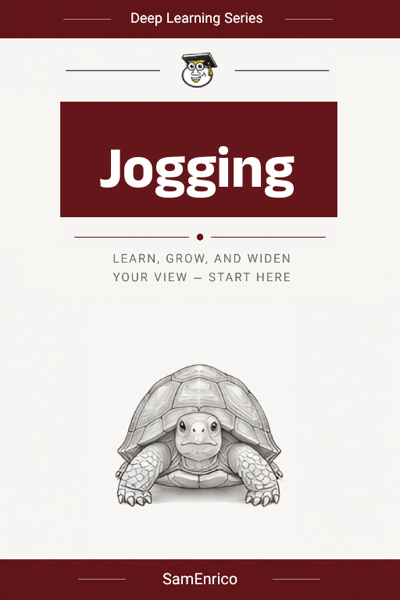
Non-FictionInformativeEducational
Jogging eBook
A Coursebook on Jogging
A Coursebook on Jogging
Formats
Free sample
Chapter 1: The Death of Jogging--–- On a cool November morning in 1972, a fifty-two-year-old insurance executive named Jim Fixx laced up his running shoes and did something that would change the lives of thirty million Americans. He jogged. Not because he was training for a race. Not because he was chasing a time goal. He jogged because a doctor had told him he was overweight, stressed, and heading for an early heart attack.
So he went outside and moved—slowly, awkwardly, with the gait of a man who had never run a day in his adult life. Within a decade, Fixx would publish The Complete Book of Running, sell over a million copies, and become the face of the 1970s jogging craze. By 1984, he would be dead of a heart attack at age fifty-two, collapsing on a Vermont road mid-stride.The headlines wrote themselves. “Jogging Kills,” they screamed. “Runner’s Heart Attack Exposes Fitness Fraud.” For a generation, the lesson seemed clear: jogging was a fad, a dangerous one, and Jim Fixx had been its martyr.But here is what the headlines didn’t tell you.
An autopsy revealed that Fixx had severe coronary artery disease—three major vessels blocked at seventy to ninety-five percent. He had a congenital heart defect that ran in his family. His father had died of a heart attack at forty-three, without jogging. The truth, buried beneath the sensationalism, was that jogging had given Fixx an extra decade of life. His doctors estimated he would have died in his early forties without the exercise.
Instead, he lived to fifty-two. He died while jogging, not because of it. The distinction matters. It matters enormously.And yet, nearly forty years after Fixx’s death, the myth persists. Jogging is still seen by millions as the consolation prize of fitness—what you do when you’re not fast enough to run, not strong enough to lift, not coordinated enough to play sports.
It is mocked in memes. It is dismissed by fitness influencers who insist that “slow cardio is a waste of time.” It is treated as the exercise of last resort. This chapter is here to tell you that the opposite is true. Jogging is not the consolation prize. It is the foundation.
It is the single most underrated, over-misunderstood, and scientifically validated form of exercise available to the human animal. And the only thing that has ever held it back is its own name.The Stigma of the Slow Let us be honest about the word itself. “Jogging” sounds soft. It sounds like something your aunt does in a neon windbreaker from 1989. It lacks the aggression of “sprinting,” the purity of “running,” the grit of “trail running.” When someone says they are a jogger, they apologize for it.
“I’m not a real runner,” they say. “I just jog.”This linguistic self-flagellation is not accidental. It has been engineered by a culture that worships speed, intensity, and suffering. The fitness industry has spent forty years telling you that if you are not gasping, sweating, or collapsing at the finish line, you are not really working. High-intensity interval training (HIIT) exploded because it promised maximum results in minimum time.
Cross Fit built an empire on the idea that “mediocre” effort is moral failure. Marathon culture, for all its virtues, has convinced millions that a 5k is not a “real” race unless you are chasing a personal record.In this ecosystem, jogging is heresy. Jogging says: go slow. Jogging says: enjoy the view. Jogging says: you don’t need to suffer to deserve to move.And that is precisely why the fitness industry hates it.
You cannot sell a $200 pair of carbon-plated marathon shoes to someone who jogs three miles in forty minutes. You cannot sell a $15 energy gel to someone who drinks water from a garden hose. You cannot sell a “30-day shred” program to someone who has discovered that consistency, not intensity, is the real secret to lifelong health.The industry has a vested interest in making you feel like a failure. If you are happy jogging twenty minutes a day, three days a week, you will never buy their coaching plans, their supplements, their “transformation challenges.” You will have discovered the most dangerous truth of all: that simple, consistent, low-intensity movement is enough.What This Book Actually Believes Before we go any further, let me state clearly what this book is and is not.This is not a training manual for marathoners. If you want to run a sub-three-hour marathon, there are excellent books by coaches like Jack Daniels and Pete Pfitzinger.
This is not one of them.This is not a guide to barefoot running, minimalist shoes, or the Pose Method. We will discuss those things—specifically in Chapter 12, where the full barefoot debate lives—but they are not the center of this book.This is not a weight-loss manifesto. Jogging can help with weight management, as we will cover in Chapter 5, but jogging for weight loss is like reading Shakespeare for spelling. You are missing the point.What this book is is a complete coursebook for the person who wants to jog—consistently, joyfully, safely—for the rest of their life. It is for the desk worker who feels stiff and tired.
It is for the former athlete whose knees hurt. It is for the parent who has thirty minutes between school pickup and dinner. It is for the sixty-year-old who wants to play with grandchildren without getting winded. It is for the person who has tried and failed to “get into running” six times because every plan told them to go faster, longer, harder.This book believes that success is not measured in minutes per mile. It is measured in years per life.
Are you still jogging one year from now? Five years? Twenty? If the answer is yes, you have won. Every race medal, every personal record, every “likes” on Strava—those are decorations.
The foundation is consistency.The Scientific Case for Jogging (Short Version)We will spend the next eleven chapters building the scientific case in detail, but let me give you the headline findings now, so you understand why you are holding this book.First, cardiovascular health. A landmark study published in the Journal of the American College of Cardiology followed fifty-five thousand adults over fifteen years. The researchers found that jogging at a slow pace for just five to ten minutes per day reduced the risk of death from all causes by thirty percent and the risk of death from heart disease by forty-five percent. That is not a typo. Five to ten minutes.
Not an hour. Not a marathon. Five to ten minutes of slow jogging produced better outcomes than running faster for longer periods. The study’s authors coined a phrase that should be tattooed on every fitness influencer’s forehead: “More is not always better. Faster is not always better.
The best dose is the one that keeps you coming back.”Second, joint health. For decades, the conventional wisdom said that running destroyed your knees. This was based on nothing—literally no evidence—but it felt true. Running is high-impact. High-impact must be bad for joints.…
This is the end of the free sample. Get the eBook to keep going. Buy now
About this book
Details
- Author
- Spring Kaycee
- Publisher
- SamEnrico
- Language
- English
- Genre
- Non-Fiction, Informative, Educational
- Released
- 2026-06-02
- Pages (approx.)
- 139
- Available as
- eBook, Audiobook

Read better in the ZLOADR app
Your eBooks on your phone or tablet. Sign in with your SamEnrico account and start reading.
More by Spring Kaycee
 Self Hypnosis For Goal Achievement HandbookSpring Kaycee$11.99
 Meditation for Bunion PainSpring Kaycee$11.99
 Francis Christmas Proclamation HistorySpring Kaycee$11.99
 Hybrid Meeting Etiquette GuideSpring Kaycee$11.99
 Assertiveness for Legal ProfessionalsSpring Kaycee$11.99
 The Unseen Architect: How a Slave Built the PyramidsSpring Kaycee$11.99
 The Midnight Ride That Wasn’t: The Forgotten Spy Behind Paul Revere’s LegendSpring Kaycee$11.99
 Understanding Epilepsy TelangiectasiaSpring Kaycee$17.99
 House Sitting Mail ForwardingSpring Kaycee$12.99
 Harvard Extension vs LSE TechnologySpring Kaycee$12.99
 How to Become a Motorcycle RepairerSpring Kaycee$11.99
You may also like
 Hong Kong Handover 1997Dunn Johnnie$11.99
 Zumba For Postnatal Recovery CourseNeal Christian$11.99
 Zumba for BeginnersLadner Nikia$11.99
 YouTube Comment Mining GuideHumes Pandora$12.99
 Worry Box MeditationCarlin Rudy$11.99
 Workplace Stress MeditationNguyen Lynn$11.99
 Workplace Stress and Sleep RepairHawley Ivory$11.99
 Workplace Perfectionism CureDelaney Jeffry$11.99
 Workplace Injustice Anger GuideWallen Isabelle$11.99
 Work Addiction and Burnout LinkGreenwood Ester$11.99
 Women in Yoga and WellnessBeattie Galina$11.99
 Women in Stand Up ComedyChun Evangeline$11.99