
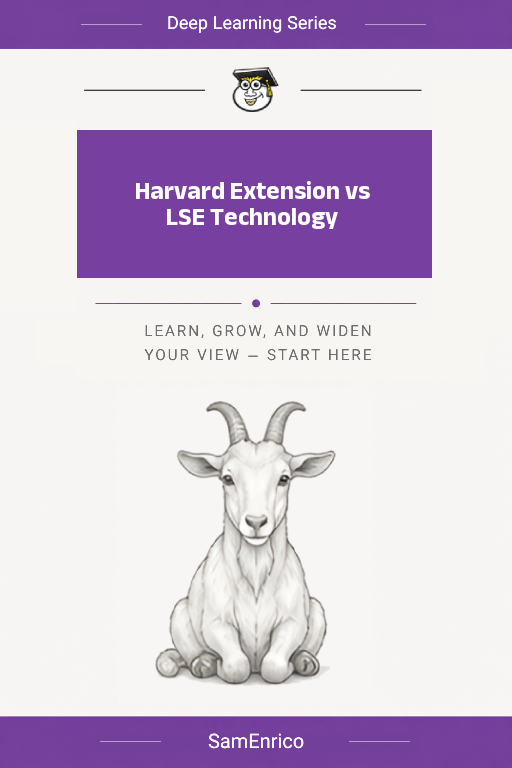
Non-FictionStudent's ShortcutEdTech Compare
Harvard Extension vs LSE Technology
Compare learning platforms, mobile apps, and digit
Compare learning platforms, mobile apps, and digital tools for online education.
Formats
About this book
Free sample
Chapter 1: The Prestige Paradox–- On a rainy Tuesday in March 2020, a Harvard Extension student named Maria sat in her cramped studio apartment in São Paulo, watching her computer screen flicker between three different login portals. She was trying to access her digital media syllabus, but the link had expired. Her professor had posted it on a third-party tool called Notion, which required a separate password from her Canvas login, which was different from her Harvard Key. Across the Atlantic, in a suburban house outside Nairobi, an LSE online student named James was having the opposite problem. He opened a single app on his phone—the LSE Student Hub—and within two taps, he could see his entire term’s schedule, download his lecture videos for the commute home, and message a classmate in Singapore about their group project.
Both students were enrolled in what their universities called “premium online education.” Both were paying substantial tuition. Both would receive diplomas bearing names that carried centuries of prestige. But their daily experience of learning could not have been more different.This book is about that difference. It is not a ranking. It is not a buyer’s guide that declares one school “better” than the other.
It is, instead, a technological and philosophical autopsy of two of the most prestigious institutions in the world—Harvard University through its Extension School, and the London School of Economics through its online programs via the University of London—and how they have made radically different bets on the future of digital learning. One has chosen modularity, flexibility, and a “best-in-class” toolkit that assumes a tech-savvy, self-directed student. The other has chosen integration, mobile-first design, and a cohesive ecosystem that assumes a global student body with unpredictable internet access and a need for structure. One treats technology as a set of raw materials for students to assemble. The other treats technology as a finished product delivered to students with care instructions included.What makes this comparison urgent is not merely academic curiosity.
The global online education market is projected to reach $74 billion by 2025, and the pandemic permanently destroyed the stigma…
This is the end of the free sample. Get the eBook to keep going. Buy now
Contents
- Chapter 1
- Chapter 2
- Chapter 3
- Chapter 4
- Chapter 5
- Chapter 6
- Chapter 7
- Chapter 8
- Chapter 9
- Chapter 10
- Chapter 11
- Chapter 12
Details
- Author
- Spring Kaycee
- Publisher
- SamEnrico
- Language
- English
- Genre
- Non-Fiction, Student's Shortcut, EdTech Compare
- Released
- 2026-06-01
- Pages (approx.)
- 134
- Available as
- eBook, Audiobook

Read better in the ZLOADR app
Your eBooks on your phone or tablet. Sign in with your SamEnrico account and start reading.
More by Spring Kaycee
 Self Hypnosis For Goal Achievement HandbookSpring Kaycee$11.99
 Meditation for Bunion PainSpring Kaycee$11.99
 Francis Christmas Proclamation HistorySpring Kaycee$11.99
 Hybrid Meeting Etiquette GuideSpring Kaycee$11.99
 Assertiveness for Legal ProfessionalsSpring Kaycee$11.99
 The Unseen Architect: How a Slave Built the PyramidsSpring Kaycee$11.99
 The Midnight Ride That Wasn’t: The Forgotten Spy Behind Paul Revere’s LegendSpring Kaycee$11.99
 JoggingSpring Kaycee$11.99
 Understanding Epilepsy TelangiectasiaSpring Kaycee$17.99
 House Sitting Mail ForwardingSpring Kaycee$12.99
 How to Become a Motorcycle RepairerSpring Kaycee$11.99
You may also like
 Hong Kong Handover 1997Dunn Johnnie$11.99
 Zumba For Postnatal Recovery CourseNeal Christian$11.99
 Zumba for BeginnersLadner Nikia$11.99
 YouTube Comment Mining GuideHumes Pandora$12.99
 Worry Box MeditationCarlin Rudy$11.99
 Workplace Stress MeditationNguyen Lynn$11.99
 Workplace Stress and Sleep RepairHawley Ivory$11.99
 Workplace Perfectionism CureDelaney Jeffry$11.99
 Workplace Injustice Anger GuideWallen Isabelle$11.99
 Work Addiction and Burnout LinkGreenwood Ester$11.99
 Women in Yoga and WellnessBeattie Galina$11.99
 Women in Stand Up ComedyChun Evangeline$11.99