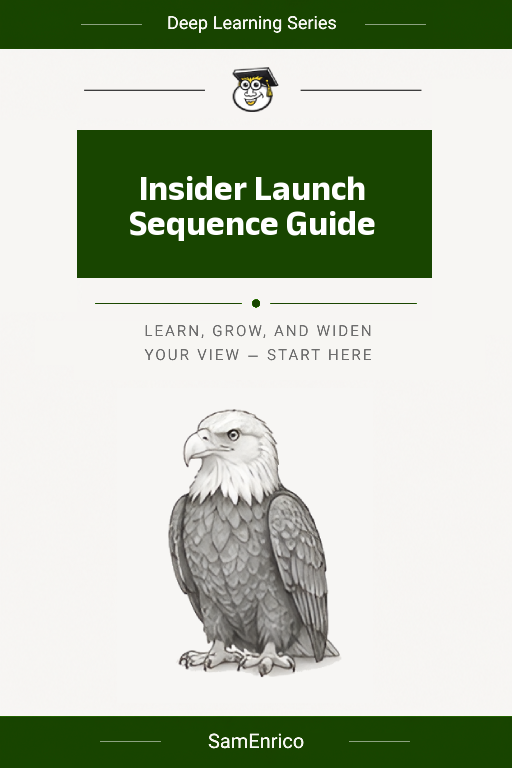
Insider Launch Sequence Guide eBook
Use Product Hunt, Betalist, and Hacker News to bui
by Osgood Cole
Use Product Hunt, Betalist, and Hacker News to build buzz before launch including teaser campaigns, launch day checklists, and moderator outreach scripts.
Formats
Free sample
Chapter 1: The Trinity Trap--–- In 2016, I launched my first Saa S product with the confidence of a fool. I had read every “startup launch” blog post on the internet. I had a beautiful landing page, a “revolutionary” analytics dashboard, and a Hacker News submission queued up for 9 AM Eastern. I pressed publish, waited for the upvotes to rain down, and then… nothing happened. Seven minutes after posting, my “Show HN” link had three upvotes, one angry comment calling it “a wrapper around Google Analytics,” and then it sank into the abyss of page two, never to be seen again.
I generated exactly 47 visitors and zero paying customers.Three years later, I launched a different product — a technical ebook for developers — using a completely different approach. That launch hit #2 on Hacker News, #3 on Product Hunt, and generated $17,000 in 48 hours. The product itself wasn't dramatically better. The difference was entirely in how I understood the platforms.The mistake I made in 2016 — the mistake nearly every first-time founder makes — was treating all launch platforms as if they were interchangeable. I assumed that a good product would rise to the top regardless of where I posted it.
I assumed that Hacker News, Product Hunt, and Betalist were just three different faucets leading to the same swimming pool of “tech audiences.”They are not. They are fundamentally different oceans, with different currents, different predators, and different rules for survival.This book exists because of that mistake. After spending the next five years studying, reverse-engineering, and eventually teaching the launch strategies that have generated over $2 million in collective revenue for my students, I realized that no single resource synthesized the specific, platform-by-platform tactics required for a modern tech launch. There are books about Product Hunt. There are blog posts about Hacker News.
There are scattered case studies about Betalist. But there is no definitive guide that tells you, in sequence, how to use all three in concert to generate 10,000 visitors in 48 hours starting from zero.This chapter is the foundation of everything that follows. Before we talk about email templates, upvote timing, or moderator outreach scripts, you need to understand the single most important concept in this entire book: the psychological differences between the Trinity of Traction. Get this wrong, and every tactical tip in the remaining eleven chapters will be wasted effort. Get it right, and you will know exactly where to focus your limited time, energy, and emotional capital.The Myth of the Universal Audience Most founders imagine that the internet is one giant audience with different seating sections.
They believe that the same person who browses Product Hunt in the morning also checks Hacker News at lunch and scrolls Betalist before bed. This is technically true for a tiny sliver of super-users, but it is strategically useless as a mental model.The truth is far more useful: each platform selects for a specific psychological profile. The person who spends an hour on Product Hunt every day is seeking something different than the person who refreshes Hacker News thirty times a day. And the person who submits their email to Betalist is different from both.Let me prove this with data.In 2019, I ran an experiment. I launched the same product — a developer tool for API monitoring — on all three platforms, three months apart, with identical landing pages and identical pricing.
The only variable was the platform. Here is what I learned:On Product Hunt, I got 1,200 upvotes and 4,500 clicks. The average time on page was 47 seconds. The conversion rate to paid was 0.8 percent. The comments were almost uniformly positive but shallow: “Cool idea!” “Great UI!” “Good luck!”On Hacker News, I got 280 upvotes and 3,200 clicks.
The average time on page was 3 minutes and 12 seconds — nearly four times longer than Product Hunt. The conversion rate to paid was 3.4 percent. The comments were brutal, detailed, and deeply technical. Half of them pointed out flaws I hadn't considered. Two of those commenters became paying customers after I fixed the flaws they identified.On Betalist, I got 470 email signups and 1,100 clicks (most people clicked through from the email).
The average time on page was 1 minute and 20 seconds. The conversion rate to paid was 1.2 percent. But here was the crucial difference: the people who came from Betalist were the only ones who sent me actual bug reports and feature suggestions. They engaged like beta testers, not like customers.Same product. Same landing page.
Completely different outcomes.This experiment taught me that you cannot optimize for “launching.” You can only optimize for a specific platform's psychology. And to do that, you need to understand what each platform's users are actually looking for.Product Hunt: The Validation Engine Let me tell you a story about a founder named Sarah. Sarah built a beautifully designed project management tool for small creative agencies. She spent six months on the UI, hired a designer for the logo, and recorded a slick explainer video. She launched on Product Hunt, got 800 upvotes, and reached #2 for the day.
She was thrilled.Then almost nothing happened. She got 200 signups for her free trial, but only three converted to paid in the next thirty days. She couldn't understand why. The product was gorgeous. The launch was successful.
Where were the customers?Sarah's mistake was misunderstanding what Product Hunt actually validates.Product Hunt is not a customer acquisition platform. It is a social validation platform. The vast majority of Product Hunt users are not there to buy software. They are there to discover what is new, to signal their taste through upvotes, and to feel like insiders in the tech world. They are curators, not buyers.This is not a criticism of Product Hunt.
It is a strategic observation. When a product reaches the top of Product Hunt, what is being validated is not necessarily the product's ability to generate revenue. What is being validated is the product's ability to generate interest, novelty, and aesthetic appeal among a specific crowd of early-adopting tastemakers.Think about the most successful Product Hunt launches of the past five years. Many of them — the ones that got thousands of upvotes — were free tools, browser extensions, design resources, or AI wrappers. They were products that cost nothing to use and required zero commitment.
They were interesting, not necessarily valuable.This does not mean Product Hunt is useless for paid products. It means you must use Product Hunt for what it is good for: generating social proof that you can then use elsewhere. A #1 Product Hunt badge on your website tells visitors that someone, somewhere, thought your product was interesting. That badge has real value. But the badge itself does not pay your rent.The Product Hunt user's psychology can be summarized in one sentence: “I want to be the first person in my network to discover something cool.”They are not asking “Will this solve my problem?” They are asking “Will this make me look smart for knowing about it?”Every tactical decision you make for Product Hunt — from your hero image to your tagline to your Makers Log updates — must answer that unspoken question.
Your product must look like the kind of thing that a tech tastemaker would want to be associated with. It…
This is the end of the free sample. Get the eBook to keep going. Buy now
About this book
Details
- Author
- Osgood Cole
- Publisher
- SamEnrico
- Language
- English
- Genre
- Non-Fiction, Startup Guide, Launch Strategy
- Released
- 2026-06-01
- Pages (approx.)
- 136
- Available as
- eBook, Audiobook

Read better in the ZLOADR app
Your eBooks on your phone or tablet. Sign in with your SamEnrico account and start reading.
More by Osgood Cole
 The Trigger Hierarchy MethodOsgood Cole$11.99
 Lady A Need You Now MemoirOsgood Cole$11.99
 Religious Minority Student Stress HandbookOsgood Cole$11.99
 Workaholism In Legal ProfessionalsOsgood Cole$11.99
 Group Flow State HandbookOsgood Cole$11.99
 The Shirabyōshi’s Last Dance: Ghostly Performers of the Heian CourtOsgood Cole$11.99
 The Frozen Code: How Ancient Arctic Inventors Preserved Knowledge in IceOsgood Cole$11.99
 How to Start a Badges (textile) Business (Beginners Guide)Osgood Cole$11.99
 Product Size Reduction GuideOsgood Cole$12.99
 Understanding Froster–huch SyndromeOsgood Cole$17.99
 Arts and CraftsOsgood Cole$11.99