
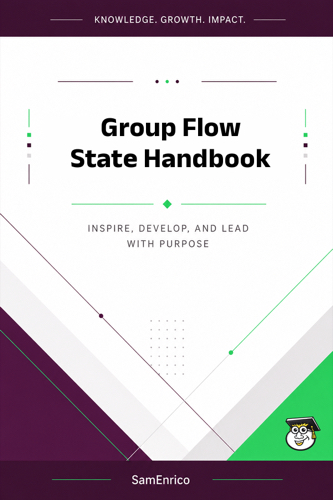
Non-FictionSelf-HelpFlow State
Group Flow State Handbook
Achieve collective creative flow with these collab
by Osgood Cole
Achieve collective creative flow with these collaboration techniques for high performing teams.
Formats
About this book
Free sample
Chapter 1: The Genius Lie--–- In 1971, a young psychologist named Mihaly Csikszentmihalyi began asking a question that most researchers had considered unaskable: What makes a life worth living? While his contemporaries studied neurosis, trauma, and mental illness, Csikszentmihalyi became fascinated with the opposite end of the human experience—those rare moments when people felt truly alive, fully engaged, and utterly absorbed in what they were doing. He called this state "flow," and over the next three decades, his research would change how we think about happiness, creativity, and human performance.But Csikszentmihalyi made a mistake. It was an understandable mistake, one shared by nearly every psychologist who came after him. He studied flow almost exclusively as an individual phenomenon—the painter losing herself in the canvas, the surgeon moving through a procedure with effortless precision, the rock climber finding the perfect sequence of handholds.
The image of flow became the solitary genius, the lone athlete, the individual in quiet communion with their craft.This image is wrong.Or rather, it is incomplete. Dangerously incomplete.The Problem with the Lone Genius Walk into any modern office, and you will see the legacy of this individualistic view of excellence. Open floor plans designed to maximize individual productivity. Performance reviews that evaluate solo contributions. Bonus structures that reward personal achievement.
Hiring processes that search for the next "rock star" or "ninja" who will single-handedly save the team. We have built our entire organizational culture around a fiction—the fiction that breakthrough ideas emerge from isolated brilliant minds, and that collaboration is merely the polite sharing of those pre-formed ideas.The data tells a very different story.In a landmark study spanning twenty years and covering more than two thousand scientific breakthroughs, researcher Kevin Dunbar found that the most important discoveries almost never happened when scientists were working alone. They happened in laboratory meetings, over coffee, in the hallway conversations where one researcher would mention an unexpected result and another would connect it to a completely different problem. Dunbar called this the "in vivo" pattern of discovery—ideas emerging not from solitary contemplation but from the friction and…
This is the end of the free sample. Get the eBook to keep going. Buy now
Contents
- Chapter 1
- Chapter 2
- Chapter 3
- Chapter 4
- Chapter 5
- Chapter 6
- Chapter 7
- Chapter 8
- Chapter 9
- Chapter 10
- Chapter 11
- Chapter 12
Details
- Author
- Osgood Cole
- Publisher
- SamEnrico
- Language
- English
- Genre
- Non-Fiction, Self-Help, Flow State
- Released
- 2026-06-06
- Pages (approx.)
- 144
- Available as
- eBook, Audiobook

Read better in the ZLOADR app
Your eBooks on your phone or tablet. Sign in with your SamEnrico account and start reading.
More by Osgood Cole
 The Trigger Hierarchy MethodOsgood Cole$11.99
 Lady A Need You Now MemoirOsgood Cole$11.99
 Religious Minority Student Stress HandbookOsgood Cole$11.99
 Workaholism In Legal ProfessionalsOsgood Cole$11.99
 The Shirabyōshi’s Last Dance: Ghostly Performers of the Heian CourtOsgood Cole$11.99
 The Frozen Code: How Ancient Arctic Inventors Preserved Knowledge in IceOsgood Cole$11.99
 How to Start a Badges (textile) Business (Beginners Guide)Osgood Cole$11.99
 Insider Launch Sequence GuideOsgood Cole$12.99
 Product Size Reduction GuideOsgood Cole$12.99
 Understanding Froster–huch SyndromeOsgood Cole$17.99
 Arts and CraftsOsgood Cole$11.99
You may also like
 Hong Kong Handover 1997Dunn Johnnie$11.99
 Zumba For Postnatal Recovery CourseNeal Christian$11.99
 Zumba for BeginnersLadner Nikia$11.99
 YouTube Comment Mining GuideHumes Pandora$12.99
 Worry Box MeditationCarlin Rudy$11.99
 Workplace Stress MeditationNguyen Lynn$11.99
 Workplace Stress and Sleep RepairHawley Ivory$11.99
 Workplace Perfectionism CureDelaney Jeffry$11.99
 Workplace Injustice Anger GuideWallen Isabelle$11.99
 Work Addiction and Burnout LinkGreenwood Ester$11.99
 Women in Yoga and WellnessBeattie Galina$11.99
 Women in Stand Up ComedyChun Evangeline$11.99