
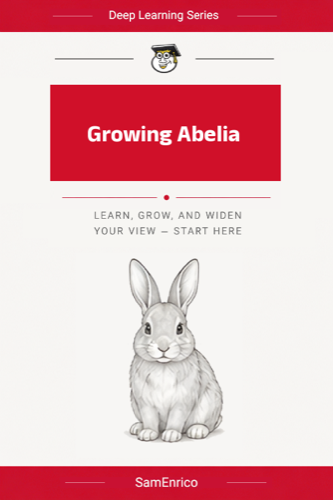
Non-FictionInformativeEducational
Growing Abelia
This publication, published by SamEnrico, covers G
This publication, published by SamEnrico, covers Growing Abelia
Formats
About this book
Free sample
Chapter 1: The Parking Lot Revelation--I killed my first Abelia. Not on purpose, of course. I ignored it completely, the way you ignore a plant you’ve decided is boring, common, and not worth your time. It sat in a one-gallon nursery pot on my back patio for an entire summer, tipped over behind a broken clay pot, receiving only the rain that happened to drift sideways onto its lopsided container. By autumn, it was a skeleton.
By winter, it was kindling. And I felt absolutely nothing.That was fifteen years ago, and I’ve since changed my tune. Dramatically. Because here’s the thing about Abelias: they’re not boring. They’re not common.
And the only thing that was beneath my attention back then was my own willingness to judge a book by its cover—or in this case, a shrub by its reputation.If you’ve picked up this book, you’ve probably seen Abelias before. You’ve definitely seen them. They’re those medium-sized shrubs with small, glossy leaves and clusters of tiny white or pink flowers that seem to last forever. They’re planted in front of office parks, along highway medians, and in the foundation plantings of apartment complexes. They’re the plants that landscapers use when they want something that won’t die, won’t complain, and won’t call attention to itself.
And because of that—because they do their job so quietly, so reliably, so unglamorously—we’ve collectively decided they’re not worth a second glance.We were wrong.The Plant That Refuses to Be a Drama Queen Let me tell you what an Abelia actually is, beyond the parking lot associations. The genus Abelia (pronounced uh-BEE-lee-uh, though you’ll hear some say ay-BEE-lee-uh) contains about thirty species of flowering shrubs, most native to eastern Asia and Mexico. The plant that dominates American gardens is a hybrid, Abelia × grandiflora, which crossed two Chinese species back in the 1880s at an Italian nursery. That hybrid turned out to be tougher, more floriferous, and more adaptable than either parent—the gardening equivalent of a mule that can also sing opera.The…
This is the end of the free sample. Get the eBook to keep going. Buy now
Contents
- Chapter 1
- Chapter 2
- Chapter 3
- Chapter 4
- Chapter 5
- Chapter 6
- Chapter 7
- Chapter 8
- Chapter 9
- Chapter 10
- Chapter 11
- Chapter 12
Details
- Author
- Oldham Breanne
- Publisher
- SamEnrico
- Language
- English
- Genre
- Non-Fiction, Informative, Educational
- Released
- 2026-05-23
- Pages (approx.)
- 136
- Available as
- eBook, Audiobook

Read better in the ZLOADR app
Your eBooks on your phone or tablet. Sign in with your SamEnrico account and start reading.
More by Oldham Breanne
 HGH and Bone Density ConnectionOldham Breanne$11.99
 Pandemic Ethics Decision GuideOldham Breanne$11.99
 Airport Terminal Memory PathOldham Breanne$11.99
 Goal Adjustment GuideOldham Breanne$11.99
 Foster Care Locked KitchenOldham Breanne$11.99
 Chemical BurnOldham Breanne$11.99
 Opioid Hyperalgesia GuideOldham Breanne$11.99
 HIIT Master GuideOldham Breanne$11.99
 The Druid's Gambit: A Cloak-and-Dagger Spell in the Tuatha Dé DanannOldham Breanne$11.99
 The Corsairs of the Stage: Black Ballet’s Golden AgeOldham Breanne$11.99
 How to Produce Window FramesOldham Breanne$11.99
 How to Produce Material Handling ToolsOldham Breanne$11.99
You may also like
 Hong Kong Handover 1997Dunn Johnnie$11.99
 Zumba For Postnatal Recovery CourseNeal Christian$11.99
 Zumba for BeginnersLadner Nikia$11.99
 YouTube Comment Mining GuideHumes Pandora$12.99
 Worry Box MeditationCarlin Rudy$11.99
 Workplace Stress MeditationNguyen Lynn$11.99
 Workplace Stress and Sleep RepairHawley Ivory$11.99
 Workplace Perfectionism CureDelaney Jeffry$11.99
 Workplace Injustice Anger GuideWallen Isabelle$11.99
 Work Addiction and Burnout LinkGreenwood Ester$11.99
 Women in Yoga and WellnessBeattie Galina$11.99
 Women in Stand Up ComedyChun Evangeline$11.99