
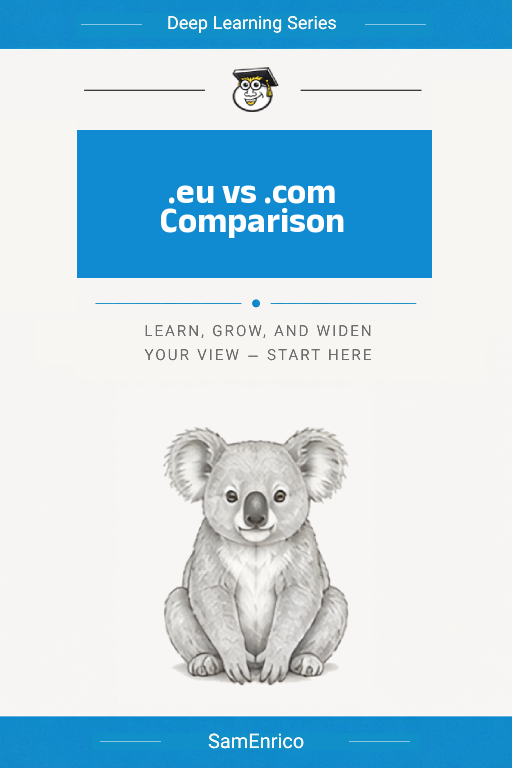
Non-FictionFirst 30 DaysEU Comparison
.eu vs .com Comparison eBook
Weighs .eu against .com for European businesses in
Weighs .eu against .com for European businesses including regional trust, GDPR compliance, and market positioning.
Formats
Free sample
Chapter 1: The Address Bar Lie...--–- Every time a European customer types a web address, they make a judgment in less than three seconds. They do not read your privacy policy. They do not check your SSL certificate’s expiration date. They do not Google your company’s legal registration. They look at the domain name, and their brain decides: trust or leave.
That decision happens before a single pixel of your website loads. Most business owners believe the lie that a domain is just a technical necessity—a string of characters pointing to a server. That lie has cost European companies millions in lost sales, unnecessary compliance headaches, and legal battles they never saw coming.The truth is brutally simple: your domain extension is a psychological weapon, a legal contract, and a trust signal all wrapped into one. And for European businesses in the post-Brexit, post-GDPR era, the choice between .eu and .com has never been more consequential. This chapter dismantles the address bar lie and rebuilds it as a strategic asset.
By the time you finish, you will never look at a domain name the same way again.The Three-Second Judgment Neuroscience research on digital trust shows that website visitors form a first impression in 50 milliseconds—that is 0.05 seconds. But the domain extension judgment happens even faster. It is automatic, subconscious, and rooted in decades of internet conditioning. The .com extension has been the default since 1985. It is the digital equivalent of a firm handshake in a business suit.
But here is the problem: that handshake belongs to American jurisdiction.For a customer in Munich, Lyon, or Milan, a .com address triggers an ancient neurological shortcut. Their brain asks: Is this familiar? Yes. Is this safe? Probably.
Does this belong to my world? No. That final question is the crack in the armor. Familiarity is not the same as trust. Trust requires belonging.
And .com does not belong to Europe.The .eu extension, by contrast, triggers a different cascade. It is less familiar but more aligned. The European customer’s brain asks: Is this familiar? Somewhat. Is this safe?
The registry is bound by my laws. Does this belong to my world? Yes—this business has gone through the trouble of verifying an EU presence. The trade-off is between raw familiarity (which favors .com) and jurisdictional alignment (which favors .eu). There is no universal winner.
The winner depends entirely on where your customer sits and what they value.Consider two identical e-commerce stores selling organic baby clothing. Store A uses organicbaby.com. Store B uses organicbaby.eu. A German mother searching for chemical-free onesies visits both. She does not know about the CLOUD Act or GDPR.
She does not care about registry operators. But she feels something different when she sees .eu. It feels local, accountable, less likely to disappear with her credit card information. That feeling is not irrational. It is based on a lifetime of exposure to country-specific domains (.de, .fr, .it) that have built a reputation for stricter verification and lower fraud rates.The Geography of Trust Trust is not universal.
It is geographic, cultural, and regulatory. A 2023 survey of 5,000 European consumers across eight countries revealed a striking pattern: when asked to rate domain extensions on trustworthiness (1 to 10), respondents gave .com an average of 7.2. That is respectable. But they gave their own country’s cc TLD an average of 8.7. And .eu scored 7.8—comfortably between the two.
The takeaway is subtle but powerful: .eu does not win against local cc TLDs, but it beats .com for European consumers who value regional accountability.The geography of trust becomes even more pronounced in business-to-business transactions. Procurement managers at large European companies and government agencies are trained to look for compliance signals. A .eu domain tells them: This company has an EU legal presence, is subject to EU data protection laws, and can be sued in European courts. A .com domain tells them: This company may have a European office, or it may be a shell company in Delaware. We will need to do due diligence.That due diligence costs time and money.
In competitive bidding processes, the .eu domain acts as a pre-filter. It signals that the vendor has already cleared basic jurisdictional hurdles. One German procurement officer interviewed for this book put it bluntly: "When I see a .com from a company claiming to serve the EU market, my first question is always: where is your EU establishment? If they cannot answer clearly, they go to the bottom of the pile."The German Case Study Germany provides the clearest laboratory for understanding the trust hierarchy. German consumers are notoriously privacy-conscious, legally sophisticated, and suspicious of non-European businesses.
The country’s .de domain is the third most popular cc TLD in the world (after .cn and .tk), with over 16 million registrations. German businesses have spent two decades training their customers to trust .de as the gold standard.But what about a German customer encountering .eu versus .com? A controlled experiment run by a Hamburg-based e-commerce association in 2024 tested exactly this. Four identical product pages (same price, same reviews, same layout) were shown to 2,000 German shoppers. The only variable was the domain extension: .de, .eu, .com, and a control group with no domain shown (product images only).
Participants were asked: "How likely are you to enter your credit card information on this site?" (1 to 10).The results were unambiguous:.de: 8.9.eu: 7.6.com: 6.8Control (no domain): 5.2The .eu domain closed 80 percent of the gap between .de and .com. For a business that cannot register .de (because it lacks a German address) or does not want to maintain separate German operations, .eu is the next best thing. It is not a perfect substitute, but it is a powerful one.The experiment also asked participants to explain their reasoning. Those who rated .eu highly said things like: "It feels European, so I assume they follow our privacy laws." Those who rated .com poorly said things like: "It could be from anywhere. Probably America.
I do not want my data going there." The emotional valence is unmistakable. For German shoppers, .com carries a data export tax—an unstated penalty for perceived jurisdictional distance.The Swedish Exception Not all EU countries treat .eu the same way. Sweden presents a fascinating counterpoint. Swedish consumers have among the highest internet trust levels in Europe. They are early adopters, comfortable with cross-border commerce, and less likely to favor domestic domains over international ones.
In a parallel experiment conducted in Stockholm, the trust gap between .se and .eu was less than half a point (8.4 vs 8.0), while .com scored 7.1.The lesson is that the .eu advantage is not uniform. It is strongest in countries with high privacy sensitivity (Germany, Austria, Netherlands) and weaker in countries with high international openness (Sweden, Denmark, Finland). A business selling primarily to Stockholm can reasonably prioritize .com without a major trust penalty. A business selling to Munich cannot.This variation is why the book introduces a trust geography map in the appendix. Chapter 1 establishes the principle: your customer’s country of origin modifies the value of .eu versus .com.
There is no single answer. But there is a framework. You must ask: where are my customers, and how do…
This is the end of the free sample. Get the eBook to keep going. Buy now
About this book
Details
- Author
- Seward Laronda
- Publisher
- SamEnrico
- Language
- English
- Genre
- Non-Fiction, First 30 Days, EU Comparison
- Released
- 2026-06-01
- Pages (approx.)
- 123
- Available as
- eBook, Audiobook

Read better in the ZLOADR app
Your eBooks on your phone or tablet. Sign in with your SamEnrico account and start reading.
More by Seward Laronda
 The Expectation Reset GuideSeward Laronda$11.99
 Smoking and ED GuideSeward Laronda$11.99
 MDD Subtypes ExplainedSeward Laronda$11.99
 The Working Memory for Chess GuideSeward Laronda$11.99
 Emergency Placement NightsSeward Laronda$11.99
 The Lost Tapes of the Apollo 11 Mission: Unearthed Secrets from the MoonSeward Laronda$11.99
 The Breeder's Guide to Randall Lineback CattleSeward Laronda$11.99
 CTO Interview Questions GuideSeward Laronda$12.99
 Opseu CourierSeward Laronda$11.99
 How to Become a Log PeelerSeward Laronda$11.99
You may also like
 Hong Kong Handover 1997Dunn Johnnie$11.99
 Zumba For Postnatal Recovery CourseNeal Christian$11.99
 Zumba for BeginnersLadner Nikia$11.99
 YouTube Comment Mining GuideHumes Pandora$12.99
 Worry Box MeditationCarlin Rudy$11.99
 Workplace Stress MeditationNguyen Lynn$11.99
 Workplace Stress and Sleep RepairHawley Ivory$11.99
 Workplace Perfectionism CureDelaney Jeffry$11.99
 Workplace Injustice Anger GuideWallen Isabelle$11.99
 Work Addiction and Burnout LinkGreenwood Ester$11.99
 Women in Yoga and WellnessBeattie Galina$11.99
 Women in Stand Up ComedyChun Evangeline$11.99