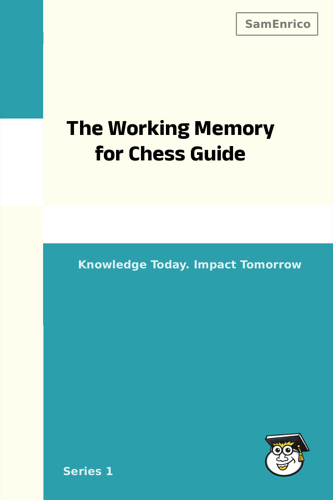
The Working Memory for Chess Guide
Holds move sequences and strategies.
Holds move sequences and strategies.
Formats
About this book
Free sample
Chapter 1: The Phantom Capacity--–- The first time it happened, you probably blamed the clock.You saw the tactic clearly. A beautiful sequence: knight takes on f7, the king drags itself to g8, your queen slides to h5, then rook to d1—checkmate in four. You calculated it twice. You saw the opponent’s only defensive move, the pathetic bishop block that only delayed the inevitable. You were proud.
This was the kind of calculation that separates club players from tournament winners.Then you looked away from the board for two seconds to adjust your pieces.When you looked back, the sequence was gone. Not fuzzy. Not half-remembered. Gone. Like a dream dissolving the moment you open your eyes.
You knew there was a knight sacrifice somewhere, but was it on f7 or e5? Did the queen go to h5 or h4? You stared at the board, feeling your face warm, your heart rate climb. The clock ticked. Your opponent drummed their fingers.
And you played something else—a safe move, a nothing move—and lost the winning attack forever.That was not a failure of chess knowledge. That was a failure of working memory.And here is the truth that most chess books will not tell you: you can study tactics for a thousand hours, master every opening trap, memorize every endgame principle, and still lose games because your brain’s mental scratchpad is too small to hold the sequences you discover.This book exists to fix that.The Great Deception of Chess Improvement Walk into any chess club or scroll through any improvement forum, and you will hear the same advice: study tactics, analyze your games, learn endgames, drill openings. All of this is useful. None of it addresses the fundamental bottleneck that separates players who calculate well from players who freeze in critical moments.The bottleneck is working memory.Working memory is not the same as long-term memory. Long-term memory is your hard drive—it stores everything you have ever learned.
The Sicilian Najdorf. The Lucena position. The pattern of a smothered mate. That knowledge can sit there for decades, perfectly…
This is the end of the free sample. Get the eBook to keep going. Buy now
Contents
- Chapter 1
- Chapter 2
- Chapter 3
- Chapter 4
- Chapter 5
- Chapter 6
- Chapter 7
- Chapter 8
- Chapter 9
- Chapter 10
- Chapter 11
- Chapter 12
Details
- Author
- Seward Laronda
- Publisher
- SamEnrico
- Language
- English
- Genre
- Non-Fiction, Self-Help, Chess
- Released
- 2026-06-06
- Pages (approx.)
- 143
- Available as
- eBook, Audiobook

Read better in the ZLOADR app
Your eBooks on your phone or tablet. Sign in with your SamEnrico account and start reading.
More by Seward Laronda
 The Expectation Reset GuideSeward Laronda$11.99
 Smoking and ED GuideSeward Laronda$11.99
 MDD Subtypes ExplainedSeward Laronda$11.99
 Emergency Placement NightsSeward Laronda$11.99
 The Lost Tapes of the Apollo 11 Mission: Unearthed Secrets from the MoonSeward Laronda$11.99
 The Breeder's Guide to Randall Lineback CattleSeward Laronda$11.99
 .eu vs .com ComparisonSeward Laronda$12.99
 CTO Interview Questions GuideSeward Laronda$12.99
 Opseu CourierSeward Laronda$11.99
 How to Become a Log PeelerSeward Laronda$11.99