
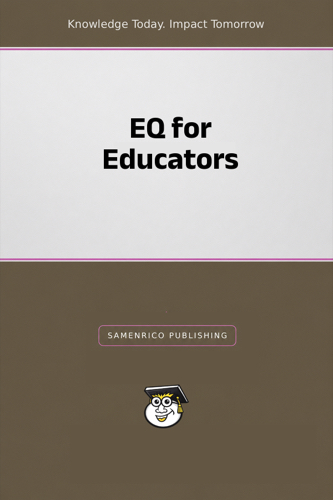
Free sample
Chapter 1: The Feelings First...--–- It was a Tuesday in October when Maria, a seventh-year math teacher, realized she had become the kind of teacher she never wanted to be. She stood at the front of her classroom, whiteboard marker in hand, staring at Jamal—a normally quiet student who had just thrown his pencil across the room. The class was silent. Twenty-nine faces watched her, waiting to see what she would do. In that frozen moment, Maria's training kicked in.
Not her pedagogical training—not the lesson planning, not the differentiated instruction strategies, not the standards alignment she had spent seven years perfecting. Something else took over. Her heart pounded. Her face flushed. Her voice came out louder than she intended: "Jamal, out.
Now."Jamal didn't move. He slumped lower in his chair, arms crossed, jaw tight. And then Maria did something she had never done before. She walked to his desk, pointed at the door, and said—no, shouted—"I said OUT." The room felt like it was holding its breath. Jamal eventually left, slamming the door behind him.
But the damage was done. Maria spent the rest of the period in a fog, going through the motions of her carefully prepared lesson while her mind replayed the scene on an endless loop. After the final bell, she sat alone in her classroom and cried.Later that week, Maria attended a professional development session on "Classroom Management Strategies." The presenter—a cheerful consultant with a Power Point full of clip art—suggested a token economy system: give students tickets for good behavior, take them away for bad behavior. Maria tried it for three weeks. It worked for about two days.
By the end of the month, she had given up on tickets, stopped calling parents (it never helped anyway), and started fantasizing about quitting teaching altogether. She had been named "Teacher of the Year" in her district two years ago. Now she barely recognized herself.This book is for Maria. And for every teacher who has ever stood in front of a classroom and felt their own emotions hijack their best intentions. It is for the kindergarten teacher whose voice is hoarse by 10 AM from redirecting the same three children over and over.
It is for the high school English teacher who has mastered the art of teaching Shakespeare but cannot figure out why one student's eye roll can ruin her entire day. It is for the special education teacher who loves her students fiercely but goes home every night too exhausted to make dinner. It is for the principal who watches teacher after teacher burn out and wonders why the expensive behavior programs never seem to stick.Here is the truth that Maria's training never taught her, that the cheerful consultant never mentioned, and that most teacher preparation programs completely ignore: Before you can teach content, you must manage the emotional channel through which all learning flows. And that emotional channel runs both ways. Your students are constantly broadcasting their emotional states—fear, anxiety, boredom, shame, anger—whether they know it or not.
And you are constantly broadcasting yours. The question is not whether emotions are present in your classroom. The question is whether you are fluent in reading them, skilled in regulating them, and intentional about using them to build connection rather than chaos.The Great Misconception: Why Lesson Plans Won't Save You Let us name the lie right now. The lie is this: teaching is primarily an intellectual profession. You learn the content.
You learn the pedagogy. You learn the standards. You learn the assessments. And if you do all of those things well enough, the classroom will run smoothly. This is what Maria believed.
This is what most teachers believe. This is what most teacher preparation programs implicitly teach.But here is the data that shatters that belief. A meta-analysis published in the Journal of Educational Psychology reviewed 30 years of research on teacher effectiveness and found that a teacher's emotional intelligence was a stronger predictor of student success than their years of experience, their subject matter knowledge, or even their scores on teacher certification exams. Let that sink in. How you manage your own emotions and read the emotions of your students matters more than how well you know math.Another study, this one from Cambridge University Press, tracked 400 teachers over three years.
The researchers measured teacher EQ at the beginning of the study and then followed classroom outcomes. Teachers with higher EQ scores had students with:Higher academic achievement (standardized test scores were 12% higher on average)Better attendance (absenteeism dropped by 34%)Fewer behavioral referrals (office referrals were cut in half)Stronger classroom community (peer conflicts decreased by 41%)And here is the statistic that should stop every school administrator in their tracks: teachers with low EQ scores were three times more likely to leave the profession within three years. The cost of teacher turnover in the United States is estimated at over $2 billion annually. Most of that money is spent replacing teachers who didn't quit because of low pay or poor working conditions—though those matter. They quit because they were emotionally exhausted, because no one taught them how to regulate their own nervous systems, because they were drowning in feelings they never learned to name.The Emotional Learner: How Students Actually Learn For decades, educational psychology operated under a model we might call the "empty vessel" theory.
The student is an empty container. The teacher pours knowledge into the container. If the container does not fill, the teacher did not pour correctly. This model is wrong. Completely, dangerously wrong.The student is not an empty vessel.
The student is a feeling being who happens to also be a learning being. And the feeling being comes first. Before a student can absorb new information, before they can engage in higher-order thinking, before they can solve a math problem or analyze a text or write a coherent paragraph, their brain must answer one question: Am I safe?This is not metaphor. This is neurobiology. The human brain has a hierarchical structure.
At the base is the brainstem and limbic system—the parts responsible for survival, threat detection, and emotional processing. Above that sits the prefrontal cortex—the part responsible for rational thought, impulse control, working memory, and executive function. Here is the problem: when the lower brain detects a threat, it literally shuts down access to the upper brain. You cannot reason your way out of a reaction you do not physically interrupt, because the part of your brain that does reasoning has been taken offline.For a student, "threat" can mean many things. It can mean physical danger—a larger student threatening to fight them at recess.
But more often, in the classroom, "threat" means social or emotional danger. Fear of looking stupid in front of peers. Fear of disappointing the teacher. Fear of being called on when you don't know the answer. Fear of being laughed at.
Fear of being excluded. Fear of being seen as different. Fear of the shame that comes with failure.When a student feels threatened, their brain enters a state of amygdala hijack—named for the amygdala, the brain's…
This is the end of the free sample. Get the eBook to keep going. Buy now
About this book
Details
- Author
- Silva Sean
- Publisher
- SamEnrico
- Language
- English
- Genre
- Non-Fiction, Self-Help / Education
- Released
- 2026-06-11
- Pages (approx.)
- 160
- Available as
- eBook, Audiobook

Read better in the ZLOADR app
Your eBooks on your phone or tablet. Sign in with your SamEnrico account and start reading.
More by Silva Sean
 Morning Exercise Habit BuilderSilva Sean$11.99
 Reddit Comparison Culture GuideSilva Sean$11.99
 CPR for DrowningSilva Sean$11.99
 The Remote Time Coach GuideSilva Sean$11.99
 Burn Wound DebridementSilva Sean$11.99
 The Queen of Crime: Isabel Allende’s Dark Tales and Latin America’s Literary RevolutionSilva Sean$11.99
 Housing Trauma TriggersSilva Sean$11.99
 Persuasion For Sales TeamsSilva Sean$11.99
 Tycho Brahe: The Astronomer Who Defied the HeavensSilva Sean$11.99
 Bloodhound: Determined SnifferSilva Sean$11.99
 Minimum Advertised Price InflationSilva Sean$12.99
 Housing Cooperative Land Buying GuideSilva Sean$12.99
You may also like
 Student Grit GuidePham Hortensia$11.99
 De escalation for TeachersJacobson Rosario$11.99
 Self Talk for StudentsDewitt Felton$11.99
 Gratitude for TeachersSamuel Chase$11.99
 Anger De escalation in SchoolsRoberge Ardis$11.99
 Homework Help ScheduleJolley Jolynn$11.99
 Difficult Student TalksSlocum Karin$11.99
 Mindfulness for TeachersCallaway Shaunte$11.99
 Mindfulness for StudentsNunes Shandra$11.99
 Going Back to SchoolMeyer Marco$11.99
 Empathy in EducationDominguez Kiara$11.99